Free summary
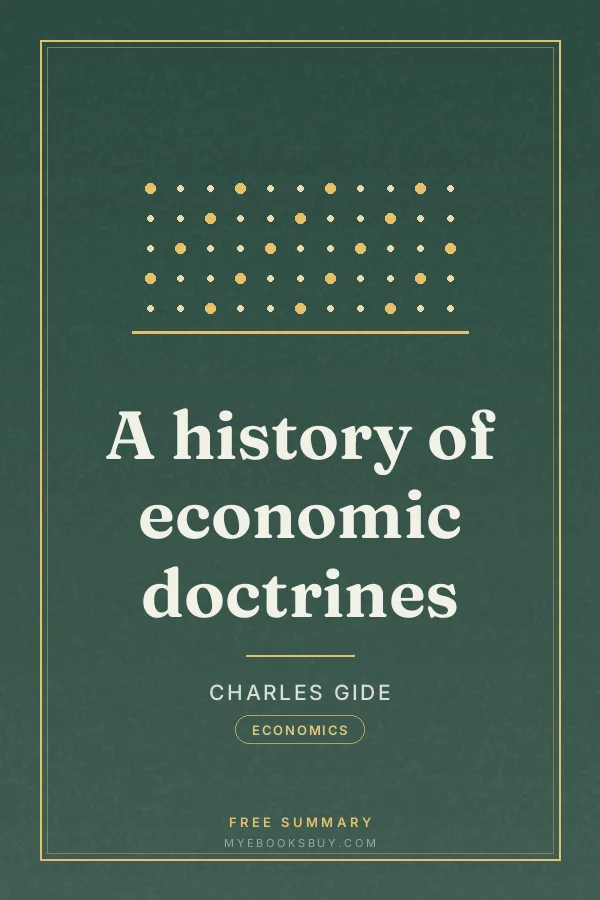
A history of economic doctrines
from the time of the physiocrats to the present day
Charles Gide (1847–1932)
A history of economic thought reveals that our current financial world is not a set of eternal truths, but a series of passionate human arguments.
In Short
This monumental survey traces the evolution of economic thought from the eighteenth-century Physiocrats through the classical doctrines of Adam Smith and David Ricardo, past the fiery critiques of Sismondi, Proudhon, and Karl Marx, up to the marginalist mathematical theories and social reform movements of the early twentieth century. Rather than treating economics as a static set of formulas, the authors chart a dynamic drama of ideas where every doctrine arises in response to the social anxieties of its day. The book examines how concepts of value, land, labor, rent, and state intervention have continuously shifted as industrial society developed. It has endured as an indispensable masterpiece because it approaches every thinker with intellectual fairness, showing how even discarded or pessimistic theories contributed vital insights to human progress. Through lucid exposition, it turns abstract theory into a compelling narrative of human attempt to understand and organise social wealth.
The Story
The intellectual journey opens in the eighteenth century with the Physiocrats, a group of French thinkers who first conceived of the economy as a living organism governed by natural laws. Viewing agriculture as the sole source of a "net product," they placed land at the center of all economic life and treated landowners with a near-religious reverence, reducing manufacturers and industrial workers to the status of a "sterile" class. Though their exaltation of idle proprietors appears absurd to modern eyes, their true breakthrough lay in demonstrating that wealth circulates through society according to discoverable, systematic laws.
This agrarian framework was soon shattered by Adam Smith, who shifted the foundation of economic science from the passive soil to human labor. In Smith’s vision, the division of labor transforms society into a vast cooperative workshop where individual self-interest spontaneously generates national prosperity. Smith introduced a sweeping optimism, arguing that the pursuit of personal gain naturally guides capital into its most productive channels, aligning private ambition with the public good.
Yet this initial harmony was short-lived. As the Industrial Revolution took hold, a darker, more pessimistic vision emerged in the nineteenth century through the work of Thomas Malthus and David Ricardo. Malthus introduced his grim law of population, warning that human numbers inevitably expand faster than the food supply, condemning the working masses to perpetual distress unless restrained by moral self-control. Ricardo deepened this gloom by dissecting the mechanics of rent and value. He demonstrated that as society grows, inferior lands must be cultivated, driving up food prices and enriching the idle landowner at the expense of industrial profits and workers' wages. Far from depicting a harmonious universe, Ricardo exposed a fundamental conflict of interest at the heart of the capitalist system.
This internal friction provoked a powerful wave of protest. Early critics like Sismondi observed the human misery behind industrial expansion, identifying a dangerous divorce between land and labor. Sismondi warned that unbridled competition was destroying the middle classes, creating an unstable society divided between property owners and a propertyless proletariat. In a different vein, social reformers like Saint-Simon and his followers attacked the very institution of private property, arguing that inheritance perpetuated idleness. They envisioned a scientifically planned society where inheritance would be abolished and every individual would be rewarded according to their capacity and works.
As political revolutions swept Europe in 1848, the critique of classical economics intensified. Pierre-Joseph Proudhon launched a direct assault on property, deeming it an oppressive privilege that allowed owners to harvest the fruits of other men's labor. Concurrently, thinkers like Louis Blanc advocated for state-backed social workshops to guarantee the right to work. In Germany, Friedrich List challenged the classical dogma of universal Free Trade, arguing that developing nations required protective tariffs to nurture their young industries before they could compete with advanced industrial powers.
The second half of the nineteenth century saw the critique of industrial capitalism reach its theoretical zenith in the works of Karl Marx and Rodbertus. Marx constructed a vast philosophy of history centered on the dynamics of capital. He argued that capitalism inevitably strips the worker of all instruments of production, reducing human labor power to a commodity. By extracting "surplus value"—the unpaid labor performed beyond what is necessary for the worker's survival—capitalists accumulate wealth while driving the system toward catastrophic economic crises.
In reaction to both revolutionary socialism and the harsh fatalism of classical economics, late nineteenth-century thought fractured into several distinct currents. The Historical School rejected the idea of universal, timeless economic laws altogether, asserting that economic policies must be tailored to the specific historical stage and cultural context of each nation. In France, social thinkers like Le Play and advocates of "Solidarism" sought a middle way, attempting to ground moral obligations and social welfare in the scientific reality of human interdependence.
Simultaneously, a theoretical revolution was brewing in abstract economics. The Austrian School, alongside mathematical economists like Léon Walras, overturned the old classical labor theories of value by introducing the concept of marginal or "final" utility. Value was no longer seen as an inherent property derived from the labor expended on a good, but as a subjective assessment based on human desire and relative scarcity. By applying mathematical equations to exchange and equilibrium, these modern economists attempted to rebuild economics as a precise science, even as political reformers used their insights on rent and land to push for single-tax movements and state intervention. The book closes on this complex landscape, showing an economic science that has evolved from crude dogmas into a sophisticated, highly contested terrain of mathematical models and social ethics.
How It Unfolds
The Physiocratic foundation The story opens in eighteenth-century France, where the Physiocrats formulate the first systematic model of economic circulation based on agricultural production. They construct a tripartite division of society that exalts the landed proprietor as the divine dispenser of all national wealth.
Adam Smith's cooperative workshop Adam Smith transforms the discipline by placing human labor and its division at the center of economic progress. He argues that individual self-interest spontaneously organizes society into an efficient, self-regulating mechanism that multiplies wealth for all.
The Classical gloom of Malthus and Ricardo The optimism of the early economists gives way to the rigorous pessimism of Malthus and Ricardo. Malthus formulates his law of population growth, while Ricardo demonstrates an inherent antagonism between the idle landlord receiving rent and the rest of industrial society.
Sismondi and the discovery of the proletariat Sismondi breaks with classical optimism after observing the human cost of industrial crises. He identifies the dangerous separation of land from labor, warning that free competition is destroying the middle class and creating a vast, dispossessed working class.
The Saint-Simonian assault on property Following the lead of Saint-Simon, a new wave of social critics turns its attention to the historical evolution of property. They argue that private ownership and inheritance foster habits of idleness, calling for a central organization of industry based on merit and work.
Proudhon and the explosion of 1848 Pierre-Joseph Proudhon mounts a fierce critique of private property as an anti-social privilege that exploits the worker. Surrounding the 1848 Revolution, various socialist theories emerge, demanding state intervention, cooperative associations, and the guaranteed right to work.
List's national system of protection Friedrich List attacks the universal assumptions of classical Free Trade doctrine, arguing that economic laws must account for a nation's specific stage of development. He advocates for temporary protective tariffs to allow young national industries to mature.
The German Historical reaction A group of German scholars challenges the abstract, deduction-heavy methods of the classical school. Thinkers like Knies and Hildebrand insist that economic policies are relative to time and place, viewing political economy as an evolving branch of social history.
Marx and the mechanics of surplus value Karl Marx synthesizes historical philosophy and economic critique into a sweeping attack on capitalism. He details how capital expropriates the independent producer and extracts surplus value from free labor, driving the industrial system toward eventual collapse.
The Marginalist revolution The Austrian School and mathematical economists like Walras replace the labor theory of value with the concept of final utility. Value becomes a subjective measurement based on human desire and scarcity, expressed through precise mathematical equations of market equilibrium.
Solidarism and the modern state The journey concludes with late nineteenth-century efforts to reconcile individual liberty with social justice. Philosophers and economists formulate theories of "Solidarism" and quasi-contracts, using human interdependence to justify state insurance, education, and social reform.
The People
The Physiocrats This eighteenth-century group of French thinkers wants to prove that society is governed by a divine "natural order." They seek to protect the revenue of landed proprietors, whom they regard as the sacred fountainhead of all economic life. Standing in their way is their own profound illusion regarding feudal property, which leads them to view industrial workers and manufacturers as a "sterile" class while treating idle landowners as the sole creators of societal wealth.
Adam Smith Smith seeks to explain how a nation builds true wealth through the spontaneous cooperation of free individuals. He envisions a world where personal self-interest naturally aligns with the general good through the division of labor and the accumulation of capital. His main obstacle is the legacy of state-enforced monopolies and protectionist trade restrictions, but he leaves the discipline permanently altered by establishing labor as the primary source of value.
David Ricardo Ricardo aims to uncover the rigorous mathematical laws that govern the distribution of wealth among workers, capitalists, and landlords. He wants to prove that Free Trade is essential to lower corn prices and stave off economic stagnation. Blocked by the political power of British landowners and the rising cost of agricultural production on inferior soils, he transforms economics into a severe science of social antagonisms.
Simonde de Sismondi Sismondi wants economic science to focus on human welfare rather than the mere accumulation of material riches. Appalled by industrial suffering, he seeks to halt the rapid polarization of society into wealthy capitalists and destitute laborers. He stands almost alone against the overwhelming optimism of the Classical school, ending his career as a lonely pioneer who first diagnosed the systemic nature of economic crises.
Karl Marx Marx aims to demonstrate that capitalism is merely a temporary phase in human history, destined to collapse under its own internal contradictions. He seeks to arm the working class with a scientific understanding of how capital extracts "surplus value" from their labor. Hindered by the state's political apparatus and the total concentration of capital in private hands, he spends his life in exile, producing a monumental critique of political economy that reshapes modern political thought.
Léon Walras Walras wants to transform economics into a pure mathematical science as exact as physics. He seeks to model how prices, supply, and demand achieve a perfect state of equilibrium in a hypothetical competitive market. Standing in his way is the messy, unpredictable reality of actual human commerce, but his abstract equations successfully introduce the marginalist paradigm that comes to dominate modern academic economics.
In Its Own Voice
When Adam Smith describes the intricate network of human efforts required to produce even the simplest tool of a common laborer, he reveals the quiet beauty of industrial co-operation:
"The miner, the builder of the furnace for smelting the ore, the feller of the timber, the burner of the charcoal to be made use of in the smelting-house, the brick-maker, the brick-layer, the workmen who attend the furnace, the mill-wright, the forger, the smith, must all of them join their different arts in order to produce them."
When Sismondi turns his gaze away from abstract wealth to observe the changing social structure of the nineteenth century, he detects a profound and troubling transformation:
"Society no longer has any room save for the great capitalist and his hireling, and we are witnessing the frightfully rapid growth of a hitherto unknown class—of men who have absolutely no property."
When Karl Marx exposes the legal and economic mechanism that forces the modern working man into the industrial system, he summarizes the harsh reality of the free labor market in a single blunt observation:
"Labor must be free—that is, saleable; or, in other words, it must be forced to sell itself because the labourer has nothing else to sell."
What It's Really About
Behind its meticulous survey of economic systems, the book is fundamentally about the endless struggle to define human value and social justice within a commercial society. It asks a deceptively simple question: when wealth is produced, who truly creates it, and how should it be shared?
The book traces how different eras have answered this question. For the Physiocrats, value was a gift of nature passed through the hands of the landowner. For Smith and Ricardo, it was the direct embodiment of human exertion. For the marginalists, it became a fleeting psychological preference inside the mind of the consumer. By tracking these shifting definitions, the text exposes the deep moral assumptions hidden within every economic equation.
Underneath the technical debates over rent, tariffs, and currency lies a deeper argument about human liberty and state power. The authors contrast two irreconcilable visions of human society: one that sees the economy as a self-regulating, spontaneous natural order that thrives best when left alone, and another that views market forces as inherently destructive, requiring conscious human direction to prevent the exploitation of the weak. The text shows that economic doctrines are never neutral scientific discoveries; they are intellectual weapons forged to defend or dismantle specific social orders. Ultimately, the book demonstrates that economic progress is not a smooth ascent toward absolute truth, but an ongoing conversation where old errors are continually recycled and forgotten insights are periodically rediscovered.
Why Read It Today
This book is an ideal choice for readers who are tired of superficial financial commentary and want to understand the deep intellectual roots of modern political and economic debates. It is particularly rewarding for students of history, philosophy, and political science who wish to see how abstract theories directly shaped the revolutions, laws, and institutions of the modern world.
Reading this text feels like sitting in a quiet, sunlit lecture hall with two brilliant, immensely patient European scholars. The narrative voice is warm, balanced, and remarkably lucid, cutting through dense theoretical jargon with vivid analogies and sharp historical context. Rather than presenting economic history as a dry list of dates and formulas, the authors write with a gentle irony and human sympathy that brings long-dead theorists to life.
The book is not without its difficulties. At roughly eight hundred pages in its full form, it demands time, focus, and intellectual stamina. Readers must navigate a dense forest of nineteenth-century terminology, lengthy footnotes, and detailed detours into forgotten French and German academic controversies. The authors also write from an early twentieth-century European perspective, which assumes a basic familiarity with European history and Classical literature that modern readers may find challenging.
What stays with you after closing the volume is a profound sense of intellectual humility. By showing how the most brilliant minds of every century were blind to their own cultural biases—such as the Physiocrats defending idle landlords or classical economists treating industrial misery as an unalterable law of nature—the book teaches us to look at our own economic dogmas with a healthy skepticism. It leaves the reader with a rare clarity: the realization that our economic rules are not unchangeable laws of nature, but choices we have inherited, questioned, and remain free to rewrite.
This summary was written by AI (g4f/auto) on 2026-08-18 and is a guide to the book, not a replacement for it — it can be incomplete or wrong. The book itself is public domain. Copyright & AI disclosure · Report a problem