Free summary
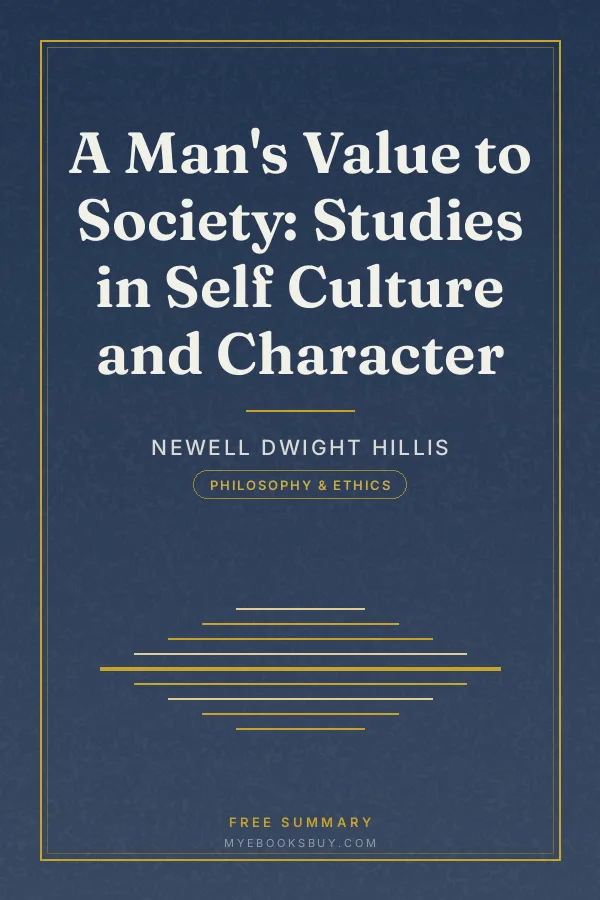
A Man's Value to Society: Studies in Self Culture and Character
Newell Dwight Hillis (1858–1929)
An examination of the human condition, this work serves as an earnest roadmap for cultivating a life of purpose, moral integrity, and social contribution in a rapidly industrializing age.
In Short
This collection of essays offers a nineteenth-century blueprint for character development, arguing that a person’s worth is measured not by material accumulation, but by the "wealth of the heart." Through a series of philosophical meditations, the text explores how individuals can refine their minds, harness their imaginations, and align their daily conduct with noble, transcendental ideals. It remains a notable example of late-Victorian moral pedagogy, providing a window into the era's preoccupation with personal responsibility, the "gospel of work," and the enduring power of high-minded aspirations to transform the individual and society.
The Story
The argument opens by establishing that a person's value is not a matter of financial net worth, but of the internal reserves of wisdom and character one carries. The author posits that the individual is a "double creature," perpetually caught in a struggle between the lower, animal instincts of the flesh and the higher, spiritual aspirations of the intellect. Success in life—defined as the attainment of true manhood or womanhood—is contingent upon the "upper man" successfully subordinating the "lower man," turning primal combative energy into creative work and service.
The narrative progresses by identifying the "teachers" that shape this character. Solitude is presented as the first great educator, a necessary space for the soul to develop its own resources, while adversity and responsibility serve as the forge where strength is tempered. The author moves through the faculties of the human mind, analyzing the moral uses of memory, which preserves the soul's triumphs and travels, and the imagination, which acts as the "architect of manhood." Far from being a mere dreamer’s indulgence, the imagination is described as the source of all practical progress; it is the faculty that allows a person to see beyond the immediate, sordid realities of the "lower life" toward a more divine ideal.
As the book nears its conclusion, the focus shifts to the social implications of this inner cultivation. The author insists that private character inevitably dictates one’s value to the community. By "the science of living with men," the author means the disciplined management of one's own temperament to avoid the friction and waste caused by pride and stupidity. The final chapters address the necessity of "vision hours"—moments when the individual, feeling the weight of conscience, re-evaluates their life against the backdrop of eternal truth. The arc of the book concludes with a call to action: that one must consciously invest in one’s own mental and moral growth, treating the soul as a temple to be kept illuminated. The ultimate aim is to ensure that when one's life is measured, it leaves behind a legacy of "service and sympathy" that echoes the lives of great historical figures, from the Hebrew prophets to the modern architects of liberty.
How It Unfolds
The architecture of worth The opening chapters define the individual as a vessel of internal values, warning that external wealth is meaningless if the person lacks the skill to manage their own nature or navigate relationships with others.
The crucible of experience The author examines how life’s "external teachers"—monotony, adversity, and solitude—serve to build or break human character, suggesting that one cannot truly learn to sail their life-craft without enduring the storms of responsibility.
The internal faculty Moving inward, the text explores the cognitive mechanics of manhood, focusing on how memory and imagination serve as the foundations for building a self that can withstand the "vulgar moods" of daily existence.
The battle for the soul The middle section depicts the human as a site of constant conflict between animal impulses and spiritual ideals, arguing that all passions must be transmuted into constructive, outward-facing social service.
The moral imperative The concluding chapters emphasize that conscience acts as an inescapable, internal judge, and that a life well-lived requires the individual to constantly return to their highest, most heroic aspirations to avoid a slow decay into "petty worthlessness."
The People
The figures appearing in these pages are not characters in a plot, but archetypes of human potential and failure. The Employer who flaunts his wealth before starving workers serves as a cautionary tale of how ignorance and pride can cause immense social destruction. In contrast, the Great Inventor (like Edison) represents the power of enthusiasm to sustain a person through failures, showing how the mind can be trained to overcome even the most daunting obstacles. King Herod stands as a chilling personification of conscience; despite his worldly power, he is haunted by his secret sins, illustrating the author's belief that no one can outrun their own moral records. Finally, Michael Angelo is presented as the ideal, a man who, even in old age and blindness, continues to learn and remains fixated on the "vision of perfect beauty." Each of these figures is intended to reflect a specific facet of human nature—either the potential for greatness through disciplined, virtuous thought or the tragedy of a life that has allowed its "inner light" to be extinguished by greed or vanity.
In Its Own Voice
"Life's crowning victory belongs to those who have won no brilliant battle, suffered no crushing wrong; who have figured in no great drama, whose sphere was obscure, but who have loved great principles midst small duties, nourished sublime hopes amid vulgar cares, and illustrated eternal principles in trifles."
(The author emphasizes that true greatness is found in the quiet, consistent application of moral principles to everyday life.)
"The spirit man rides a man of flesh and is often thrown thereby and trampled under foot."
(This illustrates the central thesis that a person's primary struggle is the subordination of their base, animal instincts to their higher, spiritual faculties.)
"No child can be called fatherless who has God and his mother; no youth can be called friendless who has God and the companionship of good books."
(The author uses this to highlight the transformative power of literature in providing guidance and fellowship to the growing soul.)
What It's Really About
The book is a sustained argument for the necessity of "self-culture" in a commercial society. The author is deeply concerned with the "waste of society"—the lost potential of individuals who allow their faculties to atrophy through misuse or laziness. At its core, the text asks how a human being can remain "human" when surrounded by the demands of a machine-driven, industrial world. It argues that character is not a static trait but an ongoing project, requiring constant vigilance, the study of great ideas, and a deliberate refusal to strike an "average" between one’s highest aspirations and one’s lowest impulses. It is an exploration of the discipline required to live according to one's own conscience.
Why Read It Today
Reading this work today feels like engaging with a stern, well-meaning Victorian grandfather who insists on the importance of "getting a good ready." For readers interested in the history of ethics or the development of the "self-help" genre, it is a fascinating, if occasionally didactic, document. Its prose is ornate, rhythmic, and deeply rooted in the Christian humanism of its time, which may feel dense to a modern reader accustomed to pithy, punchy advice.
The book is not without its difficulties. The author’s period attitudes—particularly regarding the "inevitability" of hierarchy and the moralizing language surrounding "lower" animal natures—can feel archaic and rigid. However, the underlying message—that we are responsible for the contents of our own minds and that our internal focus dictates our outward impact—retains a surprising, timeless resonance. Those who appreciate the writings of Emerson or the philosophical essays of the late nineteenth century will find a familiar intellectual environment here. It is not a book for a quick skim; it is a meditation meant for slow digestion. If you are willing to look past the occasional flowery flourish, you will find a sincere, urgent plea for the preservation of the inner life in an age that threatens to consume it.
This summary was written by AI (gemini-3.1-flash-lite) on 2026-08-18 and is a guide to the book, not a replacement for it — it can be incomplete or wrong. The book itself is public domain. Copyright & AI disclosure · Report a problem