Human history is defined by a perpetual, internal tug-of-war between basic worldly desires and the reach for higher spiritual truth.
In Short
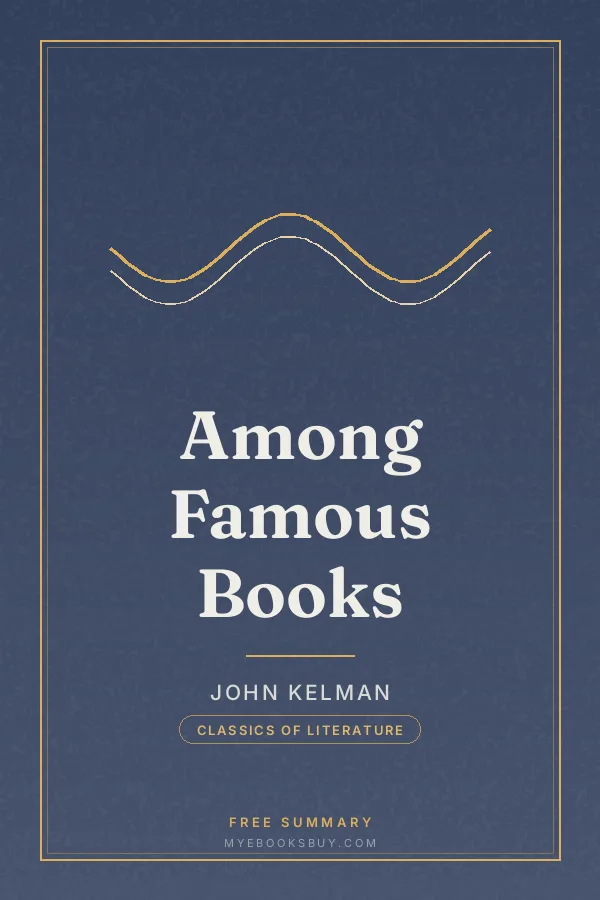
This collection of critical studies explores the historical collision between worldly paganism and spiritual idealism as expressed across western literature. Crossing three eras—the Classical age, the Renaissance, and the modern period—it examines how landmark authors and texts process the fundamental friction between body and soul. From ancient Greek myth and Pater’s Marius the Epicurean to Bunyan’s allegories, Pepys’s private diaries, Carlyle’s social critique, and the modern writings of Chesterton and Francis Thompson, the work traces humanity's shifting attempts to reconcile material realities with higher moral calling.
The Story
The intellectual journey opens in antiquity with the myth of Prometheus, establishing the foundational conflict between human aspiration and overbearing, cynical divine powers. In this early arena, the struggle for knowledge and human dignity emerges as a noble revolt, where human suffering slowly finds its ultimate reinterpretation in divine love rather than arbitrary oppression. Moving into the late Roman Empire, the narrative traces Walter Pater's Marius the Epicurean, demonstrating how a sensitive soul journeys through pagan sensory beauty and philosophical detachment to glimpse the early Christian vision of a purified "City of God."
The focus then shifts to the Renaissance and the myth of Faust, examining how Christopher Marlowe and Johann Wolfgang von Goethe chart the tragic consequences of choosing lower, degraded paths over spiritual purity. This investigation of pagan revivals expands to the Celtic twilight, scrutinizing how writers like William Butler Yeats and Fiona Macleod (William Sharp) immerse themselves in nature, risking a return to ancient earth-worship and raw elemental passion where nature's beauty threatens to overwhelm moral law.
Entering the seventeenth century, the thematic path splits into two starkly different secular and sacred responses. John Bunyan constructs allegorical visions of spiritual pilgrimage out of ordinary English chivalry and gritty human reality, finding sublime immortality within the confinement of a prison cell. Conversely, Samuel Pepys documents the raw, unvarnished details of Restoration London—recording naval battles, the devastating Great Fire, and his own quiet, courageous struggle against impending blindness with matter-of-fact endurance.
The narrative advances into the nineteenth and twentieth centuries to examine modern reactions against cold materialism. Thomas Carlyle’s Sartor Resartus strips away superficial societal "clothes" and hypocritical conventions to reveal the ultimate spiritual reality of the individual soul. The critique then confronts modern industrialism, scientific evolution, and the sharp cultural provocations of George Bernard Shaw, warning against reckless moral experimentation. Finally, the intellectual arc culminates in the orthodox paradoxical imagination of G.K. Chesterton and the luminous poetry of Francis Thompson. Thompson’s The Hound of Heaven provides the ultimate resolution: the relentless pursuit of human souls by divine love, revealing that true spiritual ideal forms are not distant abstractions, but actively present along the everyday streets of modern London.
How It Unfolds
The classical defiance Prometheus establishes humanity's primary rebellion against divine tyranny, transforming human suffering from a cruel joke of the gods into a noble pursuit of spiritual strength and ultimate divine love.
The epicurean pilgrimage Marius journeys through the refined sensory pleasures and philosophical reticence of late imperial Rome, gradually progressing toward the visionary social harmony of the early Christian City of God.
The Faustian bargain Faust yields to his lower nature, illustrating the tragic degradation that occurs when spiritual purity is sacrificed for immediate gratification and cynical, Mephistophelean worldly intellect.
The Celtic nostalgia Modern dreamers escape urban captivity to immerse themselves in nature's wild beauty, walking a perilous line between poetic appreciation and a dangerous return to ancient, earth-bound paganism.
The pilgrim's vision Bunyan transforms his harsh imprisonment into a soaring spiritual romance, demonstrating that ordinary human struggle can be elevated into an enduring journey toward heavenly immortality.
The diarist's record Pepys captures the vivid, chaotic reality of seventeenth-century London during war and fire, quietly documenting his personal struggle against failing sight without ever falling into self-pity.
The sartorial stripping Carlyle strips away the artificial "clothes" of social vanity and sectarianism, forcing readers to look past external illusions to discover the divine reality dwelling within the human spirit.
The hound's pursuit Thompson portrays the relentless, loving pursuit of the human spirit by God, demonstrating that the supernatural world is directly present in the midst of mundane urban existence.
The People
Prometheus He seeks to elevate humanity by snatching knowledge from jealous deities. Thwarted by cruel divine oppression, his ultimate suffering establishes human dignity and anticipates the transformative power of self-sacrificing love.
Marius He wants to understand life's exquisite beauty while maintaining fastidious moral integrity. Surrounded by pagan decadence, his quiet reticence drives him away from pure epicureanism toward the spiritual hope of a new, divine society.
Faust He longs for absolute knowledge and boundless worldly experience. Blocked by his own lower impulses and the cold cynicism of Mephistopheles, he succumbs to spiritual degradation and brings tragedy upon those he claims to love.
John Bunyan He desires to guide souls through the wilderness of a corrupt world. Confined to a Bedford prison, he turns his physical captivity into a brilliant allegorical pathway toward eternal life.
Samuel Pepys He seeks to manage naval affairs, protect his household, and record daily life with tireless curiosity. Threatened by urban disaster and progressive blindness, he maintains remarkable fortitude without retreating into despair.
Francis Thompson He tries to escape divine demands by fleeing into natural beauty and worldly distractions. Driven by inner sorrow and relentless spiritual pursuit, he eventually surrenders to the transforming love that haunts his steps.
In Its Own Voice
"Pater is distinctive, and borrows nothing from any writer whose influence can be traced in his work."
Walter Pater cultivated a unique, highly reticent prose style that wrapped readers in a subtle film of quiet thought.
"He had ragged long grass-coloured hair; / He had knees that stuck out of his hose; / He had puddle water in his shoes;"
William Butler Yeats captures the wild, elemental spirit of nature through vivid imagery of an unkempt wanderer.
"And so I betake myself to that course, which is almost as much as to see myself go into my grave..."
Samuel Pepys concludes his private diary with quiet heartbreak as failing eyesight forces him to abandon his shorthand journal.
What It's Really About
At its core, the work argues that human culture is defined by an unending dialectic between pagan materialism and spiritual idealism. Paganism is not merely an ancient religion, but a recurring human impulse to worship nature, physical beauty, self-interest, and worldly success for their own sakes. Idealism, conversely, insists that physical reality is merely a garment hiding deeper, eternal truths. The text explores how literature reflects this friction, demonstrating that whenever society sinks into cold intellect, vanity, or unrestrained passion, the human spirit instinctively rebels. True fulfillment requires surrendering selfish demands to discover divine love woven directly into daily human experience.
Why Read It Today
This volume appeals to readers who enjoy literary criticism that connects classic texts directly to ethical living and spiritual philosophy. Reading it feels like attending a series of intimate, deeply thoughtful lectures by a scholar who treats literature as a vital matter of soul and character rather than a mere academic exercise. The author writes with clear, deliberate prose, guiding the audience through complex movements in thought without resorting to obscure jargon.
The book does present a few period difficulties. Modern readers must navigate Victorian and Edwardian critical assumptions, occasional untranslated literary references, and a distinctly Christian framework evaluating every author's worldview. Additionally, readers accustomed to quick surveys may find the detailed philosophical explorations of specific texts demanding. Yet these challenges are easily outweighed by the book's deep insights. It leaves you with a renewed appreciation for how great authors grapple with life's ultimate questions, offering a grounded perspective on the enduring struggle between material distraction and spiritual purpose.
This summary was written by AI (g4f/auto) on 2026-08-15 and is a guide to the book, not a replacement for it — it can be incomplete or wrong. The book itself is public domain. Copyright & AI disclosure · Report a problem