True wealth consists in the abundance of real goods and services, while state intervention often produces subtle, unseen harms that far outweigh its visible benefits.
In Short
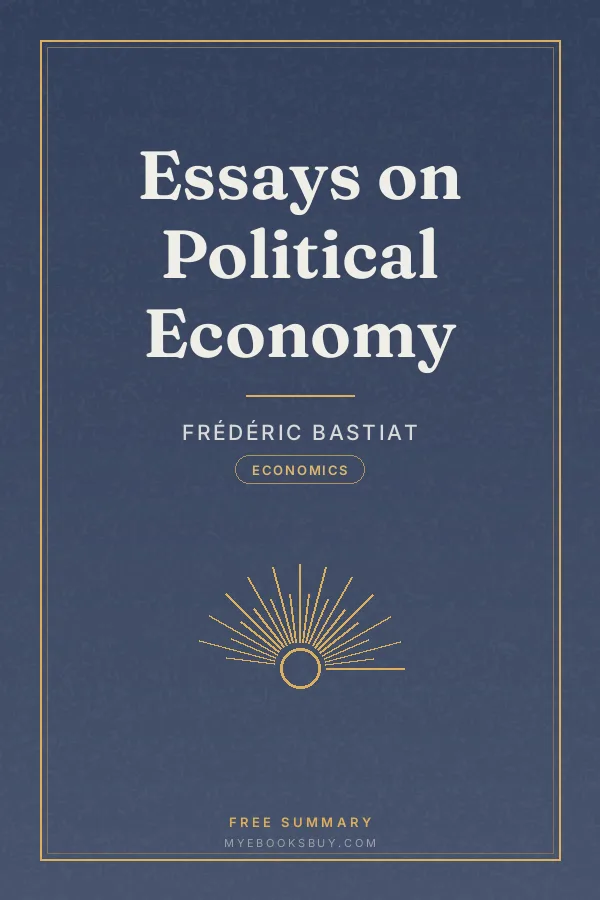
A classical liberal defense of free markets, private property, and limited governance, this collection of mid-nineteenth-century essays systematically dismantles common economic fallacies. Through sharp logic, clear allegories, and energetic polemics, the author examines interest on capital, taxation, state subsidies, monetary illusion, and statutory law. The work demonstrates how government interventions—whether protective tariffs, public works programs, or forced redistributions—routinely destroy more value than they create. Its enduring appeal rests on its lucid exposure of short-sighted economic thinking, presenting a foundational argument for individual liberty and economic freedom that remains a benchmark of political economy.
The Story
The volume opens with a vigorous defense of the lawfulness and utility of interest on capital. Addressing socialist critiques that frame interest as usurious, the argument establishes that lending tools or money represents a genuine service rendered over time. When a lender yields the use of a productive instrument like a plane or a sum of cash to a borrower, the lender temporarily foregoes personal benefit. A fair return is therefore not an exploitation, but an equitable exchange of mutual services. Furthermore, encouraging savings and capital formation benefits the laboring class by multiplying productive tools, lowering interest rates, and increasing wages through expanded enterprise.
Moving from private transactions to public policy, the work introduces a core analytical principle: evaluating both immediate, visible outcomes and delayed, invisible consequences. Popular errors routinely arise because observers focus solely on what is seen—the wages paid to public officials, the soldiers in uniform, or the state-subsidized theater—while completely ignoring what is not seen: the private spending, investment, and trade destroyed by the taxation required to fund those endeavors. Public works and state subsidies do not create net new employment; they merely divert resources from private hands, where they would have satisfied real consumer desires, to state-chosen projects that frequently result in deadweight loss.
The critique extends to monetary theory, dissecting the widespread illusion that equates money itself with real wealth. Currency, whether gold coin or paper notes, serves merely as a medium to facilitate the exchange of goods and services. Simply increasing the quantity of money does not make a nation wealthier, because real prosperity springs entirely from human labor applied to nature. Confusing the monetary token with actual wealth inevitably leads governments to pursue ruinous paper-money schemes and misguided trade protections. Legal trade restrictions, such as tariffs, rely on state coercion to enrich favoured domestic industries at the expense of consumers, amounting to little more than organized, legal plunder that restricts overall productivity.
The text culminates in an examination of the precise nature of government and statute law. Government is not a miraculous cornucopia capable of fulfilling every social demand; it possesses no resources of its own and can bestow nothing without first taking it from citizens through taxation. The proper function of law is strictly negative and protective: to defend individual personality, liberty, and private property against injustice. When state power expands beyond this defensive perimeter to forcibly organize labor, education, or religion, it perverts justice into an instrument of plunder, reducing citizens to passive raw material manipulated by social planners. True social harmony requires rejecting state-enforced systems and trusting in human liberty.
How It Unfolds
The legitimacy of interest The argument opens by proving that lending capital is a voluntary exchange of mutual services, where interest compensates the lender for temporary sacrifice and risk. Encouraging capital creation lowers borrowing costs and ultimately raises wages for working people.
The seen and the unseen The framework turns to economic analysis, demonstrating that immediate, visible benefits from government spending routinely conceal hidden, unseen costs. Taxes collected to support state programs directly extinguish private spending and private job creation.
The illusion of paper wealth Examining money, the text shows that cash is merely a vehicle for transmitting real goods, not wealth itself. Increasing the monetary supply without expanding production distorts prices without adding true value to society.
The nature of legal plunder The focus shifts to statutory law, exposing how protective tariffs and subsidies use state power to plunder consumers for the benefit of special interests. Coercive interventions destroy wealth and undermine public respect for genuine morality.
The true limit of law The concluding sections establish that government power must remain strictly limited to protecting individual rights and property. Attempting to forcibly organize society reduces human beings to passive matter and guarantees perpetual political instability.
The People
Peter and Paul Two hypothetical traders used to illustrate equitable exchange. Peter offers Paul a crown piece in exchange for ten sixpences, establishing equal value. When Peter requests to delay his payment by a year, he asks Paul for an additional service—the use of Paul's funds over time. Their transaction demonstrates that interest is a natural, justified compensation for time and benefit conferred, rather than an arbitrary penalty.
James B. The representative taxpayer and everyday consumer who bears the hidden costs of state policy. Whether paying tax-gatherers or paying inflated prices due to protective tariffs set by figures like M. Prohibant, James B. loses his earnings to fund state-chosen projects or favoured industries. His lost spending power represents the unseen economic activity destroyed by government intervention.
M. Proudhon A leading socialist reformer whose crusade against capital and interest is critically examined. Advocating for gratuitous credit and viewing capital's productiveness as the cause of poverty, his doctrines are shown to inadvertently harm workers by discouraging savings, scaring away capital, and driving interest rates higher.
F. and B. Interlocutors in a dialogue dissecting the nature of currency. F., the economist, patiently demonstrates to B. that money is not real wealth but a tool of exchange, dismantling B.'s misconceptions regarding paper currency, price fluctuations, and state-managed wealth.
In Its Own Voice
"The expense of the official is seen, because the act is performed, while that of the tax-payer is not seen, because, alas! he is prevented from performing it."
When evaluating public spending, observers easily spot the immediate employment of state officials but routinely overlook the private purchases taxpayers were forced to forego.
"To take by violence is not to produce, but to destroy."
In analyzing legal trade restrictions and tariffs, the text emphasizes that coercively reallocating resources never generates new national wealth.
"When, therefore, plunder is organised by law, for the profit of those who perpetrate it, all the plundered classes tend, either by peaceful or revolutionary means, to enter in some way into the manufacturing of laws."
When statutory law shifts from defending property to redistributing it, political life devolves into a destructive struggle among factions seeking to control state power for their own gain.
What It's Really About
At its core, the work addresses the fundamental nature of economic value, justice, and human liberty. It interrogates the persistent fallacy that state power can generate prosperity out of thin air, demonstrating that government intervention merely shifts or destroys existing resources. The book argues that human progress relies on free, voluntary cooperation and the unfettered exchange of services. Central planning and state-enforced redistribution degrade individual agency, treating citizens as inert material to be organized by politicians. The underlying philosophy asserts a providential order in human affairs: when individuals are granted full liberty under the protection of equal justice, societal harmony and material abundance naturally follow.
Why Read It Today
This work offers an accessible, brilliantly reasoned antidote to political economic fallacies that remain prevalent today. Readers looking for clear explanations of free-market principles will appreciate the author's sharp clarity and knack for illustrative parables. The prose avoids dense academic jargon, relying instead on direct dialogue, logical paradoxes, and memorable figures like the taxpayer whose simple economic choices reveal high-level truths.
The book's challenges reflect its mid-nineteenth-century European context. Modern readers will navigate references to historic French legislative debates, monetary terms like francs and louis, and nineteenth-century colonial ventures such as the French occupation of Algeria. Furthermore, the energetic, polemical style assumes a reader willing to engage with passionate philosophical arguments rather than neutral statistical data. Nevertheless, the central thesis—that we must look beyond immediate appearances to evaluate the long-term, unobserved consequences of policy—remains an indispensable tool for analyzing modern economics and governance.
This summary was written by AI (g4f/auto) on 2026-08-21 and is a guide to the book, not a replacement for it — it can be incomplete or wrong. The book itself is public domain. Copyright & AI disclosure · Report a problem