Free summary
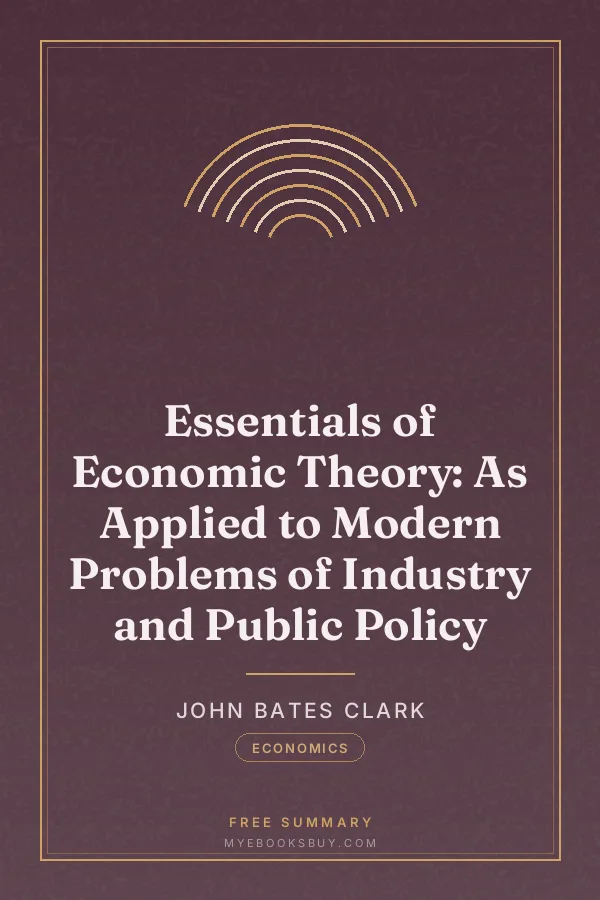
Essentials of Economic Theory: As Applied to Modern Problems of Industry and Public Policy
John Bates Clark (1847–1938)
An evolving industrial society can enrich every class if the underlying laws of capital, labor, and dynamic market forces are allowed to work.
In Short
This text is a comprehensive treatise on political economy that outlines how dynamic industrial systems operate, grow, and distribute wealth. The book traces how raw materials move through organized stages of production, how labor and capital co-operate to generate interest and wages, and how technical progress alters output. It investigates real-world market imperfections, such as monopolies, railroad freight pricing, tariff protections, and labor disputes, while offering institutional solutions like state-guided arbitration. The work has lasted as a foundational economic text because it rigorously bridges abstract static analysis with the complex realities of modern industrial growth, offering a systematic framework for evaluating value, income, and public policy.
The Story
The argument begins by establishing the primary mechanisms that govern all economic life, whether in a simple, isolated setting or a highly organized modern society. At its origin, all labor immediately creates wealth. When a person makes a tool, such as a canoe, there is no waiting period between labor and the concrete object produced. In a fully organized industrial society, this process becomes continuous: a permanent stock of capital goods exists and is maintained by a distinct set of workers, enabling society to produce consumers' goods day by day without forcing workers to go without current sustenance while creating future tools.
To explain how society organizes this production without centralized command, the argument introduces the concept of industrial groups and subgroups. Raw materials are passed down a chain of distinct stages, with each subgroup adding a specific, distinguishable utility to the product until it becomes a finished article for direct consumption. Within this structure, wealth is measured through utility and labor cost. Capital acts as a productive fund of instruments that yields returns according to the law of diminishing productivity. When additional units of labor combine with a fixed quantity of capital, each added unit of labor produces a smaller addition to total output than the unit before it. From this principle, the theoretical returns to both capital and labor—interest and wages—are derived. Net interest on capital instruments operates under principles similar to land rent, where high-efficiency instruments yield maximum rent and worn-out or marginal instruments eventually yield no rent at all.
As the argument shifts from a static framework to a dynamic one, it examines the forces of economic progress and change. Four central movements drive industrial evolution: population growth, capital accumulation, technical improvements, and the refinement of business organizations. These changes alter the nature of individual wants, diversifying consumption and increasing the overall utility realized from human labor. However, dynamic progress also introduces friction. Labor-saving inventions create greater total wealth, but they temporarily displace workers and capital, causing short-term hardship for specific groups even as they enrich society as a whole.
The progression then addresses the emergence of consolidated industry and its impact on public policy. Large corporate combinations and trusts may take the physical form of a monopoly, but their power to raise prices is held in check by potential competition—the threat that high prices will attract new rivals into the market. Where actual monopoly power does take root, as in railroad transportation, rates are no longer governed strictly by the carrier's own costs, but by external options and alternative costs available to shippers.
Finally, the argument applies these economic principles to labor markets, international trade, and monetary systems. In wage negotiations, the isolated worker suffers a strategic disadvantage when bargaining with a large employer, particularly when an idle surplus of unemployed labor exists. To secure fair outcomes, collective bargaining and state-supported arbitration are necessary to set wages without relying on industrial violence. Protective tariffs, while useful for establishing young "infant" industries, become pernicious when maintained long after those industries have matured, serving only to shield quasi-monopolies. Ultimately, when money changes in purchasing power over time, monetary interest payments adjust to convey the true rate of capital growth, ensuring that economic development continues to function through clear market signals.
How It Unfolds
Organizing the production chain Industrial society divides itself spontaneously into groups and subgroups, where each set of workers adds a new, distinguishable utility to raw materials until finished consumers' goods emerge.
Measuring value and utility Wealth is evaluated through effective utility and labor sacrifice, a principle that applies to a solitary islander as much as to a complex market where consumers' surplus is generated on higher-grade goods.
Calculating marginal returns Applying successive units of labor to a fixed fund of capital demonstrates diminishing returns, establishing how specific additions of labor determine the underlying rate of wages and interest.
Grading productive instruments Capital goods function like land, yielding a net rent based on their efficiency that gradually declines over time until an aging instrument becomes a no-rent machine.
Navigating industrial change Dynamic developments, including technological inventions and cheap motive power like electricity or harnessed waterfalls, multiply output while creating temporary displacements of labor and capital.
Constraining corporate power Large industrial trusts and corporate consolidations are limited in their pricing power by potential competition, which threatens to build new mills if prices rise above normal costs.
Regulating transportation rates Railroad freight charges under monopoly conditions are governed by alternative costs elsewhere, while competitive freight wars drop rates down toward variable operating costs.
Arbitrating labor disputes Unorganized workers face strategic disadvantages in wage bargaining, requiring collective representation and public arbitration tribunals to secure fair wages without corporate exploitation or union violence.
Reforming public policy Matured infant industries no longer require protective tariffs to survive, and monetary interest rates naturally adjust to reflect true shifts in the purchasing power of money and concrete capital growth.
The People
The Laborer The laborer seeks a fair wage and steady employment by applying physical and mental effort to the production process. Standing alone, the individual worker faces a distinct strategic disadvantage in wage bargaining because an employer can easily replace a single person, especially when unemployed workers are present in the market. The laborer's position improves through collective bargaining and public arbitration, enabling the worker to share in the broader enrichment caused by industrial progress and technological invention.
The Capitalist The capitalist provides the accumulated fund of productive tools, machinery, and resources necessary to sustain industry. Driven by the desire to earn interest, the capitalist saves portion of income and invests it into productive operations. The capitalist's returns are governed by the marginal productivity of capital, declining as more capital is applied relative to labor, and requiring constant reinvestment into high-efficiency instruments to maintain income as older machinery becomes obsolete.
The Entrepreneur The entrepreneur acts as the organizing coordinator of production, uniting labor and capital within an industrial enterprise. Seeking net business profits, the entrepreneur introduces technical improvements, adopts labor-saving devices, and expands plant capacity to lower unit costs. While transient in a competitive market, these profits provide the primary incentive for economic innovation before potential competitors copy the new methods and drive prices back down to normal production costs.
The Consumer The consumer seeks to satisfy a growing variety of personal wants by purchasing finished goods in the market. Benefiting from the diversification of commodities and the competition among producers, the consumer enjoys a "consumers' surplus" on high-grade goods—receiving more total utility from products than the market price reflects.
In Its Own Voice
"Industry always pays as it goes and tolerates no hiatus between labor and wealth in some form."
This principle illustrates how organized production immediately converts human effort into tangible goods without forcing workers to wait for basic sustenance.
"Ultimate measurements of wealth in all its forms have to be made in terms of labor."
This statement highlights the underlying standard used to evaluate capital costs, product value, and economic sacrifice across all stages of industry.
"The most economical state conceivable is one in which, in many lines of business, a single great corporation should produce all the goods and sell them at a price so slightly above their cost as to afford no incentive to any other producer to come into the field."
This observation explains how large-scale enterprise can theoretically maximize efficiency while potential competition prevents it from abusing its market position.
What It's Really About
The core argument addresses how a modern economy creates, measures, and distributes income during periods of rapid structural growth. At its foundation, the text demonstrates that wages and interest are not arbitrary figures, but are determined by the marginal productivity of labor and capital working together. It argues that economic progress is inherently dynamic, driven by four continuous shifts: increasing population, growing capital reserves, improving technology, and better industrial organization.
Underneath this structure lies the question of how society should manage the frictions caused by industrial evolution. While technological improvements and corporate consolidations increase overall productivity, they frequently disturb existing markets, displacing workers and giving rise to partial monopolies. The work asserts that state intervention should not aim to halt industrial growth or destroy large enterprises. Instead, public policy should focus on maintaining potential competition, eliminating protective tariffs on mature industries, and establishing fair systems of labor arbitration. Wealth creation and social fairness can coexist if market mechanisms are guided by sound economic law.
Why Read It Today
This work offers a clear look into classical economic theory at the exact moment modern industrial capitalism was taking shape. Readers interested in history, political economy, and public policy will appreciate its systematic attempt to build a unified theory of distribution that accounts for both abstract market laws and practical industrial problems. The text provides a clear baseline for understanding how early twentieth-century thinkers viewed corporations, labor unions, and technological disruption.
The reading experience is precise, structured, and deliberate. Rather than relying on dense mathematical formulas, the author builds concepts using logical deductions, clear diagrams, and tangible real-world illustrations—ranging from fishing canoes and shoe factories to railroad lines and Niagara Falls power plants.
The book presents some period-specific elements that require patient reading. Its style reflects the formal academic prose of the early 1900s, with long paragraphs and detailed theoretical steps. Modern readers may also notice period attitudes regarding demographic growth and international trade, where western industrial nations are treated as the central economic engine of the world. Nevertheless, its thorough analysis of corporate power, technological displacement, and wage bargaining remains surprisingly relevant to contemporary economic debates.
<ElicitationsGroup message="To explore this book further:"> <Elicitation label="Summarize John Bates Clark's theory of marginal productivity" query="Explain John Bates Clark's theory of marginal productivity as presented in Essentials of Economic Theory."/> <Elicitation label="Analyze the book's views on monopolies and potential competition" query="Analyze how Essentials of Economic Theory addresses monopolies, trusts, and the concept of potential competition."/> <Elicitation label="Detail the proposed solutions for labor disputes and arbitration" query="Detail the arguments for labor arbitration and collective bargaining in Essentials of Economic Theory."/> </ElicitationsGroup>
This summary was written by AI (g4f/auto) on 2026-08-16 and is a guide to the book, not a replacement for it — it can be incomplete or wrong. The book itself is public domain. Copyright & AI disclosure · Report a problem