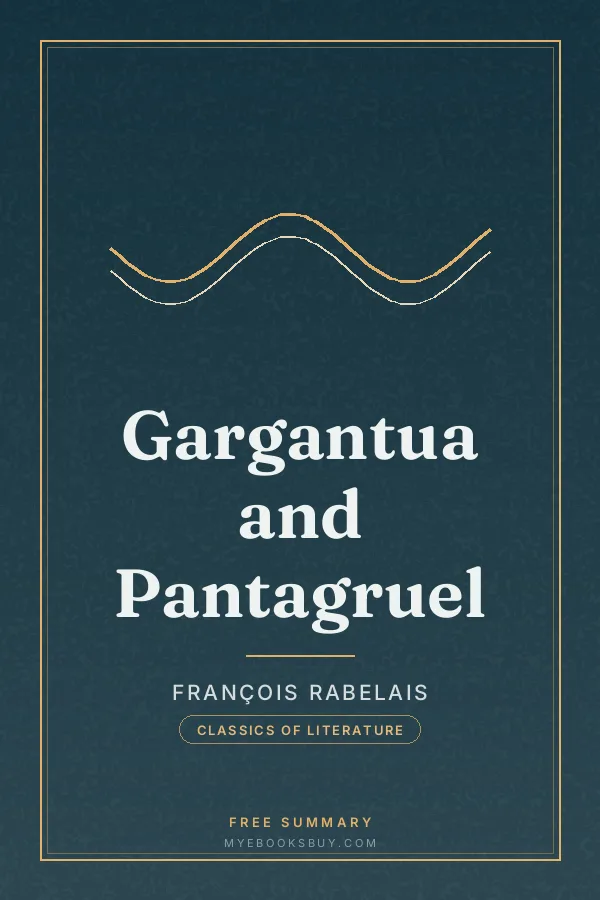
A giant’s appetite and a philosopher’s wit collide in a sprawling, riotous journey that turns the world upside down to reveal the absurd, beautiful truth of being human.
The Story
The narrative begins with the genealogy of the giants, tracing the lineage of Gargantua from the ancient, chaotic bloodlines of antiquity. Born under bizarre circumstances—his mother, Gargamelle, eats so many tripes that the child is forced out through her ear—the young Gargantua is raised with all the indulgence befitting a giant heir. His youth is defined by excess and physical play, until his father, Grangousier, recognizes that the boy’s education under traditional "Sophister" schoolmasters is failing him. Gargantua is sent to Paris, where he promptly steals the great bells of Notre Dame to hang around his mare's neck, sparking a diplomatic crisis that is only settled by the ridiculous, long-winded oration of a master sophister named Janotus de Bragmardo.
Gargantua’s education is then completely overhauled by the tutor Ponocrates, who introduces a rigorous regime of physical exercise, intellectual study, and moral discipline. This transformation creates a wise, just prince. However, tranquility is short-lived. A conflict arises between Grangousier and the neighboring king, Picrochole, over a dispute involving cake-bakers. This leads to a series of absurdist, bloody wars where Gargantua and his allies—most notably the formidable and irreverent Friar John—defend their kingdom with immense strength and strategic wit. Gargantua emerges victorious, not through simple conquest, but by emphasizing mercy and the construction of the Abbey of Theleme, a place governed by the single rule: "Do what thou wilt," reflecting the innate goodness of well-educated people.
The saga continues with the birth of Pantagruel, Gargantua’s son, whose arrival is marked by a devastating drought. Pantagruel grows to be a giant of immense learning and stature. His story is dominated by his friendship with the enigmatic trickster Panurge. Together with a band of scholars and explorers, they embark on a grand maritime voyage, seeking the "Oracle of the Holy Bottle." This is not a straightforward trek, but a surreal pilgrimage through a series of allegorical islands. They visit the Island of Tools, where weapons grow like fruit on trees, and witness the bizarre customs of the Chitterlings and the Semiquaver Friars.
Throughout the journey, the companions encounter the god-like figure of Gaster—the personification of the belly—who demands absolute obedience and drives the invention of all human arts and machines. They engage in endless debates about law, marriage, and theology, with Panurge constantly fretting over his romantic prospects and his fear of becoming a cuckold. The narrative reaches its climax not in a final battle, but in the arrival at the temple of the Holy Bottle. After traversing the subterranean wonders of the earth, the pilgrims receive the oracle’s cryptic answer: "Trinch," or "Drink." This command to seek truth through the infusion of spirit and knowledge marks the end of their quest. The companions are left to interpret this message for themselves, concluding a journey that has transitioned from the physical prowess of giants to the deep, philosophical inquiry of the human spirit.
The People
- Gargantua: A giant king whose trajectory begins in infantile gluttony and evolves into the epitome of the Renaissance prince. He is defined by his capacity to learn and his transformation from a creature of impulse to a ruler of reason, mercy, and sophisticated intellectual judgment.
- Pantagruel: The son of Gargantua, he embodies the "pantagruelism" of the book—a blend of deep learning, tolerance, and irrepressible good humor. He is a giant of intellect and spirit, serving as the steady anchor for his friends during their increasingly surreal voyages.
- Panurge: The inseparable companion of Pantagruel, he is a witty, cowardly, and perpetually anxious trickster. Driven by his obsession with marriage and the fear of being cuckolded, he represents the human tendency to overthink life's mysteries, acting as the primary foil to Pantagruel’s calm wisdom.
- Friar John: A militant, unconventional monk who joins the fray with his heavy staff and hearty appetite. He represents the vitality of the physical world, offering a pragmatic and often aggressive counterpoint to the more theoretical debates held by the scholars surrounding the main party.
- Gaster: The personification of the stomach, representing the fundamental driving force of all human civilization. He is a paradoxical deity who demands survival at any cost, yet by his sheer necessity, compels humanity to invent science, art, and tools.
In Its Own Voice
When describing the transformation of the giant's early, aimless life, the tutor introduces a new, disciplined way of being:
When Ponocrates knew Gargantua’s vicious manner of living, he resolved to bring him up in another kind; but for a while he bore with him, considering that nature cannot endure a sudden change, without great violence.
In a moment of philosophical reflection on the nature of legal processes, a character offers a vivid metaphor for how complicated disputes grow:
A suit in law at its production, birth, and first beginning, seemeth to me, as unto your other worships, shapeless, without form or fashion, incomplete, ugly and imperfect, even as a bear at his first coming into the world hath neither hands, skin, hair, nor head, but is merely an inform, rude, and ill-favoured piece and lump of flesh.
Reflecting on the limitations of the translator’s own endeavor to capture such a distinct voice, the editorial commentary notes:
Far be it from me, for all this, to value myself upon hitting the words of cant in which my drolling author is so luxuriant; for though such words have stood me in good stead, I scarce can forbear thinking myself unhappy in having insensibly hoarded up so much gibberish and Billingsgate trash in my memory.
What It's Really About
At its core, this work is a grand, carnivalesque defense of the Renaissance ideal: that human beings are capable of profound intellectual growth if they are liberated from the shackles of ignorance and rigid, dogmatic institutions. The giants are not merely figures of size; they are metaphors for the vast, uncontained potential of the human mind. The book argues that "nature" is not a static state, but a field of possibility that responds to education. When Gargantua is taught through the "Sophister" method, he is a brute; when he is taught through the humane, observant, and critical methods of Ponocrates, he becomes a sage.
The text also serves as a relentless satire of the academic and legal authorities of the 16th century. By portraying legal suits as shapeless bear-cubs that must be "licked" into form by lawyers, the author mocks the way complexity is manufactured to obscure truth. Similarly, the obsession with theological hair-splitting and the reliance on ancient authorities are constantly punctured by the arrival of the mundane or the bodily. The book argues that human knowledge is not found in the dusty archives of dead masters, but in the active, living interaction with the world.
The central tension lies between the "belly" and the "brain." By enshrining Gaster as the god of invention, the book argues that humanity’s greatest achievements—our art, our science, our tools—are born from the urgent necessity of survival. We are driven by the gut, but we are defined by what we do with that drive. This is why the final oracle is "Drink." It is an invitation to engage with the world with spirit, to "drink" in life, to be merry in the face of uncertainty, and to avoid the "dryness" of sour, misanthropic dogma. The book is an argument for joy as a form of resistance. It suggests that if one lives with intellectual rigor and a refusal to be crushed by gravity or grief, one can find a kind of freedom. It is a work that values the laughter of the common tavern as much as the logic of the university, insisting that a healthy human life requires both the high contemplation of the stars and the low, hearty indulgence of a shared meal.
Why Read It Today
Reading this book is an experience of being pulled into a tide of language that is both incredibly precise and wildly eccentric. It feels less like reading a traditional story and more like being invited to a feast where the conversation shifts abruptly from profound theology to crude, hilarious insults. For readers who enjoy the works of writers like Sterne or Joyce, the sheer density of the vocabulary and the willingness to break the fourth wall will feel exhilarating. You are never standing on solid ground; the narrative pivots from giant-sized slapstick to serious treatises on education in the span of a single page.
However, be prepared for its challenges. The humor is deeply rooted in the period, relying on wordplay, archaic medical knowledge, and references to 16th-century legal and scholastic disputes that may require a patient reader to occasionally look past the surface to find the underlying wit. The language itself is a lush, sprawling thicket, and the structure—often wandering off into lists, digressions, and long-winded orations—is intentionally designed to mimic the chaos of life. It does not prioritize a tight, "cinematic" plot; it prioritizes the texture of the journey.
What stays with you is the sheer, infectious confidence of the author’s voice. It is a book that refuses to be depressed by the world, even when describing wars, droughts, or fire. It leaves you with the sense that human folly is as vast as the giants themselves, but that the capacity for recovery, laughter, and intellectual curiosity is even greater. If you are someone who finds comfort in the idea that humanity is messy, brilliant, and worth celebrating, you will find a companion here. It is a dense, demanding, and occasionally exhausting read, but it is one that rewards the reader with a unique perspective on how to navigate a world that is, by all accounts, perpetually and delightfully absurd.
This summary was written by AI (gemini-3.1-flash-lite) on 2026-08-12 and is a guide to the book, not a replacement for it — it can be incomplete or wrong. The book itself is public domain. Copyright & AI disclosure · Report a problem