Free summary
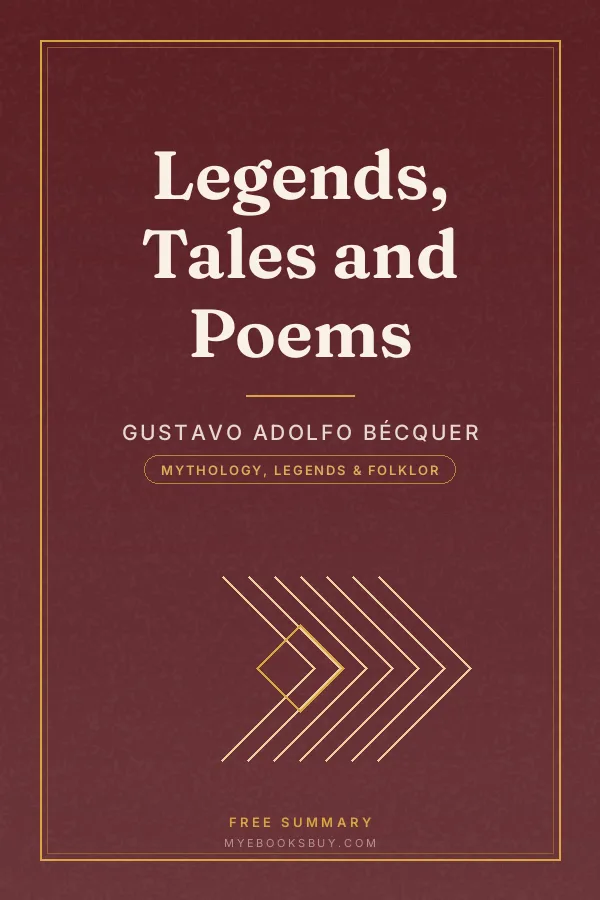
Legends, Tales and Poems
Gustavo Adolfo Bécquer (1836–1870)
Shadows of the past and the restless stirrings of the human heart converge in this haunting collection. Through a blend of prose legends and lyrical verse, the reader enters a world where the boundary between the material and the supernatural dissolves, leaving only the indelible mark of mystery.
In Short
This volume serves as a curated introduction to the work of the Spanish Romantic poet and prose writer Gustavo Adolfo Bécquer. It gathers his most evocative legends—tales steeped in folklore, religious awe, and the uncanny—alongside his introspective poetry. By framing these stories with scholarly notes on Spanish history, geography, and versification, the book preserves the atmospheric weight of Bécquer’s original vision. It remains a cornerstone of Spanish literature because it captures the ephemeral, melancholic spirit of the Romantic movement with a simplicity that feels both timeless and deeply personal.
The Story
The narrative arc of the book is not a single linear path, but rather a descent into the collective subconscious of old Spain. It begins with the editor’s invitation to explore a landscape where the "quaint tales and legends" of the past are still alive. We are introduced to the rugged, imposing backdrop of the Spanish countryside, where ancient castles and ruined convents serve as the stage for supernatural occurrences.
The stories often follow individuals—like the shepherd Esteban or the young men of Toledo—who find themselves crossing the threshold between the mundane world and a realm of frightening, ethereal beauty. In one instance, a traveler stops at a roadside cross, only to be warned by a guide that prayer in that specific, cursed place invites the intervention of dark forces rather than divine mercy. In another, a young man’s obsession with a jewel-encrusted statue of the Virgin leads him into a spiritual crisis, as he realizes his desperate love for a woman is pulling him toward sacrilege.
The legends are populated by white hinds that vanish into the brush, phantom voices in the night, and organists whose music seems to summon the dead. As these tales reach their climaxes, they often end in tragedy or an unresolved, haunting lingering. The characters are rarely rewarded for their curiosity; instead, they are consumed by the very mysteries they seek to uncover. The collection transitions seamlessly from these prose legends into Bécquer’s poetry. Here, the focus shifts inward, reflecting on the nature of artistic inspiration, the persistence of memory, and the inevitable passage of time. The book concludes with a meditation on the permanence of poetry itself—asserting that as long as there is beauty, human longing, and the silent language of a kiss, the spirit of poetry will endure.
How It Unfolds
The threshold of the past The collection opens by establishing the cultural and geographical context of Spain, inviting the reader to view the landscape as a repository of historical memory. It frames the stories as artifacts of a "rich mine" of literature where the line between reality and legend is perpetually blurred.
Into the mysterious countryside The narrative shifts to the specific, atmospheric settings of the legends, where the author describes ruins that appear as "the eyes of a ghost." The pacing slows to reflect the creeping dread of the environments, emphasizing the power of local superstition to overwhelm rational thought.
The collision of desire and fate Each legend presents a protagonist caught in a struggle between their earthly passions and an encroaching, supernatural doom. The prose builds tension as the characters face the consequences of their obsessions, leading to encounters with figures like the "white hind" or sacred statues that demand spiritual reckoning.
The lyrical conclusion The book transitions from the external drama of the legends to the internal reflection of the poems. The structure mirrors a movement from the vast, haunted geography of Spain to the quiet, dusty corners of the human heart, finally resting on the enduring power of creative expression.
The People
The characters are less like modern individuals and more like archetypes caught in the grip of forces beyond their control. Esteban, the shepherd, represents the simple man confronted by the inexplicable; his encounter with the white hind leaves him dazed and alienated from his own reality. Garcés is the devoted servant who finds his loyalty to his masters eclipsed by his own shifting, dark impulses.
Then there is the figure of the young man in Toledo, whose intense, forbidden love transforms his perception of the sacred. He is willing to risk eternal damnation for an object of beauty, embodying the classic Romantic conflict between secular desire and divine law. The author himself serves as the guide throughout, an observant traveler who admits that, in the right light and at the right hour, he, too, can be swayed to believe in the "absurd tales of witchcraft." These figures are not static; they are transformed by their experiences, moving from a state of innocence or mundane concern to a state of profound, often tragic, awareness of the unseen world.
In Its Own Voice
"In the midst of their extraordinary form and contexture a fact appears spontaneously to have taken place or to be able to take place without the slightest difficulty, if you but analyze the situation of the personages, the time in which they live, or the circumstances that surround them."
This reflection on the nature of the legends emphasizes how the author roots his most fantastic tales in the very real, heavy atmosphere of old Spain.
"While there exists a beautiful woman, there will be poetry!"
This closing assertion from the verse collection encapsulates the author’s belief that the source of all artistic inspiration lies in the emotional connection between human beings.
What It's Really About
At its core, this book examines the tension between the rational mind and the pull of the supernatural. It asks whether the "old superstitions" are merely relics of a pre-scientific age or if they represent a deeper, truer way of experiencing the world. Bécquer explores the idea that mystery is not an absence of truth, but a presence—a "thought so real" that it manifests in the landscape and the architecture of cathedrals. The work argues that human fate is inextricably tied to our capacity to imagine, to fear, and to love. It positions the poet as a mediator who translates these unexplainable, often frightening, surges of the spirit into a language that keeps the past alive for future generations.
Why Read It Today
This collection is a rewarding choice for readers who appreciate the "weird" and the atmospheric in literature. If you have ever felt a shiver while walking through a historic site or found yourself mesmerized by the persistence of a local legend, you will find a kindred spirit in these pages. The reading experience is like stepping into a dimly lit chapel; it is quiet, deliberate, and rich with sensory detail.
However, readers should be prepared for the dense, scholarly apparatus of this particular edition. The footnotes are extensive, often focusing on historical, geographical, and linguistic technicalities that provide essential context but can interrupt the flow of the stories. The book reflects the values and sensibilities of nineteenth-century Spain, which may feel distant or antiquated to a modern audience. Yet, the difficulty of the period language is softened by the editor’s clear, instructional approach. What stays with you long after the final page is the image of the "forgotten harp" gathering dust in an obscure corner—a poignant metaphor for the dormant genius within us all, waiting for the right hand to bring it back to life. This is a book for those who value the intersection of history, folklore, and the fragile, persistent beauty of human emotion.
This summary was written by AI (gemini-3.1-flash-lite) on 2026-08-15 and is a guide to the book, not a replacement for it — it can be incomplete or wrong. The book itself is public domain. Copyright & AI disclosure · Report a problem