Free summary
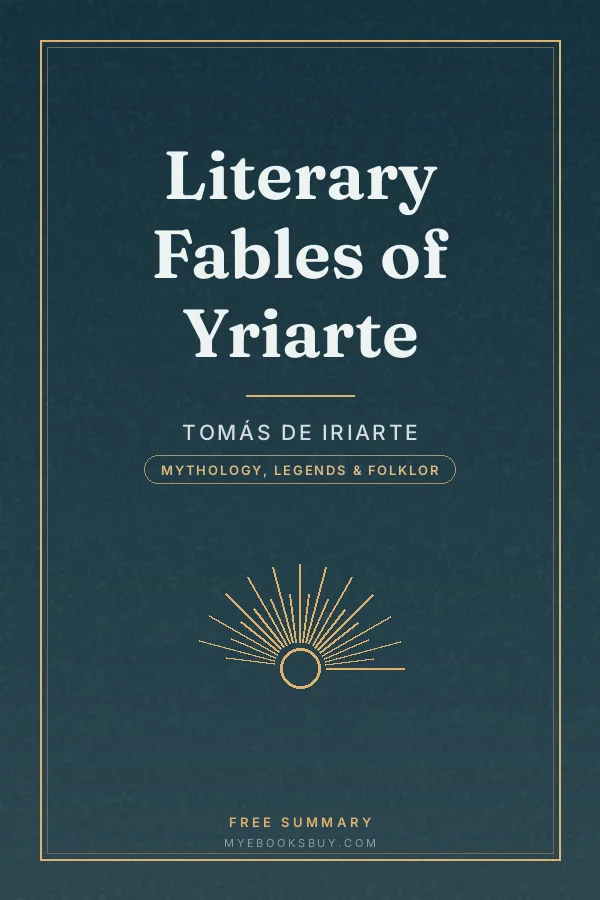
Literary Fables of Yriarte
Tomás de Iriarte (1750–1791)
<Image alt="Vintage book cover or illustration of Tomás de Iriarte's Literary Fables" caption="Literary Fables of Yriarte" src="imageagenttag1"/ Every fable carries a lesson, but these verses trade moral sermons for sharp literary critique, aiming their wit at the vanity, pedantry, and pretensions of the writing craft.
In Short
Translated from Spanish into rhyming English verse, this eighteenth-century collection presents a sequence of lighthearted animal allegories designed to criticize poor scholarship and flawed creative habits. Rather than teaching general morality, the fables focus strictly on the world of letters. Donkeys stumble into playing flutes by pure accident, frogs boast about empty reputations, and beetles dismiss delicate flowers. Through these playful scenarios, the verse systematically exposes bad critics, lazy translators, ostentatious book collectors, and self-important authors, offering a durable set of guidelines for authentic craft and sound judgment.
The Story
The work opens with an introductory framing scene where a wise Elephant gathers the animal kingdom to deliver a stern lecture on their prevailing vices. He singles out habits like envy, idleness, and the arrogance of ignorance, setting a reformist tone for the verses that follow.
From this gathering, the narrative unfolds through a series of distinct, self-contained encounters among various creatures and symbolic objects. Animals gather to argue, compare abilities, or attempt tasks far beyond their natural skills. A Pig loudly praises a Bear's clumsy dancing, prompting the Bear to realize his performance must be truly dreadful if an unrefined spectator enjoys it. Drones attempt to cover up their lazy reputation by holding a lavish funeral for a hard-working Bee, only to be mocked by a living worker who notes that empty tributes cannot replace real effort. Parrots mix French and Spanish into an ugly jargon, while a little belfry bell tries to gain prestige by ringing as infrequently as a grand cathedral bell.
As the fables progress, the scenarios highlight different angles of intellectual folly. An Ass blows into a lost flute by chance and immediately declares himself a master musician. A Duck boasts of being superior to all animals because it can swim, walk, and fly, but a Snake quickly reminds it that it excels at none of those things. A Hack mule starts a journey with wild, chaotic energy only to collapse on her belly halfway through, illustrating authors who promise massive projects they cannot complete. Creatures clash over false standards, like a Crow and a Turkey arguing during a race, where the Turkey resorts to personal insults about the Crow's diet and appearance when it realizes it cannot match the Crow's speed.
Toward the end, the focus shifts to the consumers and guardians of literature. A rich man in Madrid constructs a grand library, but to save money and effort, he hires a painter to fill the shelves with painted pasteboard boxes that look like rare leather volumes. He walks the halls memorizing the painted titles, believing himself a profound scholar. Elsewhere, an Oil-Merchant's Ass stumbles into his own stable door in the dark, complaining that despite carrying gallons of oil every day, he lacks a single lamp to see his way. The collection draws to a close with a meeting between a Viper and a Leech, establishing a clear line between constructive critique that heals and malicious attacks meant only to harm.
How It Unfolds
The censor calls a assembly The Elephant gathers all the beasts to deliver a learned critique of their foolish habits, targeting envy, laziness, and arrogant ignorance.
The Bear dances for a Pig A Bear despises his own poor performance after a Pig loudly cheers for him, realizing that praise from an unrefined audience is the worst form of embarrassment.
An Ass finds a flute A donkey snorts into a dropped flute by complete accident and instantly believes himself to be a brilliant musical genius.
The Mule collapses on the road A energetic Hack Mule sprints out of the stable with wild capers, but completely runs out of wind and falls flat before completing the journey.
The Crow wins the race A Turkey falls behind in a flying contest with a Crow and resorts to shouting personal insults about the Crow's ugly appearance and diet.
The rich man paints his books A wealthy man builds a massive saloon for a home library but fills the shelves entirely with painted pasteboard boxes disguised as rare manuscripts.
The Viper speaks to the Leech A Leech explains to a Viper that while both creatures bite, one does so to heal the sick while the other bites merely to kill.
The People
The Elephant He serves as the initial authority figure who recognizes the rampant abuses and silly habits among the beasts. He wants to bring about a sweeping reform through well-prepared and serious criticism.
The Bear He wants to perform well, but he relies on the reactions of others to judge his work. When a clumsy Pig praises his movements, he experiences a sudden wave of self-awareness and humble realization.
The Hack Mule Full of initial vigor, she wants to demonstrate immense speed and flair at the start of a trip. Her lack of endurance and stubborn temper leave her sprawling on her belly mid-journey.
The Drones They want to wash away their public reputation for sloth without doing any real work. They try to gain respect by hosting a grand funeral for a famous dead Bee rather than making honey themselves.
The Rich Man of Madrid He desires the status and appearance of a profound scholar without spending the money or time needed to read actual books. He contents himself with painted fake volumes and memorized titles.
In Its Own Voice
"The brief and simple illustrations it affords give additional weight and point to moral apothegms or sententious criticisms."
The translator's preface highlights how simple allegories help deliver dry truths directly to readers who might otherwise ignore them.
"When Monkey did my dancing slight / I did not much the censure heed; / But now I see, by your delight, / It must be miserable, indeed."
After hearing a Pig's loud praise, the Bear realizes that applause from the wrong audience reveals a truly poor performance.
"Many opinions there may be--but only one is truth!"
A astronomer resolves a debate among guests whose watches all show different times, reminding them that noisy claims cannot alter facts.
What It's Really About
The work functions as a sustained defense of disciplined artistry, clear judgment, and honest intellectual effort. Beneath its light animal interactions, it targets the absurdities of the literary world, attacking pedantic critics who hunt for minor flaws while ignoring genuine merit. It exposes authors who substitute flashy starts for sustained quality, translators who ruin original works, and readers who value rare book bindings over actual content. The underlying argument demands that creative work be judged by rigorous standards rather than popularity, pedigree, or accidental success, warning against both malicious tearing-down and mindless applause.
Why Read It Today
This collection will appeal to writers, editors, critics, and readers who enjoy sharp satire aimed at creative pretense. Its rhythmic verse keeps the pace brisk, making complex arguments about literary theory feel accessible and entertaining.
Readers should expect an older style of verse translation, along with occasional eighteenth-century framing that reflects the period's formal debates over classicism and translation methods. Because the fables focus on specific intellectual habits rather than general life advice, some references require a bit of thought regarding how they apply to modern art and publishing.
What remains memorable is how modern its observations feel. The behaviors parodied throughout—such as authors claiming credit for work done by others, critics resorting to personal attacks during arguments, or people boasting about unread books—remain strikingly familiar today.
<ElicitationsGroup message="Explore this text further:"> <Elicitation label="Analyze the specific literary rules in Yriarte's fables" query="Analyze the specific literary rules and critical theories Tomás de Iriarte promotes in Literary Fables."/> <Elicitation label="Compare Yriarte's fables to Aesop and La Fontaine" query="Compare the tone and purpose of Tomás de Iriarte's Literary Fables with traditional fables by Aesop and Jean de La Fontaine."/> </ElicitationsGroup>
This summary was written by AI (g4f/auto) on 2026-08-30 and is a guide to the book, not a replacement for it — it can be incomplete or wrong. The book itself is public domain. Copyright & AI disclosure · Report a problem