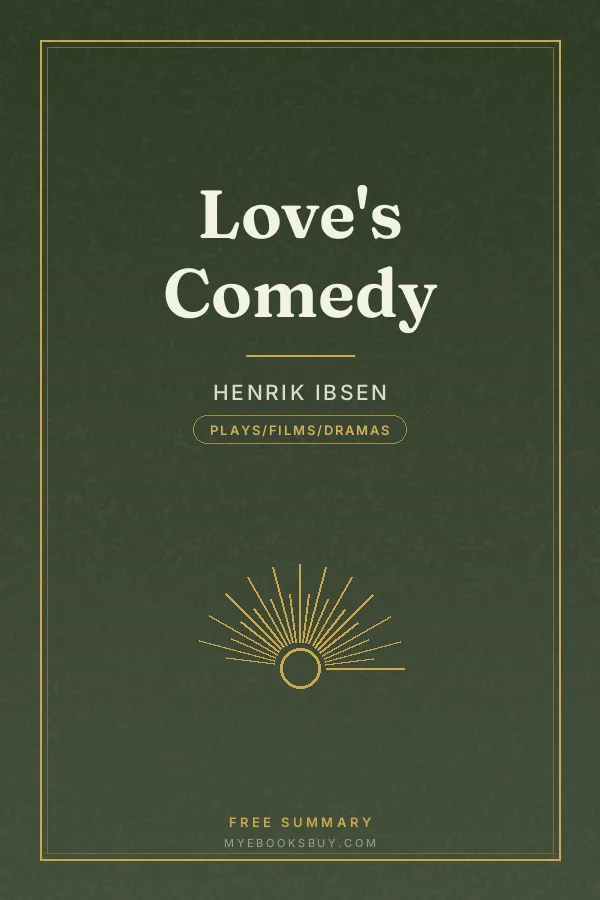
A young poet challenges the hollow, performative romance of his social circle, only to discover that preserving the purity of love may require an impossible sacrifice.
In Short
This play is a sharp, satirical comedy of manners that examines the chasm between youthful idealism and the rigid, suffocating conventions of middle-class society. Set in a suburban garden, it follows Falk, a rebellious poet who mocks his peers for their performative, "respectable" courtships. As the characters navigate engagements and social pressures, the narrative evolves into a philosophical debate on whether love can survive the realities of daily life. It remains a foundational work, capturing the early, biting wit of an author who would soon define the modern stage.
The Story
The narrative centers on a garden party in Christiania, where the social atmosphere is thick with the pretense of "official" respectability. Falk, a brilliant but cynical young poet, arrives with a burning disdain for the local habit of turning romance into a predictable, bureaucratized affair. He observes the young student Lind and his fiancée, Anna, as they revel in the early, frantic stages of their engagement, while the older, settled couples—like the Pastor Strawman and his weary wife—stand as cautionary examples of what happens when the "fire" of passion is extinguished by the demands of domestic duty.
Falk finds a kindred spirit in Svanhild, a woman who shares his sharp wit and refusal to conform. Their relationship begins as a playful intellectual jousting match, but it quickly deepens into a profound, dangerous emotional connection. Falk, ever the provocateur, launches a verbal assault on the gathered guests, labeling their marriages and engagements as mere "bankrupt" business deals held together by habit rather than true devotion. He demands that Svanhild defy convention and "leap" into a life of absolute, uncompromised freedom with him.
As the pressure mounts, the reality of their situation sets in. Falk’s friend Guldstad, a pragmatic and wealthy merchant, provides a sobering perspective: he argues that while passion is a fleeting spark, marriage is a practical, long-term endeavor that requires stability, not just poetic intensity. He notes that the very qualities that make a woman a thrilling, idealized muse are not necessarily those that make a supportive, everyday wife.
Svanhild eventually comes to a agonizing realization. She understands that if she and Falk marry, their love will inevitably succumb to the same decay they despise in others. She sees that her role as his muse is to inspire his art, not to be consumed by his domestic life. In a dramatic final act, she decides to reject marriage to save the integrity of their love. By casting her ring into the fjord, she frees Falk from the "slavery" of an earthly, doomed union. The act transforms their connection into something eternal and spiritual, untainted by the mundane. Falk, though heartbroken, accepts his path: he will go into the world to fight the "lie" of conventional society through his work, while Svanhild remains an idealized memory that fuels his genius. The play concludes not with a domestic resolution, but with a bracing, singular commitment to duty and the pursuit of an uncompromising ideal.
How It Unfolds
The garden gathering Falk arrives at a social event, instantly clashing with the smug, conventional mindset of the local elite. He mocks the "respectable" nature of their courtships and identifies the pervasive dishonesty in how they treat love.
The blooming of an ideal Falk encounters Svanhild, and they form a bond built on intellectual freedom and mutual defiance of social norms. They challenge one another, recognizing that their connection is fundamentally different from the mundane attachments of the people around them.
The assault on the status quo Falk delivers a scathing, public critique of the "tea-caucus" of guests, exposing the hypocrisy of marriages that have long since died. He forces his peers to confront the reality of their hollow lives, drawing the ire of the local pastor and the established couples.
The intervention of reality Guldstad, the pragmatic merchant, intervenes with a sobering argument about the difference between a muse and a wife. He forces Falk and Svanhild to consider whether their "higher" love can actually survive the grind of daily, practical existence.
The final surrender Svanhild realizes that to keep their love pure, it must never be subjected to the corruption of marriage. She casts her ring into the water, ending their earthly engagement to preserve the perfection of their shared ideal.
A new departure Falk accepts his solitary path, committing himself to a life of artistic warfare against convention. He leaves the garden behind, carrying the memory of his "singing-bird" as a source of strength for his future work.
The People
Falk is an iconoclastic poet who views himself as an eagle, destined to soar above the "swamp" of bourgeois existence. He begins the play as a cynical observer and ends it as a man who has traded personal happiness for the preservation of an artistic ideal.
Svanhild is the intellectual and emotional equal to Falk. She is a woman of deep, silent intensity who realizes that her love for Falk is too precious to be reduced to a mundane marriage. She undergoes the most profound transformation, evolving from a girl caught in a social web into a decisive woman who chooses the eternity of a dream over the reality of a home.
Guldstad acts as the voice of mature, pragmatic reason. He is not a villain, but a man who understands the "practical concern" of marriage. He serves as a foil to Falk, representing the middle ground of stability and realistic compromise.
Pastor Strawman is the caricature of the "respectable" life. He is a man who has long since buried his youthful dreams under the weight of his "twelve young and helpless innocents" and his pastoral duties. He serves as the primary target for Falk’s satire, embodying the domestic death that Falk fears.
In Its Own Voice
"You cram it in, like putty into cracks, / Till lean is into streaky fat converted."
Falk uses this biting description to mock the way Stiver and others manufacture "romance" by filling their lives with empty, varnished conventions.
"Then, when every bloom is shed, / Sweep together, scarce in sadness, / All that glory, wan and dead: / Fling the gates wide! Bruise and batter, / Tear and trample, hoof and tusk; / I have plucked the flower, what matter / Who devours the withered husk!"
Falk sings this song early on, establishing his defiant, hedonistic philosophy that prioritizes the intensity of a fleeting moment over the preservation of the future.
What It's Really About
The central argument concerns the incompatibility of high-minded idealism and the practical requirements of domestic life. The play asks whether "love" is a distinct, divine force that perishes once it enters the "bankrupt" estate of marriage, or if it is merely a subjective delusion used to mask social necessity. It questions if a creative spirit can ever truly be a "husband" or "wife" without violating the very nature of their individuality. Beneath the satire, there is a persistent, gnawing question about whether a human being is responsible for the "Call" of their talent or the expectations of their community.
Why Read It Today
Readers who enjoy intellectual sparring, witty banter, and the structural boldness of early modernist theater will find this work rewarding. It feels remarkably modern in its critique of "lifestyle" and social performances; the way the characters obsess over appearances and the "correct" way to be engaged reflects contemporary anxieties about performative personal lives.
However, the play is not without its difficulties. The prose translation retains a Victorian flavor that can feel dense, and the specific references to 19th-century Norwegian literary feuds may require a reader to lean into the broader, universal themes rather than the historical context. The characters can be intentionally abrasive, and the central conceit—the "tea-plant" analogy—is a relic of the era’s taste for elaborate allegories. Yet, the ending remains hauntingly powerful. It does not offer the comfort of a conventional resolution; instead, it leaves the reader with the cold, bracing realization that some ideals are too fragile to survive the world. It is a work for those who appreciate the beauty of a "what if" story, one that stays with you by refusing to grant its characters the easy happiness they think they want.
This summary was written by AI (gemini-3.1-flash-lite) on 2026-09-18 and is a guide to the book, not a replacement for it — it can be incomplete or wrong. The book itself is public domain. Copyright & AI disclosure · Report a problem