Free summary
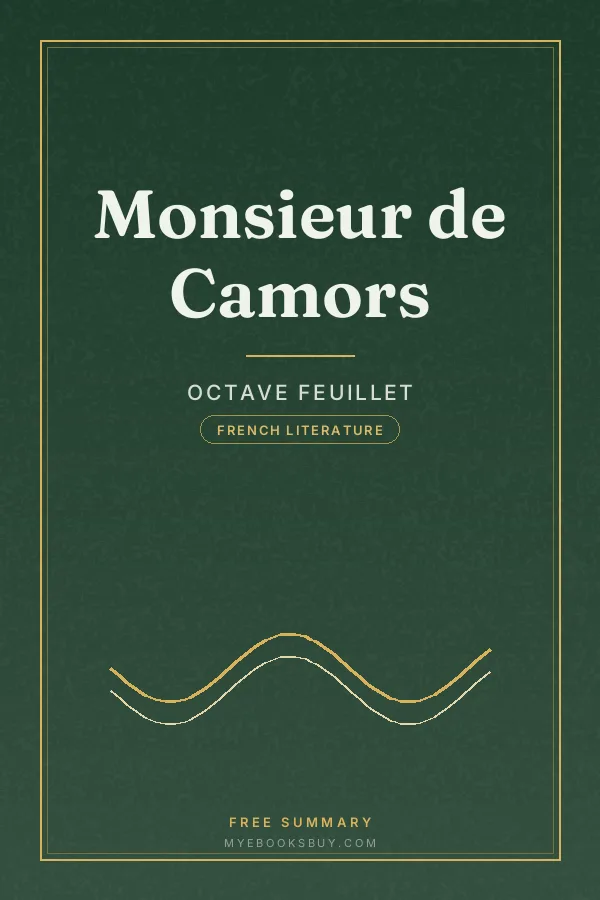
Monsieur de Camors
Volume 2
Octave Feuillet (1821–1890)
A cold, calculating aristocrat attempts to navigate the treacherous waters of Parisian society and his own unraveling moral compass. This study of ego and deception follows one man’s descent into the abyss of his own desires.
In Short
Set against the backdrop of 19th-century French high society, this novel traces the life of Louis de Camors, a man who prides himself on his total detachment from traditional morality. Guided by a philosophy of pure self-interest, he manipulates those around him—including a noble-hearted widow and a powerful General—to secure his political and social ambitions. As his secret affairs and cold-blooded schemes collide, the narrative explores the inevitable consequences of a life devoid of empathy, ultimately serving as a stark warning about the corrosiveness of unchecked pride.
The Story
The story centers on Louis de Camors, a man who has adopted a rigid, nihilistic code of conduct intended to liberate him from the "weaknesses" of human conscience. Armed with his father’s cynical teachings, he arrives in the French countryside to advance his political career. He encounters Madame de Tecle, a widow of profound integrity and grace, and her daughter, Marie. While Madame de Tecle is drawn to his apparent charisma, Camors views her as a mere tool for his social advancement, masking his disdain with a veneer of charm and strategic intimacy.
Camors is not, however, as immune to human feeling as he pretends. He finds himself dangerously entangled with the Marquise de Campvallon, a woman as beautiful, high-born, and morally bankrupt as he is. Their relationship is a volatile mix of genuine, consuming passion and cold-blooded calculation. As their secret liaison deepens, they face the constant threat of exposure, particularly from the Marquise’s husband, General Campvallon, and the prying eyes of social rivals. To protect their status and their illicit connection, Camors and the Marquise devise a monstrous plan: Camors will marry the young and innocent Marie de Tecle, thereby creating a convenient social cover that keeps him close to the Marquise while silencing any suspicion from the General.
The plan succeeds with devastating precision. Camors, despite his internal revulsion, carries out the deception with flawless social etiquette, leaving the trusting Madame de Tecle overjoyed by the prospect of her daughter’s union with such a "distinguished" man. However, the victory is hollow. The marriage becomes a tragedy of lies and isolation. The Marquise, driven by her own desperate need to maintain her wealth and prestige, orchestrates the betrayal of everyone in her circle. As the layers of manipulation are peeled back, the characters are forced to confront the wreckage of their choices. The story concludes with the total collapse of the fragile world Camors has built. His detachment, once his greatest pride, becomes his prison. The final acts of his life demonstrate that one cannot excise the soul without also destroying the capacity for any meaningful existence, leading to a grim, inevitable end where his pursuit of self-mastery results only in his own ruin.
How It Unfolds
The arrival of a tactician Camors arrives at the estate of Madame de Tecle, where he uses his refined social instincts to begin a campaign of calculated charm. He views the widow not as a person, but as a strategic asset to be managed for his political gain.
The seduction of the soul A growing, unwanted passion for the Marquise de Campvallon disrupts Camors' carefully maintained indifference. The two recognize a kindred spirit in their mutual depravity, forming a bond that defies the boundaries of their society.
The formation of a secret society Camors establishes a private club, "The Templars," to enforce a strict code of honor among his peers, ironically while he is actively violating every moral standard he claims to uphold.
The fatal masquerade To protect their affair from the General’s growing suspicion, Camors and the Marquise decide to use an innocent young girl as a social shield. They manipulate the circumstances to ensure Camors marries Marie de Tecle.
The collapse of the illusion The marriage takes place, but the weight of the collective deception begins to fracture the lives of all involved. The masks of nobility and restraint are stripped away, revealing the emptiness at the core of their high-society existence.
The People
Louis de Camors is the central figure, a man of intellect and cold ambition who believes he has transcended human morality. He ends the story having sacrificed his humanity for a power that ultimately leaves him isolated and hollow.
Madame de Tecle is a woman of profound grace and genuine maternal devotion. Her tragedy lies in her inability to recognize the malice behind Camors' charm, believing she has secured a brilliant future for her daughter.
The Marquise de Campvallon is the mirror image of Camors. Beautiful and fiercely intelligent, she is a "pagan" of high society who views life as a theatrical performance. She remains committed to her own preservation, ultimately driving the most ruthless parts of the plot to keep her status intact.
General Campvallon is the unsuspecting husband whose loyalty and trust are exploited by those closest to him. He remains a figure of pathetic confusion, never fully grasping the depth of the betrayal unfolding under his roof.
In Its Own Voice
"In spite of this preference, he would not have scrupled to adopt the opinions of M. des Rameures, had not his own fine tact shown him that the proud old gentleman was not to be won by submission."
Camors considers the best way to manipulate a social superior during his political campaign.
"When true passion surprises the human soul, it breaks down all resolves, sweeps away all logic, and crushes all calculations."
The narrator reflects on the uncontrollable nature of the desire that forces Camors to abandon his nihilistic principles.
What It's Really About
The book is a biting critique of the moral vacuum found within the elite circles of 19th-century Paris. It argues that a life lived purely for pleasure and social dominance is inherently destructive. The core question is whether a human being can effectively strip away their conscience and still maintain a functioning, meaningful life. The author suggests that such a pursuit is a form of spiritual "paganism"—a worship of the self that inevitably leads to the dehumanization of others. Ultimately, the narrative examines the tension between outward social form and internal moral decay, positing that one cannot lie to oneself without eventually losing the ability to distinguish between truth and the theater of one's own ego.
Why Read It Today
This book is a rewarding read for those interested in psychological realism and the darker side of social ambition. It feels remarkably modern in its depiction of a "sociopathic" protagonist who views life as a game to be won through branding and manipulation. The writing is elegant, sharp, and occasionally biting, capturing the stifling atmosphere of a society obsessed with appearances.
However, readers should be prepared for the author's dense, 19th-century prose and the slow, deliberate pace of the character studies. Some may find the period attitudes—particularly regarding the role of women and the rigid, often hypocritical concepts of honor—challenging to navigate. There is no sentimentality here; the author is unflinching in showing the cruelty of his characters. What stays with you is not just the plot, but the haunting portrait of a man who succeeds in every worldly sense only to find he has nowhere to go. It is a powerful, sobering look at the cost of being "above" the common moral ties that bind society together, making it a timeless study of the dangers of a detached, cynical heart.
This summary was written by AI (gemini-3.1-flash-lite) on 2026-09-20 and is a guide to the book, not a replacement for it — it can be incomplete or wrong. The book itself is public domain. Copyright & AI disclosure · Report a problem