Free summary
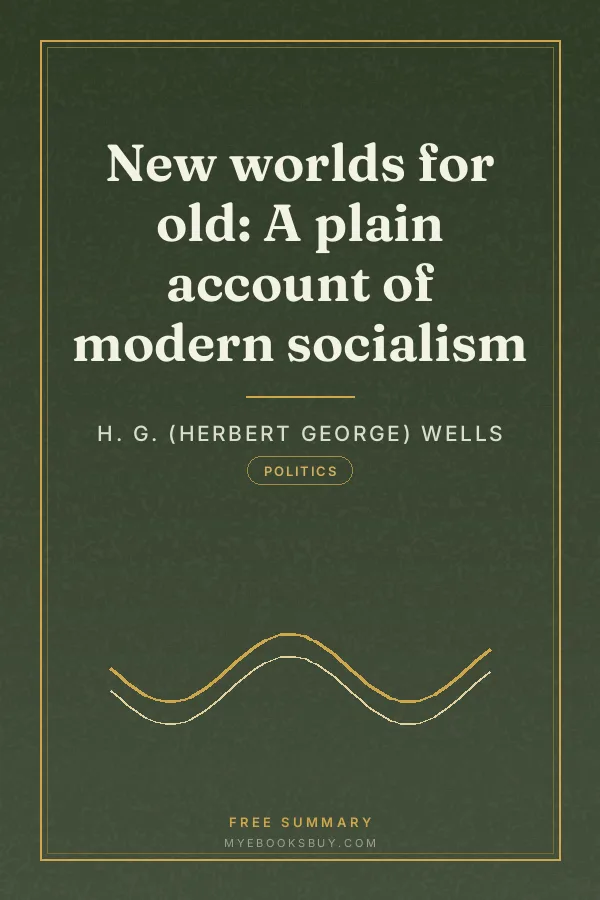
New worlds for old: A plain account of modern socialism
H. G. (Herbert George) Wells (1866–1946)
Socialism is a path toward a rationally organized future, replacing the chaos of private competition with collective responsibility and human dignity. It is an argument for order and shared opportunity in a world governed by chance.
In Short
This book serves as a foundational primer on early twentieth-century socialism. Eschewing dry polemics, it argues that modern society is an incoherent, wasteful mess that can be redeemed through state-managed resources and collective planning. It addresses common misconceptions of the era—such as the idea that socialism destroys marriage or rewards laziness—while charting a vision of an "Over-Parent" state. By grounding high-minded political theory in the practical realities of daily life, it offers a thoughtful roadmap for how a community might organize itself to prioritize human welfare over private profit.
The Story
The narrative begins by acknowledging the intense, often hostile public debate surrounding socialism, which many contemporary critics dismissed as a "nightmare" of theft and atheism. Rather than fighting these abstract labels, the text sets out to define socialism as a deliberate attempt to impose order on a world characterized by haphazard, inefficient, and often cruel impulses. The argument posits that if humanity can use science to understand and manipulate the physical world, it can certainly apply similar intelligence to social organization.
Central to this vision is the concept of the state as an "Over-Parent." The author contends that the current system unfairly exploits the instinct of parents to nurture their children, forcing them to carry the weight of the future while receiving little support. Socialism, by contrast, seeks to make the community responsible for the well-being, education, and health of every child. This is not merely a charitable act for the impoverished, but a necessary systemic shift that honors the dedication of the "middling sort" of families who currently struggle under the burden of private, competitive survival.
The argument then turns to the corrosive nature of private property. Through the example of a simple commodity—a pair of boots—the text illustrates how every stage of production, transport, and retail is currently siphoned off by land-owners, railway magnates, and middlemen who contribute nothing but the extraction of profit. This "private ownership" is described as an exaggerated right that creates immense, unnecessary wretchedness. The alternative is a state-managed economy where land and resources are held in common, ensuring that wealth circulates back into the community to build houses, develop research, and reconstruct the world.
As the argument progresses, it confronts the "spirit of gain" versus the "spirit of service." It does not pretend that the transition will be easy or that the future will be perfect. It frankly admits that many problems—such as how to incentivize individual work or manage complex human relations—remain unsolved. It also distances itself from the rigid, fatalistic dogma of certain Marxists, arguing instead that socialism is a living, evolving doctrine that requires active, sustained effort rather than a passive reliance on inevitable economic forces.
Ultimately, the book maps a choice between two futures: a stifling, corrupt plutocracy or a democratic civilization organized through the deliberate, collective will of the people. It concludes with an invitation to the reader—particularly the educated middle class—to move beyond the "chaos of human affairs" and engage in the intellectual and moral work necessary to build a more rational, humane world.
How It Unfolds
The rejection of chaos The book opens by asserting that socialism is a scientific approach to social life. It argues that modern life is governed by chance and impulse, whereas socialism seeks to replace this disorder with a calculated, foreseeable, and orderly design.
The state as protector The text introduces the metaphor of the "Over-Parent," suggesting that the modern state should assume direct responsibility for the upbringing and health of all children. This section moves from the plight of the neglected poor to the unfair burdens placed on the hard-working, middle-class family.
The critique of property The author provides a vivid illustration of how private ownership obstructs basic human needs by following a pair of boots through the supply chain. He demonstrates how profit-seeking middlemen at every level of transport and land-use inflate costs and stifle progress.
The challenge of transition The narrative confronts the practical, messy difficulties of moving away from capitalism. It acknowledges that the path is not yet fully defined and warns against the "fatalism" of those who believe history will bring about change without deliberate human effort.
The call to agency The final sections emphasize that socialism is not a finished product but an experiment requiring the active participation of an informed citizenry. It frames the struggle as a choice between a drifting, stagnating plutocracy and a renewed, democratically organized future.
The People
The book focuses less on specific individuals than on archetypes and social roles. The "Middle-Class Citizen"—the industrious, self-denying shopkeeper or employee—is the primary audience. They are someone who currently works hard to save for a future that is constantly threatened by the volatility of speculative finance and the greed of private corporations. The author wants this person to realize that their interests align with the collective rather than the plutocrat.
The "Plutocrat" serves as the antagonist. Whether it is the railway owner or the land-holder, this figure represents the "spirit of gain," standing between the people and the resources they need to live. They are warned that their way of life—characterized by excess, service, and superiority—must come to an end in a socialist society.
The "Socialist" is cast as the intellectual laborer, someone who realizes that the world is imperfect and that the work of designing a better one is an ongoing, evolving task. The author also critiques the "Common Marxist," whom he describes as a person who has allowed dogma to paralyze their critical thinking, mistaking fatalism for a genuine strategy for progress. Finally, the "Official" is identified as a potential danger; the author worries that a bureaucratic class might slip into power through the cracks of administration, replacing democratic control with an unrepresentative, "insidious" form of government.
In Its Own Voice
"The fundamental idea upon which Socialism rests is the same fundamental idea as that upon which all real scientific work is carried on."
The author explains that socialism is rooted in the belief that social life, like physics or chemistry, can be studied and improved through order and calculation.
"The conception of private property has been extended to land, to material, to the values and resources accumulated by past generations, to a vast variety of things that are properly the inheritance of the whole race."
This passage outlines the author’s primary grievance: that private owners have seized resources that should rightfully belong to all of humanity.
"It is a simple and elementary principle that all values are created by the productive activity of capital, labour and ability in industrial operations of one kind and another."
The author uses this economic point to argue that private profit is often just an extraction of value from the labor and resources of others.
What It's Really About
The book is fundamentally an argument for the supremacy of collective planning over the "haphazard" market. It explores the tension between individual ambition and the welfare of the species, positing that human progress has been retarded by an excessive, almost sacred, belief in private property. The central question is whether a society can consciously choose its own future. The author rejects the idea that economic forces are a natural, unchangeable law, insisting instead that they are social constructs that can be redesigned. By framing socialism as a "developing doctrine," the book examines the necessity of intellectual humility, arguing that the true spirit of reform lies in a constant, honest inquiry into how we can better organize our common resources to serve the common good.
Why Read It Today
Readers who enjoy intellectual history or are interested in the evolution of political thought will find this book particularly rewarding. It reads like a long, patient conversation with a mentor who is eager to clear away the fog of political vitriol. There is a palpable warmth in the way the author addresses the reader’s doubts, making it feel less like a manifesto and more like a sincere appeal to reason.
The prose is precise and engaging, though modern readers should be prepared for the occasional Edwardian turn of phrase and the specific cultural references of 1908. While the author is largely successful in stripping away the "hype" of his era, his discussion of eugenics and the "proper" way to beget children reflects the period's preoccupation with social hygiene—a section that may feel jarring or outdated to contemporary readers. Despite these dated elements, the core of the work—the challenge of balancing individual liberty with the necessity of collective action—remains startlingly relevant. It is a book for those who want to understand how a thoughtful, skeptical mind grapples with the promise of a better world. The experience of reading it leaves you with a sense that while the "great scheme" of social reconstruction is indeed complex, the effort to define and build it is the most meaningful work a citizen can undertake.
This summary was written by AI (gemini-3.1-flash-lite) on 2026-08-20 and is a guide to the book, not a replacement for it — it can be incomplete or wrong. The book itself is public domain. Copyright & AI disclosure · Report a problem
![Cover of The International Jew, the world's foremost problem [volume I]](https://cdn.myebooksbuy.com/c/the-international-jew-the-world-s-foremost-problem-volume-i-henry-ford.webp)