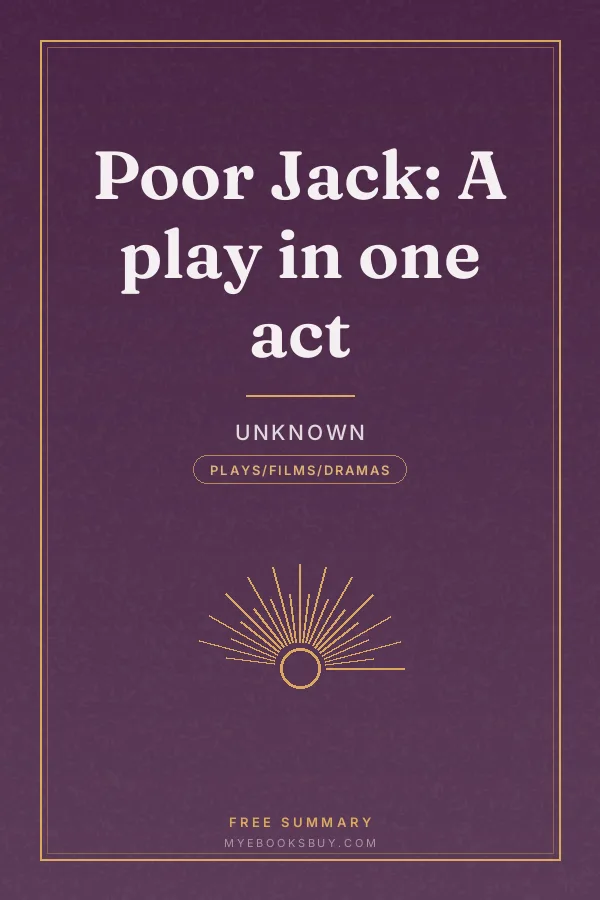
This intimate one-act play imagines the final, melancholy intersection between Shakespeare’s legendary knight, Sir John Falstaff, and the woman he loved in his youth. It serves as a poignant coda to a life defined by excess and artifice.
In Short
This play depicts a fictional, twilight encounter between the aging, disgraced Sir John Falstaff and Lady Sylvia Vernon, his sweetheart from forty years prior. Set in the Boar’s Head Tavern, the drama strips away the knight’s characteristic bravado to reveal the loneliness of a man who has outlived his own legend. By contrasting the public myth of Falstaff—the gallant soldier and hero—with the reality of his decayed, poverty-stricken existence, the work explores the inevitable cruelty of time and the heavy, often hollow, weight of personal history.
The Story
The play opens in a private room at the Boar’s Head Tavern, where a physically diminished Falstaff struggles to maintain his dignity while battling the infirmities of age and the sting of royal rejection. His loyal servant, Bardolph, and the inn’s mistress, Dame Quickly, witness the knight’s attempts to reconcile his past glory with his current, destitute reality. He maintains a facade of optimism, speaking of future military campaigns and wealth, even as he admits that his former friends have abandoned him since his former companion, Prince Hal, ascended to the throne as King Henry V.
The atmosphere shifts abruptly with the arrival of Lady Sylvia Vernon. Now a woman in her sixties, Sylvia has traveled to London to bid her son farewell before he departs for the wars. She seeks out Falstaff, whom she remembers not as the debauched tavern-dweller of public rumor, but as the romantic, noble lover of her youth. Their conversation is a delicate, painful excavation of the past. As they speak, the distance between the mythic knight and the man sitting before her collapses. Sylvia confesses that she has spent decades telling her children stories of Falstaff’s chivalry, holding him up as a paragon of virtue.
Falstaff, deeply affected, drops his mask of jester and rogue. He acknowledges that the man Sylvia loved—the “dear boy” who once wrote sonnets—is long dead, replaced by a ghost haunting the ruins of his own life. The encounter forces them both to confront the reality that they have become strangers to one another, separated by the ravages of time and the disparate paths their lives have taken.
In a gesture of closure, Sylvia returns a packet of love letters she has kept for forty years, insisting that the time for such follies has passed. They share a final, reverent moment of affection, and Sylvia departs. Left alone, Falstaff reads one of his old, flowery poems by the firelight. He feels a brief, sharp pang of regret for the life of domestic stability he might have led had he chosen differently. However, the habit of his nature proves too strong. He tosses the letters into the hearth, watching them burn to ash. Declaring that the past is a closed chapter, he calls for a final cup of wine and resolves to return to his revels with Doll Tearsheet, retreating once more into the familiar, numbing comfort of his own deceits.
How It Unfolds
The broken knight Falstaff begins the scene in a state of physical decay, nursing his aches and his bruised ego in the wake of his fall from the King’s favor. He attempts to project strength, though his hollow boasts about his past exploits and future prospects fail to mask his deepening despair.
A ghost from the past The arrival of Lady Sylvia Vernon disrupts the tavern’s atmosphere and pierces Falstaff’s defenses. She arrives with a romanticized memory of him, forcing the knight to reconcile his present decrepitude with the idealized version of himself that she continues to cherish.
The anatomy of lost youth The two engage in a quiet, somber dialogue, reminiscing about the people they knew and the dreams they held before the world hardened them. They recognize that their shared history is now a burden, and they acknowledge that they are no longer capable of the intense emotions of their youth.
The final surrender Sylvia returns Falstaff’s youthful love letters, signaling an end to her own attachment to the past. Left alone with these relics, Falstaff reads his own poetry, acknowledges the man he once was, and then destroys the evidence of his former sincerity.
A return to the mask The play concludes with Falstaff choosing to abandon his momentary introspection. He commits himself to his current, dissolute path, choosing the immediate distraction of the tavern over the pain of confronting his lost potential.
The People
Sir John Falstaff is the central figure, a man who has spent his life performing a character of his own invention. He wants to maintain the illusion of his legendary status, but he is constantly thwarted by his own poverty, failing health, and the cold reality that he is no longer relevant to the world that once courted him. He ends the play having confronted his mortality, only to retreat further into his well-worn persona.
Lady Sylvia Vernon serves as the mirror for Falstaff’s lost youth. She seeks to validate the romantic memories of her life by visiting the man who once defined them. While she remains elegant and composed, she ultimately realizes that the object of her affection is gone, leaving her to depart with a sense of regret for having disturbed the past.
Bardolph and Dame Quickly act as the grounding forces of the play. They represent the practical, mundane world that Falstaff inhabits. Their interactions with the knight highlight his isolation; they are his audience, yet they remain largely untouched by the profound existential crisis he experiences during his meeting with Sylvia.
In Its Own Voice
“What, old acquaintance! could not all this flesh Keep in a little life! Poor Jack, farewell! I could have better spared a better man.”
The narrator introduces the play by reflecting on the tragic, diminished state of the once-vibrant knight.
“Faith! we are both old; and I had not known it, my lady until to-day.”
Falstaff admits this to Sylvia as they sit together, finally acknowledging the toll that time has taken on their spirits.
“There are some ghosts,” said poor Jack, “that will not easily bear raising....”
This sentiment, cited in the introduction, captures the central tension of the story: the danger of revisiting a past that is best left buried.
What It's Really About
The work is a meditation on the nature of identity and the corrosive power of regret. It questions whether we are the sum of our public reputations or the private, often disappointing, reality we hide from the world. Falstaff’s struggle is not merely about old age, but about the difficulty of maintaining a performance when the stage—and the audience—has moved on. The play argues that identity is a fluid construct, easily rewritten but difficult to sustain, and suggests that there is a profound, quiet tragedy in outliving the version of oneself that others have come to love. It explores the tension between our desire for the past and the necessity of moving forward.
Why Read It Today
Readers who appreciate Shakespearean character studies will find a haunting, speculative expansion on one of literature’s most complex figures. The play captures the specific, lingering ache of realizing that the doors to one's youth have truly closed. It is a brief, atmospheric read, steeped in the melancholic realization that even the most "mountainous" personalities eventually shrink before the relentless passage of time.
The writing requires an ear for the period’s cadence and a tolerance for its archaic vocabulary, which may be a barrier for those unaccustomed to such prose. However, those who persevere will find a deeply human portrait of aging. It avoids the caricature often associated with Falstaff in favor of a vulnerable, private man who is forced to confront the wreckage of his own choices. What stays with the reader is the image of the fire consuming the letters—a powerful, final rejection of sentimentality in favor of survival. It feels less like a traditional drama and more like a quiet, intimate eulogy for a man who, until the very last, refuses to stop playing the fool for his own sake.
This summary was written by AI (gemini-3.1-flash-lite) on 2026-09-19 and is a guide to the book, not a replacement for it — it can be incomplete or wrong. The book itself is public domain. Copyright & AI disclosure · Report a problem