To judge a fellow human being is to condemn oneself, for no soul can truly measure the tangled web of ancestry, environment, and circumstance that shapes another’s life. Force and punishment are not remedies for human failings, but reflections of the very cruelty they claim to suppress.
In Short
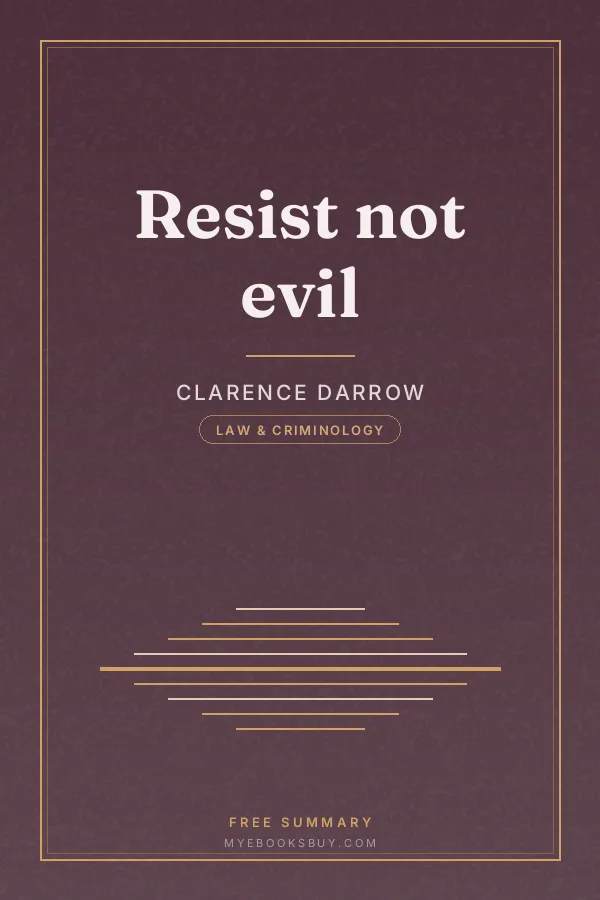
This book is a provocative, philosophical inquiry into the nature of the state, the utility of criminal punishment, and the efficacy of violence as a tool for social order. It argues that modern governments, like the primitive tribes before them, rely on force to protect the property and privileges of the ruling class. By examining the history of human cruelty—from public hangings to the modern prison—the work concludes that punishment is not only ineffective at preventing crime but inherently corrupts those who administer it, advocating instead for a social philosophy rooted in charity and love.
The Story
The narrative begins with a stark rejection of the state as a benevolent protector. It posits that governments, regardless of their form, are essentially engines of force maintained by the strong to keep the resources of the earth from the many. The author traces this evolution from the violent rule of early kings to the complex, bureaucratic machinery of modern civil government. Throughout this history, the purpose remains unchanged: the preservation of status and the enforcement of obedience through the threat of the sword, the jail, and the scaffold.
Moving into the realm of criminology, the text deconstructs the logic of punishment. It points out that human history is littered with shifting definitions of crime; acts once deemed capital offenses—such as witchcraft or heresy—are now viewed with horror, suggesting that our current legal judgments may be similarly judged by future generations. The author insists that crime is not a manifestation of "evil" in the abstract, but a consequence of natural causes, including poverty, disease, and social neglect. The prison, therefore, is not a place of rehabilitation but a warehouse for the victims of an unequal society.
The argument deepens as the author explores the psychology of the judge and the jailer. He suggests that those who participate in the legal machinery—the prosecutor, the sheriff, and the judge—are inevitably brutalized by their work. By repeatedly choosing to meet violence with violence, the state hardens its own heart and teaches the public to rely on vengeance rather than compassion. The text highlights the absurdity of current property laws, noting that while the law may punish a man for a minor theft, it ignores the systemic "extortion" practiced by powerful economic combinations that control resources.
The resolution lies in the abandonment of the "eye for an eye" doctrine. The author insists that society must treat human behavior as a natural phenomenon rather than a product of free-willed malice. Just as a physician treats disease with understanding rather than condemnation, society should address the root causes of crime—want, hunger, and ignorance—with resources and empathy. The book concludes with a call to replace the heavy hand of the state with a commitment to human fellowship. It posits that when we remove the institutions of violence, the majority of humanity will naturally gravitate toward social order, rendering the "organized viciousness" of the law obsolete.
How It Unfolds
The anatomy of the state The argument identifies government as an instrument of the strong, established to divide resources among the favored few. It asserts that behind every civil law lies the threat of violence, ensuring the submission of the toiling millions.
The futility of militarism The text examines how armies and navies, while presented as protectors, serve only to drain productive energy and invite hostility. By fostering an artificial spirit of patriotism, states manipulate their citizens into sacrificing their lives for the benefit of the ruling class.
The history of penal failure The author surveys the evolution of punishment, illustrating that no two generations have agreed on what constitutes a crime or how best to punish it. He demonstrates that the brutality of these methods has always reflected the state’s own disregard for the sanctity of life.
The myth of the deterrent The narrative challenges the idea that punishment prevents crime, noting that prison populations continue to grow despite harsh sentences. It argues that public displays of violence, whether through the scaffold or the press, only serve to harden the public and spread cruelty.
The rejection of judgment The final section calls for the end of the judicial role, arguing that no person possesses the wisdom to weigh the soul of another. It advocates for a transition from a system of retribution to one of social understanding and unconditional love.
The People
The book is framed not as a story of individuals, but as a confrontation between two classes of people: the Rulers and the Common People.
The Rulers represent the legislative and judicial powers. They are characterized by their desire to preserve status and wealth, using the machinery of the state to enforce their will. They are viewed as being blinded by their own authority, acting with a cruelty that they mistake for justice. The author posits that the Rulers are ultimately trapped by their own system, as the exercise of violence inevitably corrupts their own character and limits their ability to see humanity in others.
The Common People are the subjects of the state, the ones whose lives are molded by forces beyond their control. They are the victims of the "property laws" and the primary candidates for the prison cell. The author treats them with profound empathy, arguing that their actions are the inevitable results of their environment, poverty, and lack of opportunity. Through the course of the book, these individuals are transformed from "criminals" in the eyes of the law into victims of a larger social failure who deserve, above all, the charity and understanding of their fellow men.
In Its Own Voice
"From the early kings who, with blood-red hands, forbade their subjects to kill their fellow men, to the modern legislator, who, with the bribe money in his pocket, still makes bribery a crime, these rulers have ever made laws not to govern themselves but to enforce obedience on their serfs."
The author describes the inherent hypocrisy of the ruling class in their creation of legal codes.
"No heart is so pure that it may not be defiled and hardened by cruelty, hatred and force, and none so defiled that it may not be touched and changed by gentleness and love."
The author summarizes his core philosophy regarding the transformative power of compassion over punishment.
What It's Really About
The central theme is the rejection of the state’s monopoly on violence. The work questions the morality of a society that claims to value life while maintaining systems—jails, armies, and courts—that exist to destroy it. It asks whether humanity can ever be truly free as long as it adheres to the archaic logic of retribution. The underlying inquiry is not just about law reform, but about the nature of human responsibility: if our actions are determined by our environment and biology, is it possible for one human to be the judge of another? The book posits that until society moves beyond the "eye for an eye" mentality, it will remain trapped in a cycle of bitterness, hatred, and state-sanctioned cruelty.
Why Read It Today
Readers who are interested in the roots of modern libertarian or anarchist critiques of the justice system will find this work strikingly relevant. Its prose is sharp, earnest, and deeply rooted in the humanist traditions of the early 20th century. While the book was written in 1902, the author’s critique of economic inequality—specifically how price-fixing and trusts drive people into poverty and crime—reads with an urgency that mirrors modern debates on systemic injustice.
However, the reader should be prepared for the book's unrelenting tone. It is a polemic, not a neutral overview; the author possesses an unyielding conviction that leaves little room for middle ground. Readers expecting a nuanced defense of the current legal system will likely find the author’s stance frustrating, as he dismisses the necessity of the courts entirely. Furthermore, the prose reflects the intellectual style of its era, characterized by long, rhythmic sentences and a moralizing fervor that can feel heavy at times. Despite these difficulties, the book is a powerful artifact of American intellectual history. It forces a pause, making the reader confront the uncomfortable question of whether our institutions of "order" actually produce the very chaos and misery they are intended to eliminate.
This summary was written by AI (gemini-3.1-flash-lite) on 2026-09-15 and is a guide to the book, not a replacement for it — it can be incomplete or wrong. The book itself is public domain. Copyright & AI disclosure · Report a problem