Free summary
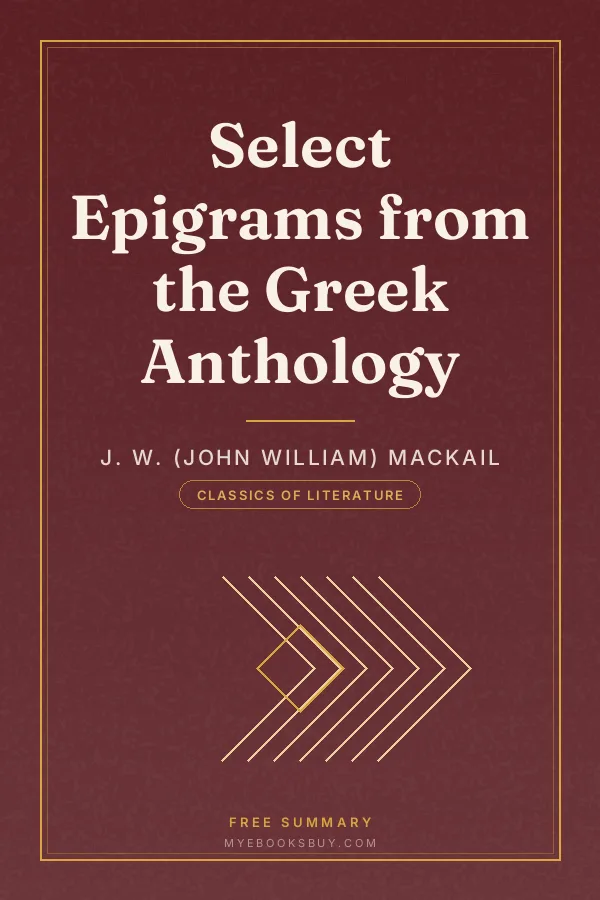
Select Epigrams from the Greek Anthology
J. W. (John William) Mackail (1859–1945)
This collection preserves the fragile, enduring voices of the ancient world, capturing fleeting moments of love, grief, and beauty in the lapidary perfection of the Greek epigram.
In Short
This volume curates the finest Greek epigrams, spanning from the archaic sixth century B.C. through the Byzantine era. Originally functioning as inscriptions on tombs, statues, or votive offerings, these short poems evolved into a sophisticated literary form. They touch upon the full spectrum of human experience: the quiet devotion of family life, the sting of lost youth, the solace of nature, and the ache of romantic longing. By distilling complex emotions into a few precise lines, these works have survived millennia to offer a piercing, intimate connection to the ancient soul.
The Story
The arc of these poems mirrors the unfolding of Greek history itself, beginning with the austere, monumental clarity of the early inscriptional period. In the sixth century B.C., an epigram was a physical object—a stone monument set up by a father for a fallen son or a maiden taken by death before marriage. These early works possess a "divine simplicity," characterized by a stately reserve that speaks volumes through what it leaves unsaid. They represent a culture where the pain of death is absorbed into the ardor of life, and where the purpose of the poem is to ground a memory in the earth.
As society shifts, the epigram moves from the public monument to the private page. The Hellenistic age brings a new diffusion of humanity, where the focus broadens to include the comforts of home, the merchant’s retirement, and the shepherd’s prayer. Here, the "eager and curious spirit of youth" begins to intersect with a growing sense of universal kinship. The poems become more descriptive, dwelling on the cool shade of a plane tree or the rustling of a poplar, capturing the Mediterranean landscape as a backdrop for both holiday joy and existential reflection.
The narrative of the collection then deepens into the realm of the heart. The amatory epigrams of poets like Meleager and Strato introduce a sophisticated, often bittersweet, exploration of love. The tone shifts from the solemnity of the grave to the feverish intensity of the lover, who struggles against Reason or finds his soul hovering on his lips during a kiss. This period marks the height of the form's elegance, where the language is vivid, natural, and rhythmically precise.
However, the final chapters record a slow, inevitable decline. As the Byzantine period takes hold, the vibrant, living Greek of the classical era hardens into a treasury of "glittering words." The poetry becomes more artificial, its colors dimmed by a forced, pedantic tone. The once-fluid connection between the poet and his subject becomes a labor of "tessellation"—a mosaic-like reconstruction of old themes that lack the original, spontaneous spark. By the time of the late empire, the art essentially dies out, leaving the epigram as a preserved relic of a vanished world. The collection concludes not with a flourish, but with the quiet, lingering echo of those who, having passed through the "mournful sleep," remain fixed in the amber of these verses, forever young and forever remembered.
How It Unfolds
The archaic bedrock The journey begins with the sixth-century epitaphs, where the language is thrillingly simple and directly tied to physical monuments. These verses establish a tone of delicate austerity, focusing on valor, wisdom, and the tragic brevity of unmarried life.
The shift toward humanity As the civic spirit decays, the poems broaden to include the domestic and the pastoral. The focus turns to the small mercies of daily life: the retirement of a merchant, the gratitude of a fisherman, and the cooling shade of the mountain fount.
The flowering of emotion The collection finds its emotional center in the erotic and personal epigrams of the Hellenistic poets. Love is explored as a powerful, often chaotic force that captures the mind and challenges the dictates of philosophy.
The Byzantine twilight The final movement tracks the formalization and eventual stagnation of the genre. As the spoken language drifts from the literary, the epigram loses its freshness, becoming a clever but hollow exercise in scholarship.
The People
The figures in this collection are less characters in a continuous plot than archetypes of the human condition. We encounter the "weary" fisherman, who hangs up his spear to seek a quiet age; he represents the dignity of labor and the universal human desire for rest. Beside him stands the "hapless" maiden, such as Phrasicleia, whose name becomes synonymous with a marriage denied by the gods. These figures do not change so much as they are frozen in a moment of transition—from life to death, from travel to home, or from indifference to love. The poets themselves, from the "golden" Plato to the "modern" Paulus Silentiarius, serve as the observers who translate these lives into art. They appear as voices in a conversation across centuries, each grappling with the same questions of memory, mortality, and the relentless passage of time.
In Its Own Voice
Regarding the quiet finality of the grave, the collection offers this reflection on the nature of departure:
The monument of Phrasicleia; I shall for ever be called maiden, having got this name from the gods instead of marriage.
In a moment of intense, romantic longing, one poet describes the precarious state of the soul in the presence of a beloved:
Kissing Agathon, I had my soul upon my lips; for it rose, poor wretch, as though to cross over.
Reflecting on the inevitable, cyclical nature of time and our place within it, the text observes:
Time carries all things; length of days knows how to change name and shape and nature and fortune.
What It's Really About
At its core, this collection investigates the tension between the permanence of the written word and the transience of human existence. It asks how we might anchor our lives—our loves, our griefs, and our fleeting observations of the natural world—against the erosion of time. The poems function as a sustained meditation on mortality, not as a source of terror, but as a condition that gives the "ardour of life" its meaning. By elevating the obscure grave or the humble roadside spring to the status of art, the anthology argues that true significance is found in the specific, the local, and the intensely felt, rather than in the grand, abstract sweep of history.
Why Read It Today
Reading these epigrams feels like unearthing a series of polished, ancient stones that still retain the warmth of the sun. For the modern reader, the experience is one of profound, surprising intimacy; the concerns of a Greek merchant or a mourning parent two thousand years ago feel startlingly current. You will love this book if you appreciate economy of language and the kind of emotional resonance that requires no background to feel.
The primary difficulty lies in the brevity of the form—it is a book to be tasted in small portions, not devoured. Some readers may find the later Byzantine poems, with their more ornate, artificial style, a test of patience compared to the "thrilling" simplicity of the archaic epitaphs. There is also the inevitable distance of period attitudes toward gender and social roles, which are presented here without the tempering of modern moral critique. Yet, these are small hurdles. What stays with you is the haunting, "piercing" quality of a voice reaching out from a lost time to say, "I was here, I felt this, I loved." It is a testament to the idea that while our names may fade, the structure of our feelings remains, and in these verses, that structure is made timeless.
This summary was written by AI (gemini-3.1-flash-lite) on 2026-08-18 and is a guide to the book, not a replacement for it — it can be incomplete or wrong. The book itself is public domain. Copyright & AI disclosure · Report a problem