Free summary
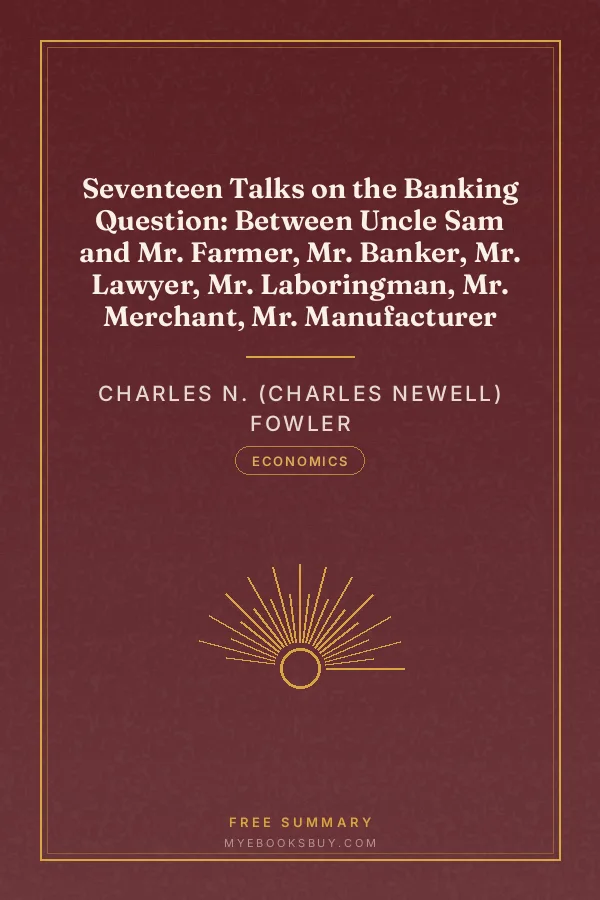
Seventeen Talks on the Banking Question: Between Uncle Sam and Mr. Farmer, Mr. Banker, Mr. Lawyer, Mr. Laboringman, Mr. Merchant, Mr. Manufacturer
Charles N. (Charles Newell) Fowler (1852–1932)
The American financial system, once a chaotic landscape of competing currencies and recurring panics, is dissected here through a series of Socratic dialogues designed to reveal the mechanics of stable, honest banking.
In Short
This book presents a seventeen-part transcript of a confidential, high-level debate held among Uncle Sam and six representatives of American economic life: a farmer, a banker, a merchant, a manufacturer, a lawyer, and a laborer. Seeking to solve the nation’s systemic financial failures, the group works through the fundamental definitions of money, credit, and reserves. By tracing the history of colonial paper money, the failures of bond-secured bank notes, and the successes of the Suffolk System, the participants eventually coalesce around a legislative proposal. Published in 1913, the book serves as both a primer on economic theory and a polemical critique of contemporary banking reform, ultimately offering a blueprint for a decentralized, reserve-based system designed to prevent the commercial tragedies that plagued the era.
The Story
The narrative begins with Uncle Sam gathering his six guests—each representing a vital sector of the economy—for a series of weekly, frank discussions. The group’s objective is to strip away the political cowardice and public ignorance surrounding finance to build a resilient, rational banking system.
In the early "nights," the conversation focuses on the basics: the definition of money, the nature of value, and the difference between cash and credit. The banker leads the charge, effectively dismantling the popular belief that the government’s greenbacks or bond-secured bank notes are sound currency. He argues that these are, in fact, the worst forms of money because they are inflexible and tethered to the government’s own credit, which is periodically imperiled. The group examines the historical "Suffolk System" of the 19th century as a model for excellence, noting how it provided uniform currency through private cooperation rather than government fiat.
As the dialogues progress, the participants navigate the complex world of exchange and commercial credit. They define credit as the result of confidence, acknowledging that while it is essential for business, it becomes a "bane" when used for real estate speculation or unfunded government debt. They move from theory to history, debating the disastrous impact of the Civil War’s legal tender acts and the subsequent oscillations of the Supreme Court regarding the constitutionality of paper money. The farmer and manufacturer play critical roles, pressing for practical solutions that will protect the laboring classes from the "spasms" of economic panics.
The middle arc of the book focuses on the necessity of "elasticity" in reserves. The group concludes that the current system is "cast-iron" and brittle, preventing banks from adjusting to seasonal demands or localized crises. They look to international models, particularly comparing the Canadian system—which lacks a central bank but thrives on independent, well-regulated institutions—against the troubled German model.
The story reaches its climax in the final nights, where the group moves from diagnosis to prescription. They draft a legislative bill that would organize the country into "commercial zones," each with its own clearing house and reserve bank, aimed at removing politics from banking and ensuring that every bank carries its fair share of the insurance burden. The final act shifts into a sharp, aggressive critique of the "Aldrich Plan," a contemporary proposal for a central bank. The participants expose this plan as a plot by a few powerful, "sinister" banking interests to consolidate power under the guise of an altruistic, coöperative institution. The book ends not with a victory lap, but with a warning that the American public must remain vigilant against such concentrated control, emphasizing that true stability comes from economic law and localized, transparent supervision rather than top-down political engineering.
How It Unfolds
The foundational dialogue Uncle Sam establishes the ground rules for the series, insisting on "brutal frankness" as the group tackles the definition of money. They begin by agreeing that the gold standard is the only reliable benchmark for value, grounding their discussion in Aristotle’s ancient observations on the necessity of money for trade.
The critique of government currency The banker systematically deconstructs the reliability of the greenback and the bond-secured note. By documenting the history of treasury failures, the group reaches a consensus that these instruments are fundamentally flawed because they rely on government solvency rather than gold redemption.
The exploration of credit and clearing The participants analyze how credit instruments—checks, drafts, and bills of exchange—actually facilitate the vast majority of American business. They review the mechanics of the clearing house, illustrating how this "marvelous method" reduces the need for actual cash and stops the waste of energy inherent in individual bank settlements.
The lessons of history The group turns to the pre-1860 banking landscape, specifically the Suffolk System, to identify what worked before the Civil War disrupted the economy. They discuss the necessity of reserves and the perils of ignoring "economic law" in favor of political expedience.
The legislative synthesis After weeks of investigation, the group drafts a formal bill to establish a new financial system. They argue for the creation of independent commercial zones that reflect the geographic and economic diversity of the United States.
The final confrontation In the concluding sessions, the group shifts to a fierce rejection of the Aldrich Plan. They argue that this centralizing scheme is a deceptive power grab by the very banking interests that have historically "held the country by the throat."
The People
Uncle Sam acts as the inquisitive, skeptical moderator. He represents the common American, positioning himself as someone "from Missouri" who refuses to accept established financial dogma without proof. He is the glue of the group, ensuring that the talks remain focused and that the legal and ethical implications of every proposal are thoroughly vetted.
Mr. Banker serves as the primary technical guide. He is knowledgeable, sharp, and occasionally cynical, possessing an intimate understanding of banking’s "woes." He provides the historical context and the necessary critiques of the existing system, though his primary goal is to shift the banking industry from a state of government-dependent fragility to one of self-regulating, elastic resilience.
Mr. Manufacturer represents the pragmatic business perspective. He is concerned with the "conversion of liquid capital into fixed investments" and acts as a reality check, ensuring that the theories discussed by the others have practical applications for the real-world manufacturing sector.
Mr. Merchant provides insight into the movement of goods. He is fascinated by the efficiency of credit instruments and the clearing house, and he helps the group understand how the "interwoven" nature of the American economy makes it susceptible to localized "rotten spots" in the credit fabric.
Mr. Farmer speaks for the agricultural interests, specifically highlighting the struggles of obtaining loans for seasonal crops. He is the most concerned with how the banking system affects the actual production of the "necessaries of life" and keeps the others grounded in the realities of those who produce, rather than merely handle, wealth.
Mr. Lawyer ensures that the group remains within the bounds of constitutional and legal reality. He is the historical researcher of the group, tasked with reading primary documents—such as those from the Constitutional Convention—to keep the group honest about the historical precedent of paper money.
In Its Own Voice
"The present situation is one demanding immediate attention, and only our ignorance, greed or political cowardice can prevent us from arriving at a satisfactory solution of this problem."
Uncle Sam opens the first night by setting the stakes for the entire project.
"The notes in the safe of a banker are exactly similar to the goods in the shop of a retail dealer."
The banker explains the nature of banking as a business of buying and selling commercial paper rather than just holding gold.
"It is so interlaced, and so interwoven that one rotten spot map prove as dangerous to the whole fabric of credit as a box of dynamite under one's chair."
The manufacturer emphasizes the systemic fragility of the banking industry when it lacks consistent, required reserves.
What It's Really About
At its core, this work is an argument for decentralized, coöperative capitalism. It posits that the American financial system suffers because it has been shackled by political interference, bad law, and the lack of a uniform, elastic reserve system. The book’s deeper questions concern the fundamental tension between government power and private enterprise: can a republic provide a sound, non-political currency, or does the very attempt to regulate money lead to the empowerment of "sharpers" and banking cartels? It defends the idea that banking is a social utility—a "single business" that requires transparency and shared risk—rather than a tool for speculative gain. The underlying theme is one of institutional distrust; the author fears that without a clear, economic-law-based structure, the nation will forever be susceptible to the "sickening experiences" of panics and the manipulative "plots" of concentrated financial power.
Why Read It Today
Readers who enjoy Socratic dialogue, institutional history, or the nuts and bolts of economic theory will find this a fascinating, if occasionally dense, study. The book captures the intellectual ferment of the pre-Federal Reserve era, offering a window into how Americans once debated the very nature of money.
The reading experience is unique; the dialogue format makes complex concepts accessible, though the reader must be prepared for the author's relentless focus on technical detail. The book does not shy away from the specialized language of 1913 finance—terms like "red dog" paper and "consuls" appear without modern glossaries. Furthermore, the period attitudes are starkly present, reflecting the era’s specific anxieties about "foreign" influences and the moral character of the nation. It is not a quick, light read; the discussions are methodical, and the legislative sections are dry by design. However, the book’s value lies in its earnest, almost desperate attempt to find a rational middle ground between state-controlled fiat and the unchecked power of a few central banks. For those who wonder how the modern American financial system arrived at its current shape, this provides a raw, unfiltered look at the competing visions of a century ago. It remains a powerful testament to the idea that economic stability is not merely a technical problem, but a moral and political one. You will walk away with a profound sense of how long the struggle for a balanced, transparent, and democratic financial system has been, and how relevant the arguments for local, coöperative accountability still feel.
This summary was written by AI (gemini-3.1-flash-lite) on 2026-08-24 and is a guide to the book, not a replacement for it — it can be incomplete or wrong. The book itself is public domain. Copyright & AI disclosure · Report a problem