Free summary
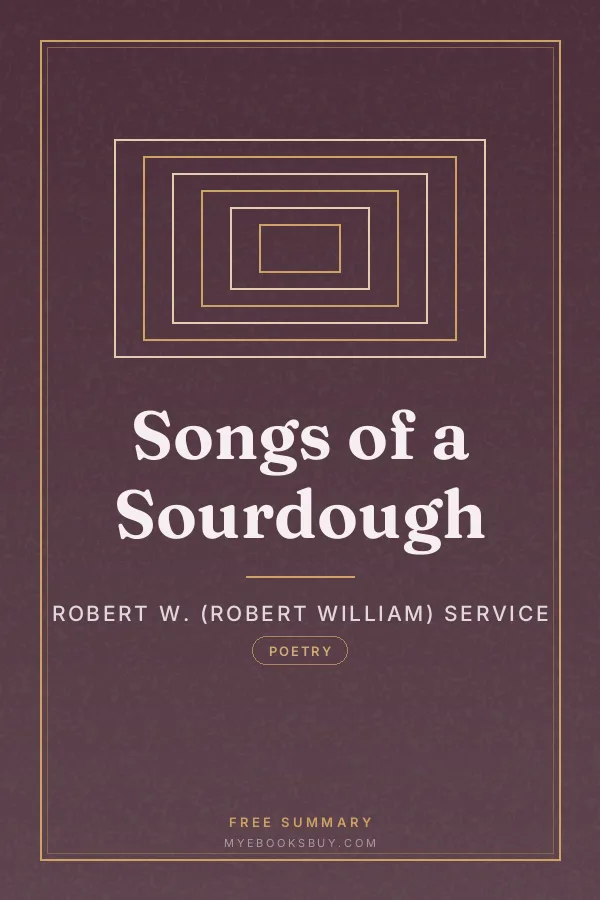
Songs of a Sourdough
Robert W. (Robert William) Service (1874–1958)
HOOK In the frozen, lawless reaches of the Yukon, men gamble their lives against the lure of gold and the crushing weight of a landscape that demands everything.
In Short
This collection of verse captures the brutal, mesmerizing spirit of the Klondike Gold Rush. Through rhythmic, narrative-driven poems, the collection explores the lives of prospectors, outcasts, and drifters who find themselves both repelled and possessed by the Far North. It has endured for over a century because it captures the raw intersection of human ambition and nature’s indifference, rendering the isolation of the Arctic with a visceral, haunting intensity that resonates far beyond its specific time and place.
The Story
The journey begins in the "lonely sunsets" of the Yukon, where the mountains stand "as still as death" and the land waits for men with the hearts of Vikings to test their mettle. The narrative arc of the collection is not a single linear plot, but rather a descent into the psyche of the pioneer. We meet the Sourdough, a man who initially sought gold like a slave, only to realize that the metal itself is secondary to the land’s siren call. He returns to the wilderness again and again, knowing that the Wild will eventually claim him.
As the poems progress, we encounter the desperate characters who populate the boomtown of Dawson. There is the "parson’s son," a pioneer who squandered his life on drink and dance-hall jades, dying alone in his shack as the huskies howl outside. We witness the bloody tragedy of the Malamute Saloon, where a mysterious, haggard miner confronts the man who stole his lady, ending in a double murder that leaves the "lady that’s known as Lou" clutching a corpse. We follow the dark humor of Sam McGee, the man from Tennessee who so feared the cold that he extracted a deathbed promise of cremation, only to be found "cool and calm" in the heart of the furnace, finally feeling warm.
The journey continues through the lives of the "restless ones"—men who fled the structures of civilization only to find themselves trapped in the cycle of "wage-slaves" or the bottomless pits of addiction. The poems move from the exuberance of the trail to the hollow reality of the "low-down white," a man who lives in squalor but remembers his Greek and Latin. The collection culminates in a somber reflection on the cost of glory. Whether it is the "Army of the Dead" haunting a victory parade or the tragic fall of a decorated soldier, the tone shifts from adventure to the heavy realization of what has been sacrificed. Ultimately, the collection offers a farewell to the reader, acknowledging that for these Argonauts of the North, even to win is to fail, as they remain forever seared by the brand of the land they served.
How It Unfolds
The call of the North The journey opens with an address from the land itself, laying out the law: only the strong survive, and the earth will eventually consume those who treat her as a mere commodity. The poet establishes the setting as a place of both "eternal beauty" and "abysmal loneliness."
The fever of the trail We see the frantic, obsessive search for gold, where men hurl their youth into the grave for a fortune that never feels like enough. These early pieces illustrate the transition from a practical quest for wealth to a spiritual addiction that makes the wilderness impossible to leave.
The shadows of Dawson The narrative shifts to the crowded, dangerous life of the gold-rush town, defined by "sin and blaze." Here, the poems focus on the fragility of human connections and the sudden violence that erupts in saloons over gambling debts and betrayals.
The reckoning of the soul The final movement turns inward, grappling with the physical and moral decay of those who have reached the end of their rope. The tone becomes one of resignation, as the protagonists look back at the "little old log cabin" of their youth, acknowledging that they are "signed and sealed to nature."
The People
The characters are archetypes of the frontier, defined by their obsessions and their ultimate brokenness. The Sourdough serves as the primary witness; he is a man of "simple faith" who realizes too late that the land has hollowed him out. He is the bridge between the man who seeks gold and the ghost who eventually haunts the landscape. Sam McGee represents the lighter, albeit morbid, side of the struggle, his obsession with the cold providing a dark, ironic contrast to the stoicism of his peers. Dangerous Dan McGrew is the embodiment of the boomtown’s violent volatility; he is a man with a "dreary stare" who is ultimately undone by the very woman he keeps. The Lady known as Lou is the elusive femme fatale, a woman who navigates the wreckage of these men’s lives with a cold, survivalist detachment. Finally, the Parson’s son stands as the tragic cautionary tale, a man of intellect and background who completely sheds his identity under the pressure of the North, dying in a state of delirium while reciting fragments of prayers and gambling lingo.
In Its Own Voice
"The lordly mountains soar in scorn, / As still as death, as stern as fate."
These lines set the tone for the entire collection, emphasizing the indifference of the Yukon landscape toward the humans trying to conquer it.
"I wanted the gold and I got it-- / Came out with a fortune last fall,-- / Yet somehow life's not what I thought it, / And somehow the gold isn't all."
This admission captures the central conflict of the prospector who achieves his goal only to find his spirit remains restless.
"The Arctic trails have their secret tales / That would make your blood run cold."
This warning serves as the preamble to the grim and ghostly narratives that define the folklore of the region.
What It's Really About
The central argument of the book is that the wilderness acts as a mirror, exposing the naked soul beneath the veneer of civilization. It explores the tension between human ambition—the "lure of the golden things"—and the crushing, inevitable reality of nature’s domain. Service questions whether the "strong" truly thrive or if they are simply deluding themselves as they are ground down by the geography they inhabit. There is a persistent inquiry into the nature of memory and regret, asking whether the peace found in the "silence" of the North is a genuine spiritual awakening or merely the final, numb surrender of a man who has lost everything else.
Why Read It Today
You will love this book if you appreciate vivid, rhythmic storytelling that leans into the darker, grittier side of human adventure. It feels like hearing a ghost story told by a campfire; the language is punchy, musical, and deeply evocative of the biting cold and the vast, "god-like" spaces of the North. It is a vital document for understanding the mythology of the frontier and the specific, desperate energy of the Gold Rush era.
However, readers should be prepared for the period-specific attitudes embedded in the text. The portrayal of women and indigenous peoples reflects the narrow, often harsh worldviews of the early 20th-century frontier, which can be jarring to modern sensibilities. Additionally, the relentless focus on suffering, alcohol, and failure may feel heavy, though it is balanced by the poet’s undeniable mastery of cadence. What stays with you long after reading is the haunting sense of place; Service manages to make the Yukon feel less like a location and more like a living, breathing antagonist. It is a challenging, sometimes uncomfortable read, but it remains a masterclass in atmospheric poetry that captures the precise moment a man realizes he has traded his soul for a "barren gain."
This summary was written by AI (gemini-3.1-flash-lite) on 2026-08-16 and is a guide to the book, not a replacement for it — it can be incomplete or wrong. The book itself is public domain. Copyright & AI disclosure · Report a problem