Free summary
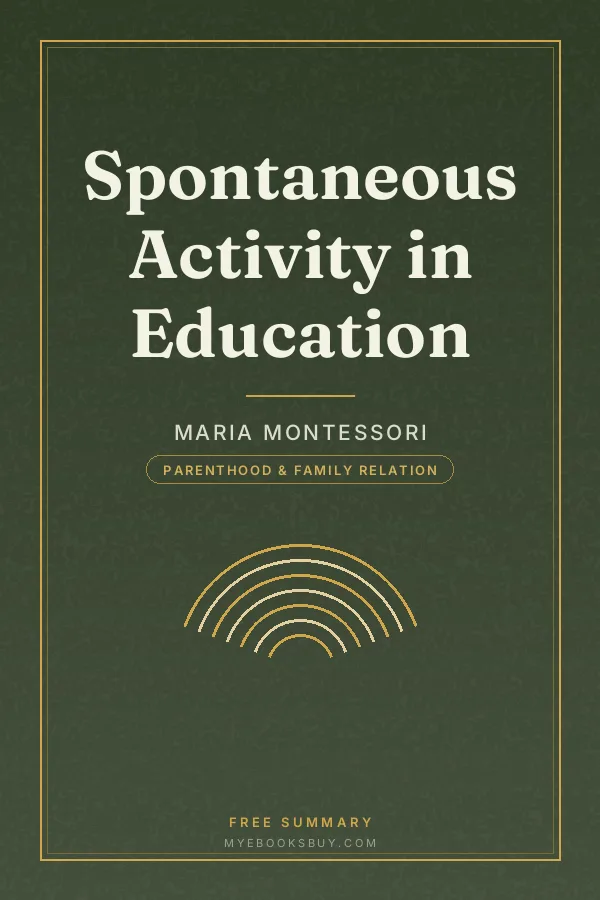
Spontaneous Activity in Education
Maria Montessori (1870–1952)
A radical call to free the human spirit by reshaping the way we educate children, this volume argues that true intellectual and moral growth begins with self-directed activity.
In Short
This foundational work of educational philosophy lays out the psychological principles behind self-directed learning for older children. Maria Montessori contrasts traditional schooling—which relies on passive obedience, rigid lesson plans, and external rewards—with an approach rooted in independent action, sensory refinement, and internal order. By examining the physical and psychical needs of the child, the text demonstrates how structured environments and specialized materials allow children to concentrate deeply, build character, and achieve genuine intellectual progress. It endures as a passionate, scientifically grounded defense of the child's right to liberty and self-formation.
The Story
The argument opens with a sweeping critique of how society treats its youngest members. While modern hygiene has liberated infants from physical swaddling clothes, education continues to shackle the child’s spirit through forced passivity and social neglect. Montessori highlights the systemic injustices faced by children, from the exploitation of wet nurses to home environments designed entirely without regard for a child’s physical scale or independent activity.
Moving into the classroom, the critique turns to modern instructional methods. Standard schools expect children to acquire virtues through imitation and compulsory silence rather than internal development. Teachers operate as dominant forces, delivering rigid "model lessons" that reduce learning to isolated facts. Experimental psychology, as practiced by contemporaries who merely measure fatigue or assign arbitrary coefficients to academic subjects, fails to address the root issue: traditional instruction actively causes exhaustion because it lacks interest and joy.
To remedy this, the text presents a new framework built upon experimental observation and the principle of liberty. Just as bacteriologists must provide an environment where microbes can live freely to observe their true characteristics, educators must grant children the freedom to act so their genuine psychological processes can emerge. When provided with self-correcting, structured materials, children display a natural capacity for intense concentration and repeated practice. This sustained effort is not mere play; it is the fundamental process through which the child constructs internal order, discipline, and strong character.
As the child matures from early childhood into the elementary stage, this interior organization becomes the foundation for higher culture. Learning transitions from simple sensory repetition to complex projects in mathematics, grammar, geometry, and the sciences. The educator’s role shifts from a dominating lecturer to an observant guide who prepares the environment, supplies materials when requested, and steps back to preserve the child's focus.
Finally, the narrative expands to address the broader spiritual, moral, and social implications of human growth. True imagination and intelligence do not spring from fantastical fables or artificial moralizing, but from an accurate, ordered perception of reality. The text warns that modern industrial civilization has accelerated the external environment without developing the inner human personality to match, leaving humanity vulnerable to spiritual decay. By protecting the child's natural drive toward self-education and honoring their innate moral and religious sensibilities, society can cultivate independent, resilient individuals capable of navigating the modern world.
How It Unfolds
The condition of the child The opening diagnosis reveals that despite advances in physical hygiene, society systematically ignores the child's civil and social rights. Homes lack scaled furniture, toys serve as useless substitutes for real action, and adult interference constantly disrupts the child's natural spiritual and physical development.
Critique of standard schooling Traditional education relies on the domination of the child's will, enforcing passive obedience through badges, marks, and rigid timetables. Model lessons reduce complex reality to fragmented, artificial exercises that induce mental exhaustion rather than genuine understanding.
Liberty as a scientific necessity Genuine scientific observation of the human mind requires freedom of action. When children are allowed to choose their own tasks from a prepared environment, they demonstrate sustained attention, deep concentration, and a natural instinct for self-education.
Building internal order Through persistent application to chosen tasks, the child constructs internal mental organization. Order in the mind operates like order in creation, transforming chaotic sensory input into clear intelligence and forming the foundation of personal character and decision-making.
The evolution of culture and spirit As children progress, their interest expands to systematic academic disciplines like mathematics and science, pursued with calm intensity. The ultimate goal of education is not mere instruction, but nurturing an autonomous, morally grounded individual equipped for a rapidly changing world.
The People
- The Child
The central figure of the text, seeking independence, meaningful work, and internal order. Hindered by adult domination, arbitrary schedules, and environments unsuited to small hands, the child ultimately reveals a deep capacity for sustained concentration and self-directed moral growth when given freedom and appropriate materials.
- The Educator
Positioned as either a traditional obstacle or a scientific guide. The conventional teacher seeks to dominate the child's will and impart facts by force, while the reformed educator bows in humility, prepares the environment, supplies materials, and steps back to protect the child's spontaneous activity.
- The Mother
Represented both as a figure bound by societal prejudice and as a potential force for moral liberation. When constrained by convention, she fails to protect her children from moral degradation; when possessing true maternal dignity, like the ancient matron Veturia, she demands that her children serve humanity with integrity.
- The Pioneer of Science
Exemplified by figures like Christopher Columbus, who demonstrates that great breakthroughs rely on simple logical clarity, deep faith, and persistent effort rather than chaotic complexity. The true scientist approaches investigation with patience, humility, and respect for natural laws.
In Its Own Voice
"The child who persists in his exercises, concentrated and absorbed, is obviously elaborating the constant man, the man of character, the man who will find in himself all human values, crowning that unique fundamental manifestation: persistence in work."
(On how self-directed activity builds human character.)
"Order is, in short, the true key to rapidity of reaction. In a chaotic mind, the recognition of a sensation is no less difficult than the elaboration of a reasoned discourse."
(On the vital role of mental organization in intelligence.)
"Freedom to live is the true basis for every method of observation applied to living creatures."
(On the fundamental prerequisite for understanding human development.)
What It's Really About
At its core, the book argues that true education is an agent of human liberation, not a mechanism for social conditioning. It contends that intelligence and character are not built by forcing knowledge into a passive mind, but by providing the conditions under which an innate drive for order and self-perfection can unfold naturally.
The text addresses the deep friction between an increasingly complex, fast-paced modern world and the static, mechanical methods used to prepare children for it. It questions the efficacy of artificial incentives like prizes and punishments, proposing instead that joy, concentration, and moral strength arise spontaneously when a human being is granted autonomy over their own work and environment.
Why Read It Today
This text offers a profound re-examination of how human beings learn, focus, and develop agency. Readers interested in pedagogy, child development, or the philosophy of mind will find a refreshing argument against the hyper-standardization and passive consumption that still characterize much of modern schooling. Montessori writes with an urgent, uncompromising clarity that combines rigorous observation with a deep respect for human potential.
The reading experience demands patience. The prose reflects early twentieth-century academic and philosophical styles, complete with detailed critiques of long-obsolete educational experiments, dense scientific analogies, and formal, sometimes lofty rhetoric. It does not offer quick instructional shortcuts or light reading; instead, it lays out a comprehensive philosophy that challenges deep-seated assumptions about authority, discipline, and freedom. What remains with the reader is a lasting impression of the child as an active, capable builder of their own mind, and a compelling case for creating environments that honor human independence.
This summary was written by AI (g4f/auto) on 2026-08-15 and is a guide to the book, not a replacement for it — it can be incomplete or wrong. The book itself is public domain. Copyright & AI disclosure · Report a problem