Free summary
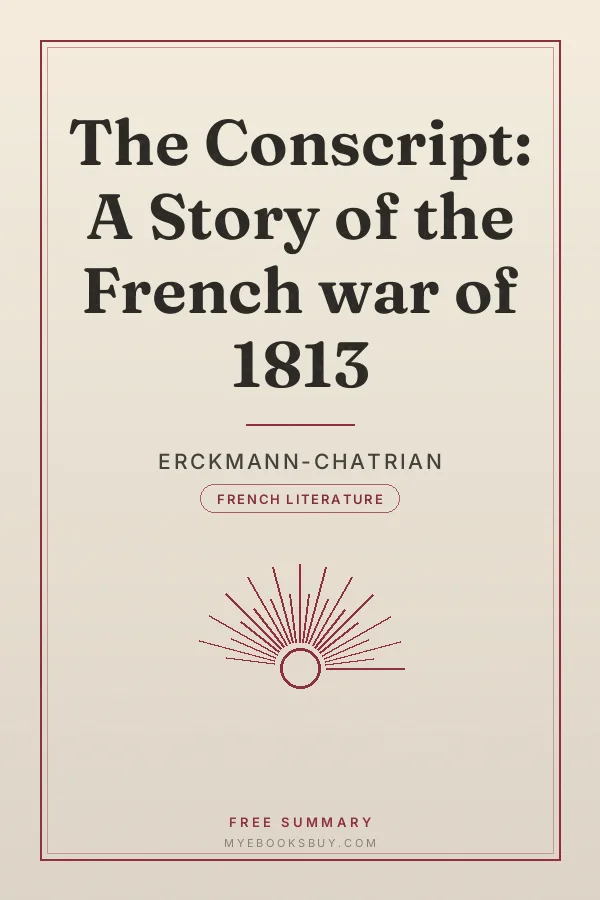
The Conscript: A Story of the French war of 1813
Erckmann-Chatrian
The shadow of the Emperor’s ambition falls across every hearth in France, turning a generation of peaceful apprentices into hollow-eyed fodder for a collapsing empire.
In Short
This novel serves as a powerful, grounded indictment of the Napoleonic Wars, told through the eyes of a young, reluctant conscript. Joseph Bertha, a humble watchmaker’s apprentice, is dragged from his peaceful life and his betrothed, Catharine, to serve in the disastrous 1813 campaign. The narrative eschews the typical glorification of military conquest, focusing instead on the grueling, pathetic reality of the common soldier. It has endured as a classic of anti-war literature for its unflinching portrayal of how the "national pursuit of glory" systematically destroys the lives of ordinary citizens.
The Story
The story begins in the years leading up to the Russian disaster, capturing the hypnotic, god-like status Napoleon held over the French people. Joseph lives a quiet, content life in Phalsbourg under the tutelage of the wise, elderly watchmaker Monsieur Goulden. He is in love with Catharine, and his greatest ambition is to marry her and work in peace. However, the crushing weight of the Emperor’s insatiate need for soldiers soon reaches his village. Despite a physical disability that should exempt him, Joseph is swept up by the conscription machinery. His fiery Aunt Gredel attempts to hide him and rail against the injustice of the drafts, but the state’s demand for bodies proves irresistible.
Joseph is marched away from his home, his early days in the ranks marked by bewilderment and the physical agony of long, freezing treks. He quickly learns the grim reality of army life: the indifference of officers, the lack of food, and the omnipresent threat of death. He witnesses the retreat of the Grande Armée, seeing the demoralized, hollow survivors of the Russian campaign as they return to the frontiers. As the new campaign begins in 1813, Joseph finds himself at the center of momentous, bloody clashes, including the battles of Lutzen and Bautzen. He is gradually desensitized by the sheer scale of the carnage, noting with horror how artillery wheels roll over heaps of dead as if they were nothing more than straw.
The narrative arc reaches its climax at the decisive, chaotic Battle of Leipzig. Joseph, now a seasoned but disillusioned soldier, experiences the terror of the fighting firsthand, suffering a severe shoulder wound during the retreat. He survives the slaughter, though he is left physically and mentally shattered, floating in a delirium of pain and hunger. The book concludes with his long, arduous return to Phalsbourg. He is discovered by Catharine and Aunt Gredel among a convoy of wounded, barely recognizable and dying of starvation. Saved by the care of those he loves, Joseph eventually recovers and marries Catharine. The story closes on a note of cautious, fragile hope: the wars have temporarily ceased, the Emperor is in exile, and the survivors are left to rebuild their lives in the shadow of a world that—despite the horrific lessons learned—appears poised to repeat its mistakes.
How It Unfolds
The peaceful apprenticeship Joseph describes his quiet existence working for Monsieur Goulden, his budding romance with Catharine, and the pervasive, almost religious fervor that surrounded Napoleon during his peak years. This calm is punctured by the arrival of the conscription orders, which shatter his domestic dreams.
The march to the front Joseph joins the ranks and endures a brutal, cold journey toward the major theatres of war. He encounters the remnants of the defeated army, witnessing the first signs that the Emperor’s power is not as invincible as the public propaganda suggests.
The reality of the campaign The unit engages in minor skirmishes that quickly escalate into full-scale conflict. Joseph struggles with the dehumanization of combat and the growing realization that his life is viewed as entirely expendable by the commanders.
The disaster at Leipzig The narrative captures the massive, overwhelming scale of the final defeat. Joseph experiences the terror of the defensive retreat through the streets of Leipzig and sustains the wound that marks the end of his military service.
The long road home Following the collapse of the army, Joseph experiences the grim, slow transit of the wounded back through the French countryside. He is eventually reunited with his family, finding survival in the simple, quiet intimacy of his home and his eventual marriage to Catharine.
The People
Joseph Bertha serves as the heart of the story; he is a man of simple needs—love, labor, and safety—who is forced to confront the monstrous nature of a political machine that cares nothing for his humanity. Monsieur Goulden acts as his moral anchor, a voice of quiet, weary reason who understands that the "glory" celebrated by the state is merely a cover for death. Aunt Gredel is the embodiment of the local resistance; she is sharp-tongued, fiercely protective, and utterly unafraid to call the Emperor a murderer to his face, though her protest is futile against the weight of the conscription. Through these figures, the reader sees the contrast between the individual, who values life, and the state, which treats that life as a commodity to be spent on the field of battle.
In Its Own Voice
"God showed his finger this winter; He saw that we feared a man more than we feared Him; that mothers--like those whose babes Herod slew--dared no longer cling to their own flesh when that man demanded them for massacre."
Aunt Gredel reflects on the divine judgment she believes caused the failure of the Russian campaign.
"Russians, French, Prussians, were there heaped pell-mell, as if God had made them to love each other before the invention of arms and uniforms, which divide them for the profit of those who rule them."
Joseph describes the aftermath of the battle at Lutzen, where the dead from opposing sides lie indistinguishable from one another.
What It's Really About
The central theme is the irreconcilable conflict between the life of the individual and the "glory" of the state. The book argues that war is not a noble pursuit but a calculated, wanton destruction of the youth and domestic happiness of common people for the vanity of rulers. It asks how a man can remain "good and honest"—as Monsieur Goulden urges Joseph to be—when he is placed in a system specifically designed to turn him into a killer. Ultimately, it is an argument against the blind acceptance of authority and a plea for the preservation of the small, local joys of life that war inevitably consumes.
Why Read It Today
Readers who appreciate a grounded, historical perspective on the Napoleonic era will find this book essential. It does not offer the sweeping, triumphant maps of a textbook; instead, it provides the visceral, uncomfortable experience of being a cog in a military machine that is grinding itself to pieces. The prose is warm and personal, making Joseph’s journey easy to follow, though the emotional weight of the suffering he describes is heavy. It is a sobering read that remains relevant in its critique of how propaganda can distort the public’s perception of conflict until the tragedy hits their own doorsteps. Some readers may find the pacing deliberate, as it spends as much time on the anxiety of waiting as it does on the chaos of the battlefield, but this only heightens the sense of being trapped in a fate one cannot control. The book is not interested in the tactical movements of generals, but in the shivering soldier in the rain, the frantic mother at the village window, and the watchmaker who knows that time is the only thing we truly own. It is a quiet, devastating, and deeply human work that lingers long after the final page.
This summary was written by AI (gemini-3.1-flash-lite) on 2026-08-26 and is a guide to the book, not a replacement for it — it can be incomplete or wrong. The book itself is public domain. Copyright & AI disclosure · Report a problem