Free summary
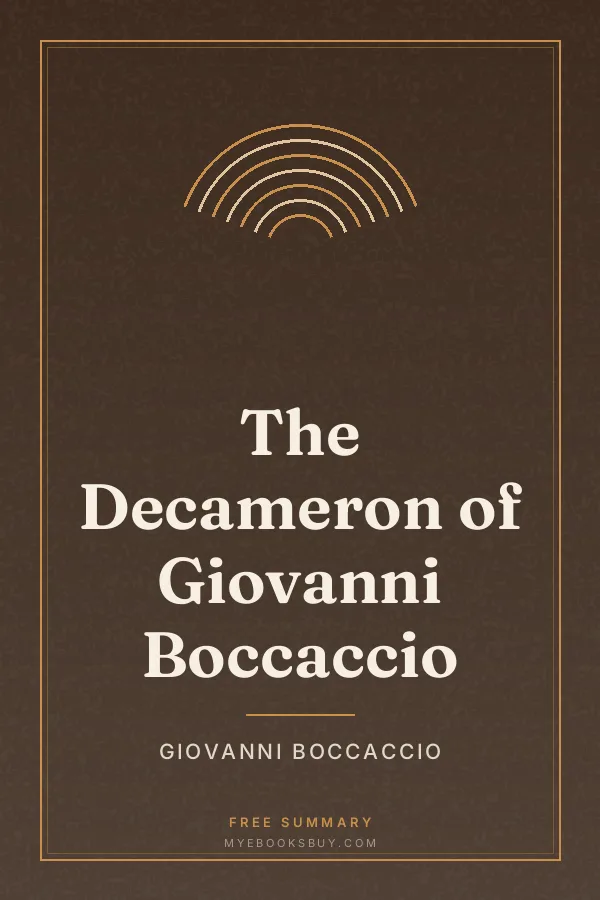
The Decameron of Giovanni Boccaccio
Giovanni Boccaccio (1313–1375)
The world is falling apart, but the stories are just beginning. Ten young people flee a plague-stricken city to reclaim their humanity through the simple, radical act of speaking their minds.
The Story
In the spring of 1348, the Black Death descends upon Florence with such ferocity that the social, legal, and moral fabric of the city dissolves. Amidst the chaos of rotting corpses and abandoned homes, seven young women meet in the church of Santa Maria Novella. They recognize that if they remain in the city, they will likely perish. They resolve to retreat to a secluded villa in the surrounding hills, inviting three young men to join them to ensure their protection and to provide a more balanced company.
Once established in their picturesque refuge, the group decides that the best way to maintain order and joy is to organize their days around structured conversation. Each day, a different member is chosen as "king" or "queen" to set the theme for the afternoon’s storytelling. This framework dictates the narrative flow: for ten days—excluding Fridays and Saturdays—each member tells one story per day, resulting in a total of one hundred tales. The retreat is not a somber vigil, but a deliberate, hedonistic, and intellectual protest against the grim reality of the world they have left behind.
The stories range across all of human experience. In the early days, the focus is often on the fallibility of the clergy and the cunning of those who manipulate social hierarchies. One tale features a notorious sinner who, through a series of tactical lies on his deathbed, is mistaken for a saint and subsequently revered by the pious. Another follows a Jewish merchant who, when interrogated by a powerful ruler about which religion is true, deflects the trap with a parable about three identical rings, suggesting that the truth is indistinguishable from the practice of faith. As the days progress, the stories drift from satire toward the complexities of romantic entanglement. The characters navigate secret assignations, mistaken identities, and the often-hilarious, often-tragic consequences of jealousy.
Some narratives are deeply compassionate, exploring the redemption of cruel rulers or the loyalty of long-separated lovers who survive shipwrecks and captivity to reunite. Others are biting and irreverent, showing how servants outwit masters and wives outmaneuver suspicious husbands. A recurring motif involves the "trickster"—someone who uses wit to solve a problem that brute force or money cannot touch. In one instance, a scholar who was cruelly humiliated by a lady exacts a cold, precise vengeance, leaving her to suffer the elements for her vanity. In another, a nun cleverly escapes a charge of impropriety by noting that the Abbess, in her rush to catch her, has mistakenly donned a priest’s trousers as a head-covering.
As the ten days draw to a close, the mood shifts from the frantic energy of survival to a quiet contemplation of what has been shared. The stories have acted as a form of communal therapy, allowing the ten companions to process the loss and disorder of their world by reimagining it as a stage for human agency. When the time comes to return to Florence, the group does so with a renewed sense of purpose. They have not ended the plague, but they have preserved the memory of what it means to be a person—to laugh, to err, to forgive, and to listen. The final tales acknowledge the imperfections of the narrator himself, who admits that his tongue may be sharp, but insists that the act of telling these stories has been his own way of honoring the life that persists even when the world seems to have ended.
The People
- The Ten Companions: These seven women and three men are the architecture of the book. They want to preserve their sanity and dignity in the face of indiscriminate death. They are not merely observers; they are arbiters of taste who reward wit and punish crudity. By the end, they transform from fearful refugees into a sophisticated, self-governing community.
- The Deceivers and Tricksters: Characters like Master Ciappelletto or the unnamed nun represent the spirit of survival. They want to escape the consequences of their actions—often sins of the flesh or greed. They stand in the way of conventional morality, but they are driven by a sharp, agile intelligence that forces the reader to admire their ingenuity, even when their motives are entirely self-serving.
- The Jealous Husbands and Guardians: Figures like the husband who disguises himself as a priest to trap his wife are the antagonists of the domestic tales. They want absolute control over the people they consider their property. Their failure is almost always inevitable, serving as a reminder that human desire cannot be successfully "mewed up" or legislated by force.
- The Noble-Hearted Figures: Occasionally, characters like the King of Cyprus or the various separated lovers appear. They want to live in accordance with their virtues. They stand in the way of the general cynicism of the narrative, acting as anchors of hope that demonstrate how honor, once lost, can be reclaimed through a single act of valiance or grace.
In Its Own Voice
The narrator reflects on the necessary art of interpretation, warning that those who seek only deep, hidden meanings may miss the simple, human truth of a story:
"I do not pretend to see farther through a stone wall than my neighbours."
In one of the most satirical segments of the work, the narrator addresses his critics, acknowledging that his descriptions of religious figures have invited both praise and scorn:
"The friars are a good sort of folk, who eschew unease for the love of God and who grind with a full head of water and tell no tales, and but that they all savour somewhat of the buck-goat, their commerce would be far more agreeable."
The narrator concludes his work by addressing the readers directly, hoping the stories have served some purpose beyond mere entertainment:
"Abide you in peace with His favour, remembering you of me, if perchance it profit any of you aught to have read these stories."
What It's Really About
At its core, this book is an inquiry into the relationship between human nature and the uncontrollable forces of the world. By framing the stories within the context of a catastrophic plague, the work argues that when the structures of society—law, religion, and hierarchy—collapse, the only things that remain are the individual's wit and their capacity for connection. The stories are not just escapism; they are a manifesto for the power of the human voice to create order out of chaos.
The text is obsessed with the concept of ingegno—natural intelligence or mother-wit. It suggests that while fortune is arbitrary and death is inevitable, a person’s ability to navigate their circumstances depends entirely on their capacity for improvisation. This is why the characters who succeed are rarely the most pious or the most powerful, but rather the most adaptable. The book posits that morality is not a fixed set of rules, but a fluid performance; a person is defined not by their abstract principles, but by how they handle a moment of crisis.
Furthermore, the work is a profound critique of hypocrisy. It spends significant time deconstructing the gap between the public performance of virtue and the private reality of desire. By placing monks, nuns, and merchants in the same compromising positions as common laborers, the text flattens the social hierarchy. It argues that physical desire and the need for self-preservation are universal, transcending class and calling. The "argument" of the book is that humanity is essentially equal in its appetites and its follies.
Finally, the book asks a difficult question about the role of the artist in dark times. By creating a beautiful, intricate, and often hilarious world while the real world is being destroyed, the narrator confronts the tension between art and reality. Does storytelling provide a necessary refuge, or is it a cowardly retreat? The text doesn't provide a definitive answer, but the act of finishing the project suggests that the preservation of human culture—the recording of our jokes, our shames, and our loves—is a vital, even heroic, defense against the silence of extinction. It is a celebration of the messy, contradictory, and irrepressible nature of being alive.
Why Read It Today
Reading this work feels like stepping into a crowded, boisterous market square that happens to be built on the edge of a graveyard. It is not a difficult read in terms of complexity, but it can be startling in its frankness. Because the stories were written in the 14th century, the reader must be prepared for a world where religious figures are often the punchline of a joke and where the agency of women is frequently expressed through the subversion of patriarchal authority.
You will love this book if you are interested in the origins of the modern short story. It possesses a cinematic quality; each tale is self-contained, sharp, and paced with a modern sense of timing. There is an incredible pleasure in watching the narrator weave these hundred threads into a single, cohesive tapestry. The prose is warm, conversational, and surprisingly modern in its psychological acuity. It does not look down on its characters; it laughs with them, even when they are at their most ridiculous.
However, the book is substantial. If you are looking for a singular, driving plot, you may find the episodic nature of the storytelling challenging. There are no "main characters" in the traditional sense, only the shifting perspectives of the ten friends. Furthermore, the period attitudes—specifically regarding the treatment of servants, the role of women, and the casual brutality of the era—are unfiltered. The text does not provide a modern lens through which to view these behaviors; it presents them as the reality of its time.
What stays with you is the sheer vitality of the language. Despite the looming shadow of the plague, the book feels alive. It reminds you that even when the world seems to be narrowing, the human imagination can still expand. It is a testament to the resilience of the human spirit, not in the sense of grand, heroic endurance, but in the small, quiet, and often very funny ways we continue to find joy, connection, and truth, no matter the circumstances. If you value books that treat their readers as intelligent, adult companions, this is one to keep on your shelf.
This summary was written by AI (gemini-3.1-flash-lite) on 2026-08-12 and is a guide to the book, not a replacement for it — it can be incomplete or wrong. The book itself is public domain. Copyright & AI disclosure · Report a problem