Free summary
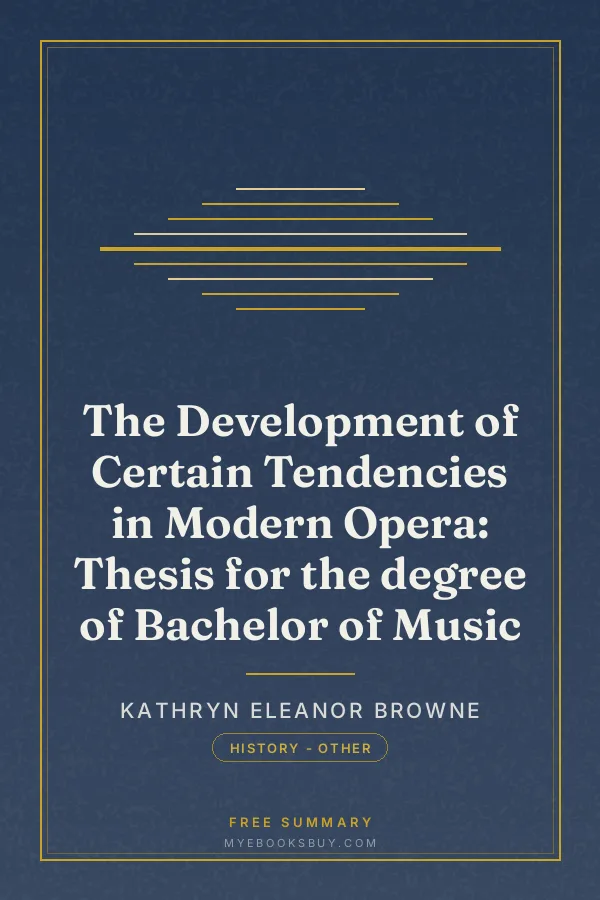
The Development of Certain Tendencies in Modern Opera: Thesis for the degree of Bachelor of Music
Kathryn Eleanor Browne (b. 1895)
Opera, once a spectacle of vocal artifice, evolved into a complex dramatic medium where orchestra and stagecraft hold equal weight with the voice. This study examines that transformation by tracing the shifting balance of musical forms across centuries of repertoire.
In Short
This thesis provides a systematic examination of the structural evolution of opera from the late Renaissance to the early twentieth century. By analyzing thirty-four selected works, the author quantifies the shifting proportions of solo arias, recitative, ensemble singing, and orchestral presence. The work serves as both a historical narrative of operatic reform—highlighting the pivotal roles of Gluck and Wagner—and a statistical survey of the medium’s maturation. It remains a fascinating artifact of early musicology, capturing a scholarly moment that sought to reconcile dramatic truth with formal musical composition.
The Story
The history of opera begins with modest, experimental efforts, such as the early pastoral dramas and madrigal plays of the late sixteenth century. These initial iterations, characterized by spoken dialogue interspersed with song, lacked a unified aesthetic. The music was often incidental, and the reliance on complex, disconnected counterpoint meant that the emotional resonance of the text was frequently lost. The narrative of the art form’s maturation begins in earnest with the reforms of Gluck, who attempted to strip away the "concert in costume" approach—where performers prioritized vocal flourishes over dramatic coherence. Gluck insisted that the music serve the drama, introducing a more integrated role for the orchestra and demanding that singers abandon empty ornamentation in favor of emotional authenticity.
Following this shift, the narrative traces the dominance of the Italian school, particularly the work of Rossini. While Rossini brought a new level of instrumental sophistication and technical brilliance to the opera, the focus remained heavily on the beauty of the vocal line. The author argues that this period saw a temporary retreat from dramatic rigor, as the audience’s appetite for melody often superseded the need for theatrical realism. Figures like Bellini and Donizetti continued this tradition of "pure melody," though they began to experiment with more nuanced orchestral textures.
The true seismic shift in the story occurs with the emergence of Wagner. His influence is presented as a return to the foundational principles of dramatic integrity first envisioned by the early Bardi coterie. By discarding the rigid structure of the separate aria and finale in favor of the leitmotiv and continuous, declamatory "speech-song," Wagner fundamentally redefined the relationship between the stage and the pit. His vision of the Gesamtkunstwerk—a synthesis of all artistic elements—demanded that every note of music serve an ethical or dramatic purpose.
The final arc of the study explores the post-Wagnerian landscape, where composers across Europe and America grappled with this legacy. The author surveys a diverse field: from the Russian school’s focus on the chorus as a protagonist to the French Impressionistic nuances of Dukas and the gritty realism found in Charpentier’s Louise. The narrative concludes with a look at contemporary American composers, such as Victor Herbert and Walter Damrosch, noting that while they adopted elements of the modern music drama, they remained caught between the pull of Wagnerian theory and the lingering desire for lyrical, melodic clarity. The story of opera, as told here, is one of a perennial struggle to balance the visceral power of the human voice with the intellectual and emotional architecture of the orchestra.
How It Unfolds
The pre-operatic roots The study opens by defining the early "operatic symptoms" in the thirteenth and sixteenth centuries, such as madrigal plays and pastoral dramas. These rudimentary works established the initial, disjointed relationship between music and text.
The call for reform The work examines the transition from the "concert in costume" to the structural reforms of Gluck. This beat details the struggle to replace posturing singers with genuine dramatic acting.
The dominance of melody The focus shifts to the Italian masters, specifically Rossini, Bellini, and Donizetti. The argument explores how their focus on vocal purity and melodic flow sometimes obscured dramatic development.
The Wagnerian revolution This section outlines the radical departure from set forms, explaining the use of the leitmotiv and the elevation of the orchestra to a primary narrator. The text details how Wagner’s theories forced a permanent change in the expectations for both the libretto and the score.
The modern synthesis The final beat surveys the twentieth-century reaction to Wagner, covering composers from Rimski-Korsakov to Puccini. It concludes by looking at the state of American composition, suggesting a future where dramatic truth remains the ultimate goal.
The People
The narrative is driven by the composers themselves, who act as the primary intellectual protagonists in this history of artistic development. Gluck stands as the first great reformer, a man of "dramatic genius" who fought against the artificiality of the seventeenth and eighteenth-century stage. Rossini serves as the master of the melodic tradition, a figure who expelled the male soprani and modernized orchestral accompaniment, yet whose work still adhered to a formalistic approach that the author finds dramatically lacking. Wagner is portrayed as the ultimate disruptor, the "revolutionary" who dismantled the set-piece structure to build a continuous music drama. His influence is the gravitational center around which all subsequent composers orbit. Verdi is treated with nuance, credited for his "keen dramatic vision" and ability to balance voice and orchestra, despite his adherence to older, more detached structural methods. Finally, the various Russian and French composers, such as Rimski-Korsakov and Charpentier, appear as the inheritors of these conflicting traditions, each attempting to forge a path that honors local color and folk tradition while navigating the shadow of the German music-drama legacy.
In Its Own Voice
The rules became strict, and it is not difficult to see how the operas became a concert in costume.
This line illustrates the rigid and artificial constraints imposed upon early opera, where performers took precedence over the dramatic narrative.
Gluck and Wagner brought back undying principles of dramatic worth.
This summary of the two most significant reformers encapsulates the author’s primary thesis: that modern opera’s success relies on the subordination of music to the requirements of dramatic truth.
In the modern music drama the orchestra expresses all that cannot be expressed by the dramatic action and the singers.
This statement highlights the evolution of the orchestra from mere accompaniment to a primary vehicle for psychological and narrative development.
What It's Really About
The central argument concerns the tension between "set" musical forms—the aria, the duet, the chorus—and the requirement for dramatic consistency. The author posits that as opera matured, the art form moved away from vocal self-indulgence toward a unified, psychological storytelling medium. Underlying the technical analysis is a philosophical question: can music ever be truly truthful to the drama, or is it always, to some extent, an artifice? The study suggests that while composers like Gluck and Wagner provided the tools for this unity, the "modern" era of the early twentieth century is defined by the ongoing struggle to harmonize the beauty of the human voice with the weight of descriptive, symphonic orchestration.
Why Read It Today
Readers with a background in musicology or an interest in the history of the performing arts will find this an essential, if rigorous, survey. It captures the transition from the highly structured, vocal-centric operas of the eighteenth century to the expansive, psychologically dense works of the early twentieth. Because the author writes from the perspective of 1917, the reader gains a unique window into how that era perceived the recent history of the stage; the inclusion of American figures like Horatio Parker and Walter Damrosch offers a fascinating, often-overlooked perspective on how the Wagnerian movement was received and adapted in the United States.
However, a contemporary reader should be prepared for the dense, technical nature of the work. The text relies heavily on the provided tables and statistical analysis of measure-counts, which, while providing a concrete "truth" to the author’s argument, can feel clinical to those seeking a purely biographical or literary history. The prose reflects the academic standards of its time, sometimes favoring rigid categorization over fluid narrative. Nevertheless, for those who wish to understand the structural "bones" of the opera as it stood at the start of the modern age, this thesis remains a precise and deeply researched guide.
This summary was written by AI (gemini-3.1-flash-lite) on 2026-09-15 and is a guide to the book, not a replacement for it — it can be incomplete or wrong. The book itself is public domain. Copyright & AI disclosure · Report a problem