Free summary
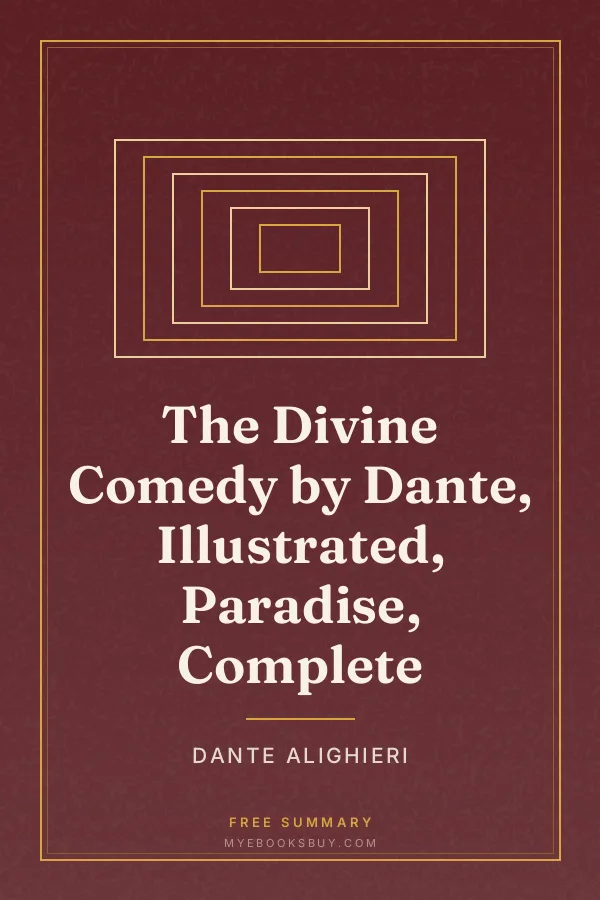
The Divine Comedy by Dante, Illustrated, Paradise, Complete
Dante Alighieri (1265–1321)
A traveler ascends through the spheres of heaven, guided by the woman he loves, leaving behind the corrupted earth to seek the ultimate source of light and truth.
In Short
A mortal man journeys through the celestial spheres, guided by a blessed soul who leads him upward toward the eternal light. Along the way, he encounters the spirits of the saved, from devout nuns to ancient warriors and righteous rulers, who answer his theological questions and lament the greed and corruption tearing apart the mortal world below. The journey culminates in a blinding, transformative vision of the divine order, cementing the poem as a foundational exploration of love, justice, and the soul’s ultimate destination.
The Story
The voyage begins as the narrator, having reached the highest point of human understanding, prepares to ascend into the sacred realm. He fixes his eyes upon his gentle guide, Beatrice, who gazes directly into the sun. Through her radiating influence, he transcends his mortal limitations and lifts into the heavenly spheres, leaving behind the vain, inconclusive anxieties of human life—from the pursuit of wealth to the empty squabbles of earthly law and medicine.
As they rise, the narrator meets souls dwelling in different celestial spheres. He first encounters those whose holy vows were broken or neglected, appearing as faint, translucent reflections in clear glass. Beatrice explains the nature of their spiritual placement, the supreme gift of human free will, and why divine justice places them there. The pair continues upward, where the narrator converses with radiant, singing spirits who recount the histories of great saints and fiercely condemn the moral decay of earth. A revered ancient ancestor appears as a living jewel of light, warmly greeting his descendant. This forebear reminisces about a simpler, more chaste era of their home city, Florence, before delivering a grim prophecy: the narrator will soon be exiled, forced into a life of bitter wandering, leaving behind everything he holds most dear.
Despite the sorrow of this impending doom, the traveler presses on, witnessing breathtaking, living formations of souls. He sees spirits arrayed as a massive eagle that sings of divine justice, severely rebuking the corrupt kings, greedy priests, and feuding leaders of the mortal world. He meets the founders of cloistered monastic orders and is later temporarily blinded by the overwhelming brilliance of a spirit who once lay upon the breast of Christ. Throughout these encounters, Beatrice repeatedly answers his deep theological doubts, explaining the mystery of the crucifixion, the nature of human redemption, and the flawless justice of the celestial court.
The journey reaches its climax as the pair ascends beyond the physical spheres into the pure, motionless center of existence. Here, Beatrice leaves his side to take her rightful, radiant throne among the blessed. In her place, a gentle elder named Bernard appears to guide the traveler through the final steps. Bernard directs the narrator’s gaze to the queen of heaven and then toward the eternal light itself. Empowered by divine grace, the traveler looks into the terrifying, bottomless depth of this supreme radiance. Within a single, blinding flash of understanding, he perceives all the scattered elements of the universe bound together by love. He sees three rings of distinct colors occupying a single space, and finally catches a glimpse of the human image painted within the divine circle, ending his journey in a state of absolute, suspended awe.
How It Unfolds
The voyage begins The narrator calls upon divine inspiration to help him recount the unfathomable depths of his journey. Following Beatrice's unwavering gaze into the sun, he entirely transcends his human bounds and lifts upward into the celestial spheres, leaving behind the empty pursuits of mortal men.
The souls of the broken vows In the lowest sphere, he speaks with pale, translucent spirits whose earthly religious vows were interrupted or neglected. Beatrice uses their faint presence to instruct him on the absolute sanctity of human free will, warning mortals against the danger of making reckless, unkeepable pledges.
The ancestral prophecy Deep within the heavens, the traveler meets his great-grandsire, Cacciaguida, who addresses him from within a brilliant, living jewel of light. The ancestor sharply contrasts the virtuous, sober past of their home city with its current vanity and corruption, warning the narrator that he will soon face a painful, bitter exile.
The eagle of justice A magnificent host of spirits joins together to form the shape of an eagle, singing with one unified voice about the unyielding righteousness of divine judgment. They deliver a sweeping, continent-wide condemnation of Europe’s current monarchs, exposing their endless greed, warmongering, and the minting of counterfeit currencies.
The blindness and the light Approaching the highest realms, the traveler's eyes are utterly dazzled and temporarily blinded by the sheer intensity of the radiant souls who once followed Christ on earth. Beatrice eventually restores his failing sight with a divine smile, preparing him to behold the ultimate, motionless center of all existence.
The final vision Beatrice peacefully departs to her heavenly throne, leaving the revered elder Bernard to direct the narrator’s final, upward gaze. Staring directly into the blinding eternal light, the traveler sees all the scattered properties of the universe bound securely together by love, forever changing his soul.
The People
The narrator seeks ultimate truth and a deeper understanding of the divine order, but his mortal limitations, fear, and intellectual doubts constantly hinder his progress. Through the journey, his vision is stretched and repeatedly shattered by the blinding light of heaven, transforming him from a confused wanderer into a soul capable of comprehending the universe's greatest mysteries.
Beatrice desires to elevate her beloved from his earthly ignorance to a state of absolute spiritual clarity. She is forced to navigate his persistent human frailties, carefully metering out her brilliant smiles so as not to instantly incinerate his unready senses. By the end, having successfully guided him to the threshold of the highest heaven, she silently returns to her eternal throne, her mission fulfilled.
Cacciaguida, an ancient ancestor, longs to prepare his descendant for the harsh realities of mortal life. He must pierce through the narrator's earthly idealism by delivering the painful truth of a looming exile. In doing so, he steels the narrator to become a fearless speaker of truth.
Bernard steps in at the very end to finish what Beatrice started, wishing to focus the traveler’s gaze upon the supreme light. He successfully strips away the narrator's lingering earthly distractions, directing his eyes straight into the face of eternity.
In Its Own Voice
As she explains the intricate theological complexities of human free will and broken vows, Beatrice reminds the traveler that merely hearing divine wisdom is entirely useless unless he actively absorbs it.
“Open thy mind to what I now unfold, And give it inward keeping. Knowledge comes Of learning well retain’d, unfruitful else.”
A celestial eagle made of radiant souls sharply rebukes the flawed, earthly nature of mankind while praising the unwavering, eternal perfection of divine justice.
“O animals of clay! O spirits gross I The primal will, that in itself is good, Hath from itself, the chief Good, ne’er been mov’d.”
Staring into the ultimate light of the universe, the narrator finally realizes that everything humanity desperately searches for is contained within that single, magnificent point.
“For all the good, that will may covet, there Is summ’d; and all, elsewhere defective found, Complete.”
What It's Really About
Beneath the wondrous descriptions of singing spheres and radiant angels, the text is a profound meditation on the mechanics of divine justice and the supremacy of human free will. It constantly asks how a perfect God balances mercy with vengeance, exploring why good souls suffer while corrupt kings and greedy preachers thrive on earth. The poem argues that human misery is born from choosing lesser, temporal goods—like wealth or political power—over eternal truth. It insists that true freedom is only found in aligning one's personal will with the divine order. Ultimately, it is an exploration of love not merely as a mortal emotion, but as the fundamental physical and spiritual force that binds the universe together, moving the stars and illuminating the human mind.
Why Read It Today
Readers who appreciate sweeping philosophical arguments and intensely visual, cosmic poetry will find themselves captivated by this ascent through the stars. It feels less like reading a traditional narrative and more like navigating a dense, towering cathedral made entirely of light and theology. The poem’s intricate interrogations of faith, justice, and the cosmos offer a deeply rewarding intellectual challenge.
However, modern readers must approach it with patience. The text is thickly layered with medieval theology and lengthy astronomical metaphors that can slow the pacing to a crawl. The excerpts reveal frequent, dense detours into the political grievances of the author's specific era, with numerous call-outs to obscure kings, popes, and local Florentine families that require careful reading to unpack. Furthermore, the archaic translation style—filled with words like "nathless," "erst," and "wherewith"—demands a slow, deliberate reading pace.
Yet, for those willing to endure its steep learning curve and historical baggage, the reward is extraordinary. What remains with you is the poem's sheer, audacious scale. The breathtaking final images of a universe bound entirely by love, and the profound articulation of a soul finally finding absolute peace, continue to resonate with an unmatched, timeless majesty.
This summary was written by AI (g4f/auto) on 2026-08-14 and is a guide to the book, not a replacement for it — it can be incomplete or wrong. The book itself is public domain. Copyright & AI disclosure · Report a problem