Free summary
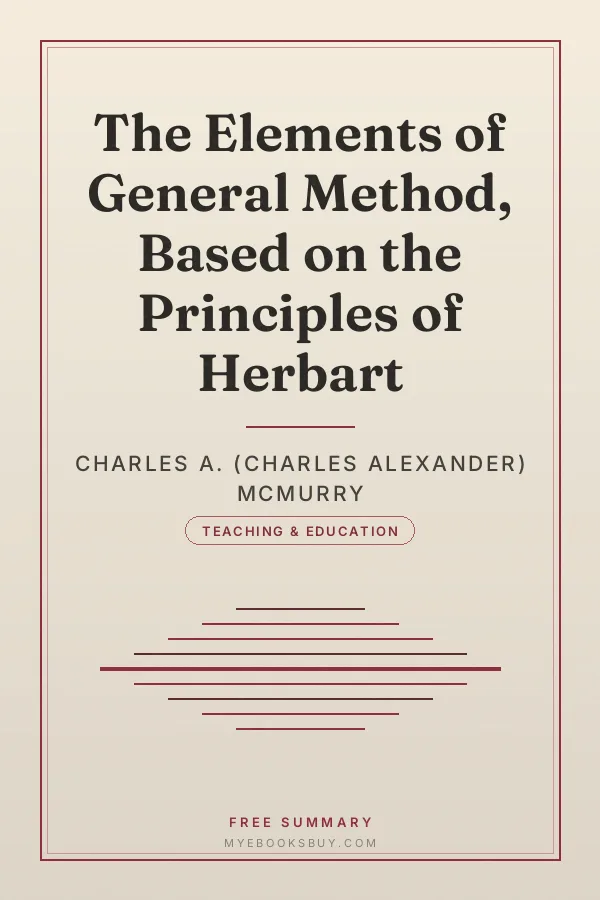
The Elements of General Method, Based on the Principles of Herbart
Charles A. (Charles Alexander) McMurry (1857–1929)
An overarching moral purpose must anchor all teaching, organizing diverse subjects into a unified force that shapes a child's character and strengthens the active will.
In Short
This foundational treatise on educational theory introduces American educators to the pedagogical principles of Johann Friedrich Herbart and his followers. Addressing the chaos of an expanding public school curriculum, the text argues that education must center on moral character building rather than mere rote instruction. It outlines how a core of history and literature, combined with natural science, creates genuine intrinsic interest in pupils. By unifying subjects through concentration and applying the mental mechanics of induction and apperception, the work presents a systematic blueprint for turning scattered classroom lessons into a cohesive, life-long culture of character and disciplined will.
The Story
The text opens with an urgent inquiry into the central purpose of education, warning that modern common schools have become an unorganized batch of miscellanies. Because traditional classical dominance has faded, schools now admit a wide variety of new subjects—from drawing and natural science to history—without a unifying principle. To prevent superficial instruction and intellectual overload, the exposition establishes that the primary aim of education must be moral development and character formation.
To achieve this moral purpose, the argument weighs the relative value of school subjects. It positions history and literature as the ultimate source of moral impulses and inspiring human examples, while natural science provides the essential practical insight into the physical world. Rather than relying on superficial incentives or competitive prizes, effective instruction must cultivate a direct, permanent interest in these core subjects for their own sake.
The narrative of the book then shifts to how a school curriculum ought to be structured to reflect this vision. It advocates for the principle of concentration, wherein a central core of historical and literary studies—organized around cultural epochs that mirror a child's natural stages of growth—serves as the anchor for all other subjects, including geography, language, and arithmetic.
From curriculum design, the argument transitions into the psychological mechanisms of learning. It details how the mind naturally acquires knowledge through induction, moving from concrete individual observations to abstract general concepts. It stresses that learning requires active mental digestion and assimilation rather than passive reception. This process relies entirely on apperception—the continuous practice of using a child's existing stock of experiences and ideas to interpret, assimilate, and give vivid meaning to new information.
Finally, the text connects these instructional methods directly to the cultivation of the will and the formation of conduct. True strength of character arises when a child's self-activity is carefully guided and exercised toward high moral choices. The progression concludes by surveying the contributions of Herbart and his European disciples, offering their systematic principles as a practical, harmonious working plan for American teachers seeking to reform their classrooms.
How It Unfolds
A search for central purpose The text exposes the fragmented nature of the modern common school curriculum and asserts that moral character development must serve as the primary organizing aim of all instruction.
Evaluating the relative worth of studies The argument balances the moral inspiration drawn from history and literature against the practical environmental insight supplied by natural science, establishing them as the two necessary pillars of popular education.
Cultivating direct and permanent interest It contrasts harmful indirect motivators, such as prizes and competitive ambition, with direct, intrinsic interest that fosters an enduring desire for knowledge and moral growth.
Unifying the curriculum through concentration The exposition presents a method for binding disparate school subjects together around a central historical and literary core that matches the child's evolving developmental stages.
Building concepts through inductive learning It traces how the mind moves naturally from concrete observations of specific specimens to the creation of general abstract concepts and lasting mental associations.
Apperception as the key to understanding The text explains how new ideas are interpreted and assimilated through the lens of a child's previous experiences, requiring teachers to build systematically on past knowledge.
Training the will toward moral choice It illustrates how habits of thought and active self-directed exercises shape the child's volition, establishing a firm, noble character capable of choosing the good.
The People
The Child The developing learner at the center of the educational endeavor. The child naturally possesses curiosity, physical activity, and expanding ambitions, but lacks organized experience; through proper instruction, the child's mental stock is unified, converting raw interest into a disciplined will and strong moral character.
The Teacher The guiding mentor responsible for organizing the child's intellectual and moral environment. Standing as a sympathetic observer of the child's changing mental states, the teacher selects noble historical examples, directs self-activity, and uses deliberate methods to connect new lessons to the child's existing experiences.
Johann Friedrich Herbart and His Disciples The German educational philosopher and his followers, including Ziller and Rein, whose psychological and pedagogical theories form the framework of the text. They seek to replace haphazard teaching with a coherent system that harmonizes moral purpose, curriculum design, and the natural laws of human thought.
John Locke The historical philosopher noted in the text for his opposition to public schools due to the corrupting influences of peer groups. His views highlight the teacher's heavy responsibility to counteract negative external social environments when private tutoring is impossible.
In Its Own Voice
"Our common school course has become a batch of miscellanies."
This observation frames the central challenge of the book: the chaotic, unorganized state of an expanding public school curriculum that desperately needs a unifying moral purpose.
"To awaken a child's permanent interest in any branch of knowledge is to accomplish much for his character and usefulness."
This statement highlights the book's conviction that genuine, lifelong interest in learning is fundamental to building a child's moral and practical life.
"Apperception is the practical key to the most important problems of education, because it compels us to keep a sympathetic eye upon the child in his moods, mental states, and changing phases of growth..."
This passage emphasizes the necessity of understanding a child's existing personal experiences before attempting to teach new concept or ideas.
What It's Really About
The work addresses the fundamental question of how public education can build unified moral character in an increasingly complex world. It argues against viewing schools as mere sites for memorizing facts or training intellectual machines. Instead, it contends that all learning is interconnected and that true moral action stems from properly guided thoughts and feelings. By analyzing how the mind digests knowledge, the text explores the deep relationship between raw instruction, personal experience, and human volition. It ultimately asserts that an organized curriculum, grounded in rich history and natural science, provides the necessary foundation for a free, self-directed individual to make righteous choices.
Why Read It Today
This text offers a clear window into the late nineteenth-century movement to transform American public education through systematic psychology. Readers interested in the history of pedagogy, curriculum design, or classic educational philosophy will appreciate its structured, deliberate approach to teaching. Its tone is earnest, reflective, and deeply committed to the moral potential of youth.
While modern readers may find its strict alignment with nineteenth-century Herbartian doctrine and historical culture-epoch theories somewhat antiquated, the core challenges it raises remain strikingly relevant. The prose demands focused attention as it navigates abstract pedagogical theories, historical curriculum structures, and Victorian educational terminology. Yet, beneath its formal academic style lies a deeply practical concern for the daily work of the classroom. The book's insistence on treating children as active thinkers, its critique of superficial standardized learning, and its warning against using artificial prizes to motivate students will resonate with anyone still asking what it truly means to educate a human being.
This summary was written by AI (g4f/auto) on 2026-08-24 and is a guide to the book, not a replacement for it — it can be incomplete or wrong. The book itself is public domain. Copyright & AI disclosure · Report a problem