Free summary
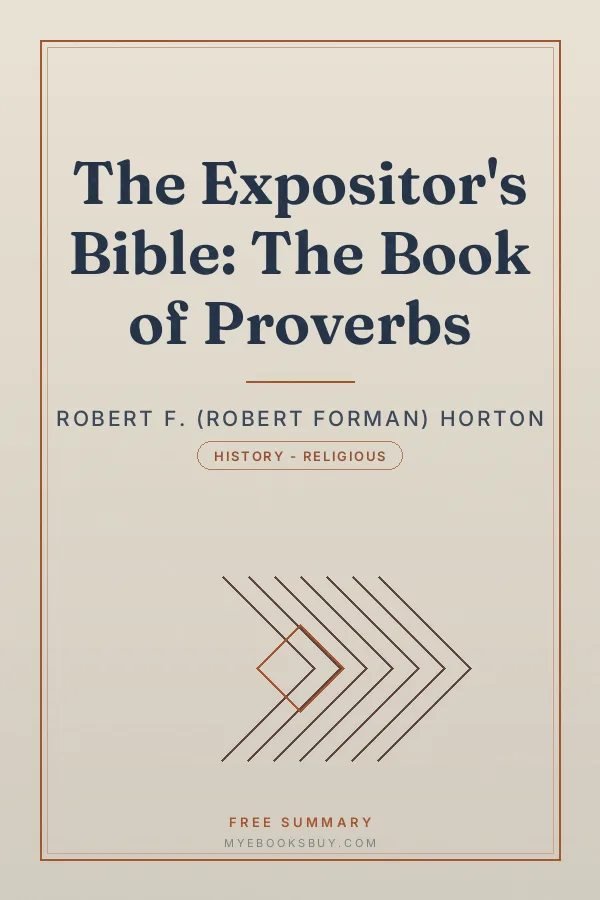
The Expositor's Bible: The Book of Proverbs
Robert F. (Robert Forman) Horton (1855–1934)
A guide to moral choices, practical living, and spiritual insight waiting in ancient verses.
In Short
This work examines the biblical Book of Proverbs, breaking down its ancient maxims into practical moral and spiritual guidance for everyday life. Traversing themes from youthful temptation and family dynamics to economic equity, self-control, and the governance of speech, the exposition frames wisdom not as abstract philosophy, but as an active, daily choice between righteousness and ruin. It bridges the distance between ancient Hebraic instruction and modern Christian life, arguing that true understanding requires personal accountability, divine direction, and active compassion. Ultimately, the work endures as a thoughtful, thorough commentary on how spiritual convictions shape concrete human conduct across every generation.
The Story
The intellectual journey begins by establishing Wisdom as an active, vocal guide in the public square. She calls out to the young and impressionable, urging them to choose her disciplined paths over the immediate allurements of destructive living. The early chapters frame human life as a field of fundamental moral choices, where youth face two predominant dangers: the lawless lure of violent bandits offering easy loot, and the seductions of loose, unrestrained living. The commentary highlights that true wisdom requires giving up worldly self-seeking; only by surrendering selfish desires to a higher divine order do temporal blessings, inner peace, and genuine spiritual security return to the individual.
Moving forward, the narrative addresses the vital foundation of moral instruction within the family. It outlines how early parental training instills deep-seated character traits that dictate a person's future trajectory. The text explores the progressive nature of sin, describing how subtle moral compromises gradually erode the soul's health. While physical vices may leave obvious marks, spiritual corruption works quietly within, rendering a person unsuited for a holy existence. The discussion emphasizes that personal responsibility cannot be delegated; each individual must stand alone in choosing the path of life or the incline toward death.
As the central exposition unfolds, the focus broadens from individual development to social and communal duty. The commentary categorizes human behavior through key practical themes: the righteous stewardship of wealth, the mastery of a hot temper, the solemn obligation to aid the poor, and the careful governance of the tongue. Slander, deceitful speech, and idle gossip are identified as destructive forces that dismantle communities, whereas disciplined, truthful words bring healing. The text contrasts the fleeting, selfish nature of ancient pagan friendship with the selfless ideal of Christian love, which seeks to elevate the weak rather than merely commune with social equals.
In its concluding movement, the argument addresses the broader structures of society, governance, and divine revelation. It critiques political tyranny and unchecked greed, identifying Jesus Christ as the ultimate fulfillment of the perfectly just and merciful ruler foreshadowed in the Old Testament maxims. Human reason and scientific inquiry are acknowledged as valuable yet inherently limited; they demonstrate humanity's profound need for a divine revelation that they cannot themselves supply. The commentary culminates in a study of ideal womanhood—depicting a life of diligent labor, active charity, and enduring strength—and leaves the reader with a clear final vision: true wisdom is an unreserved, active devotion to God that transforms individual character, ennobles the home, and uplifts the wider human community.
How It Unfolds
The call of wisdom Wisdom lifts her voice in the crowded public places, pleading with the young to abandon dangerous paths. She offers safety from lawless men who live by violence and from the subtle allure of sensual ruin.
The architecture of character Parental guidance builds the early foundation of a person's moral life. Unchecked sin acts as a hidden disease, quietly destroying spiritual health long before its devastating consequences become visible to the outside world.
The discipline of daily life Life requires constant mastery over anger, speech, and material wealth. Words carry the power to heal or destroy, while true riches are measured by goodness, generosity toward the poor, and honest dealings rather than accumulated property.
The limits of human knowledge Human reasoning and physical sciences clarify worldly mechanics but cannot satisfy the deepest spiritual needs of the human soul. True understanding requires divine revelation, which unfolds progressively through Scripture and finds its ultimate clarity in Christ.
The nobility of active goodness The journey concludes with an image of practical, god-fearing virtue embodied in compassionate action. Genuine strength displays itself through diligent work, hands extended to help the needy, and a quiet, enduring devotion to God.
The People
Wisdom Wisdom acts as the primary guiding voice throughout the text. She stands in busy public spaces, earnestly inviting the young and simple to follow her ways of peace, integrity, and life. She opposes lawlessness, foolishness, and moral deceit, seeking to deliver human beings from self-destruction and guide them into a right relationship with God.
The Fool The Fool represents the individual who rejects moral instruction and relies entirely on self-interest and impulse. Driven by pride, unchecked passion, or short-sighted greed, the Fool falls into lawlessness, excessive indulgence, or malicious speech. Unwilling to exercise self-control, the Fool ultimately reaps shame, personal ruin, and spiritual isolation.
The Righteous Person The Righteous Person strives to align daily conduct, speech, and financial affairs with divine commands. Seeking peace, humility, and honest labor, this individual acts as a stabilizing influence in the community. The Righteous Person demonstrates compassion toward the poor and finds lasting security in a quiet, trustful devotion to God.
The Virtuous Woman The Virtuous Woman embodies practical wisdom, untiring diligence, and active charity. She manages her household with skill, engages in productive labor, and reaches out to comfort and support the needy. Her character shows that true beauty rests not in fleeting physical charm, but in a reverent fear of the Lord and a life of selfless service.
In Its Own Voice
"The backsliding of the simple shall slay them, and the prosperity of fools shall destroy them."
This solemn warning underscores how easily unchecked foolishness and unmerited good fortune lead the undisciplined straight to ruin.
"A soft answer turneth away wrath: but a grievous word stirreth up anger."
This timeless proverb illustrates the immense power of calm speech to disarm hostility where harsh words only fan the flames of strife.
"Favour is deceitful and beauty is vain, but a woman that feareth the Lord she shall be praised."
This concluding insight shifts the measure of human worth away from superficial external attraction to an enduring, god-fearing character.
What It's Really About
At its heart, the book argues that morality is not an abstract theory, but a series of daily, concrete choices that shape the human spirit. It explores the tension between short-term self-indulgence and long-term spiritual health, asserting that human beings are fully responsible for the paths they choose. The commentary insists that wisdom requires total commitment to a higher divine order rather than reliance on human pride or raw intellect. Beneath its practical advice on speech, temper, and business lies a deeper argument: true religion must express itself in tangible social justice, compassionate care for the poor, and an honest evaluation of one's own heart before God. Ultimately, it presents faith as a living, transformative discipline.
Why Read It Today
This volume appeals to readers seeking a grounded, thoughtful exploration of biblical ethics without sensationalism or superficial cheerleading. It offers a steady, analytical voice that systematically unpacks ancient maxims, applying them directly to personal ethics, family life, and social responsibilities. Readers who appreciate clear moral reflection will find rich material in its treatment of temperance, honest speech, and neighborly duty.
The reading experience is reflective and structured, marked by an earnest nineteenth-century pastoral tone. It does not rush through its subject, preferring to carefully examine the moral psychology behind human choices. The text remains accessible, though readers should anticipate Victorian phrasing, occasional Latin references, and formal thematic organization typical of classic commentary series.
What lingers long after reading is the insistence that tiny, daily decisions accumulate into an unalterable direction of character. The book leaves an enduring impression that true wisdom is neither a static collection of facts nor a passive trait, but an active, compassionate way of living in the world.
This summary was written by AI (g4f/auto) on 2026-08-18 and is a guide to the book, not a replacement for it — it can be incomplete or wrong. The book itself is public domain. Copyright & AI disclosure · Report a problem