Free summary
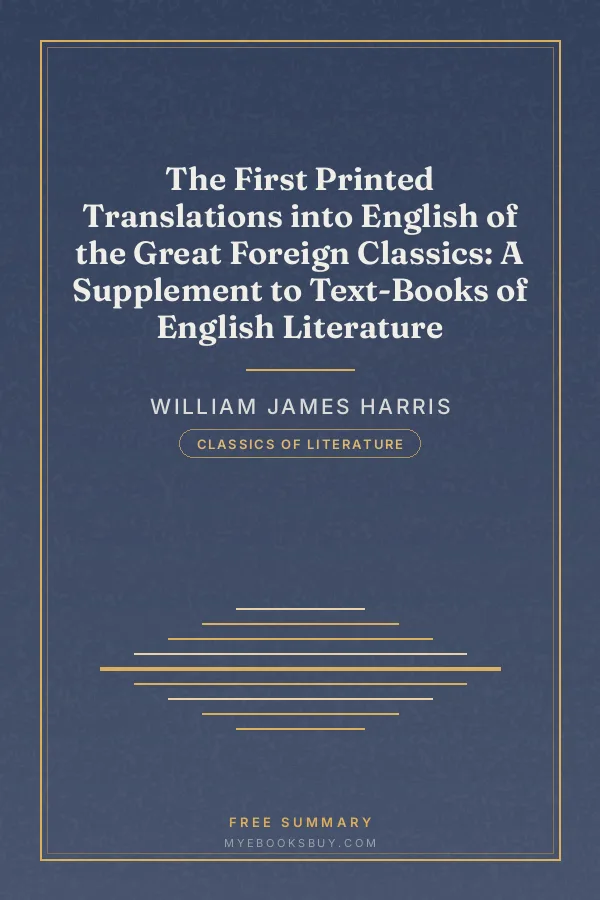
The First Printed Translations into English of the Great Foreign Classics: A Supplement to Text-Books of English Literature
William James Harris
Tracing the genealogy of English literature reveals a bridge between disparate cultures and languages, built by the patient work of early translators. This bibliography serves as a map to that intellectual landscape, cataloging the first English arrivals of foreign classics.
In Short
This work is a specialized bibliographic reference designed to assist students and librarians in identifying the first English translations of significant foreign literary works. By systematically listing authors, titles, and publication dates, it creates a concise record of how continental and classical texts entered the English-speaking world. It has lasted as a useful finding aid for researchers who wish to trace the historical cross-pollination of ideas and the specific moments when influential foreign voices were first introduced to English readers.
The Story
The narrative of this book is one of historical recovery and intellectual mapping. It begins with the premise that English literature does not exist in a vacuum but is instead deeply molded by a continuous stream of external influences. The author positions the bibliography as an essential tool for "tracing the outside influences which at various periods... have affected or moulded our literature." The text argues that students often struggle to locate these connections, wasting valuable time in general catalogues when they should be focusing on the substance of the literary history.
The progression moves from this pedagogical necessity toward a comprehensive, alphabetical catalog of foreign authors—ranging from ancient Greek and Roman figures like Aristotle and Sophocles to nineteenth-century novelists like Victor Hugo and Paul Bourget. Each entry functions as a miniature case study in cultural transmission. For Aristotle, the list spans from a 1547 ethics manual to an 1891 constitutional study, illustrating a centuries-long engagement with his thought. For a figure like Sebastian Brandt, the entry focuses on the singular, monumental arrival of The Ship of Fools in 1509, which the text identifies as the "parent of a considerable satirical progeny" in English literature.
As the entries accumulate, a broader story emerges about the habits of English intellectual life. The text demonstrates that early interest was often directed toward classical philosophy and medieval romance, while later centuries saw a shift toward the importation of foreign novels, political histories, and scientific treatises. The arc reaches its conclusion through extensive appendices and indices that catalog the works by genre and subject, effectively organizing the chaotic sprawl of centuries of printing. The book does not claim to be a definitive history of literature itself, but rather a final, stable record—a guide that spares the reader the "fatigue of searching" by providing, at a glance, the foundational documents that allowed foreign classics to become part of the English canon.
How It Unfolds
The rationale for discovery The author establishes the necessity of the project, explaining that students are frequently tasked with identifying first translations for examinations but lack a consolidated guide. This opening sets the stage for a practical tool that serves the professional needs of librarians and literary scholars alike.
The classical foundations The bibliography begins by anchoring itself in antiquity, detailing the early English arrivals of Greek and Roman thinkers. It highlights how these translations—such as those of Aristotle—functioned as the bedrock for the development of later English drama, poetry, and political theory.
The shift toward modern influence The middle sections trace the transition from ancient philosophy to the narrative and satirical works of the European Renaissance and the nineteenth century. Here, the entries demonstrate the active imitation of French and German models by English writers, linking specific translations to the creative output of authors like Dryden and Tennyson.
The catalog of popular fiction The final stages of the book expand into the proliferation of nineteenth-century novels, particularly those from French and Scandinavian writers. The text shows a rapid increase in availability, reflecting a changing cultural climate where foreign fiction became a standard part of the English reading experience.
The People
The primary figure is the student of literature, who occupies the role of the seeker. This individual wants to understand the "why" and "how" of literary evolution but is frustrated by the scarcity of accessible bibliographic data. The author, writing from his position as a borough librarian, acts as the guide for this student, wanting to provide a clear, concise pathway through the dense forest of library catalogs.
Alongside these figures are the authors who populate the pages—men like Aristotle, whom the text describes as having "dominated the thinking of the Middle Ages," and Victor Hugo, whose prolific output required a lengthy list of translations to track. The translators themselves, though often remaining in the background, emerge as the vital agents who stood between the original foreign text and the English reader. They are the ones who transformed a Greek tragedy or a French romance into an English artifact. Each of these groups—the student, the librarian, the classical author, and the translator—is part of a collaborative, centuries-long effort to expand the reach of human thought, eventually finding their place in this organized record.
In Its Own Voice
The great foreign classics have exercised a direct and decided influence upon English literature and the object of this bibliography is to give in concise form the authors and titles, translations and dates of the first English translations of the chief foreign authors.
This statement defines the author’s intent to provide a bridge between foreign influence and English literary history.
'In the history of Western civilization there is no example of any other philosopher having exerted so great an influence on the minds of men as Aristotle'.
This quotation underscores the significant weight placed on the early translations of classical Greek philosophy.
Despite its errors and shortcomings, this famous treatise on the "Boundaries of Poetry and Painting," a work of criticism in the philosophy of the beautiful, has perhaps influenced more minds than any other work on æsthetics except those of Aristotle and Longinus.
This note accompanies the entry for Gotthold Lessing's Laocoon, highlighting how specific translated works acted as turning points for intellectual discourse.
What It's Really About
At its core, this book is an argument for the interconnectedness of literary traditions. It posits that English literature is not a solitary achievement but the result of a long, deliberate process of cultural borrowing. By cataloging the first translations of the "great foreign classics," the author asks the reader to consider how the arrival of a single book—be it a Greek tragedy, a French romance, or a German treatise—can fundamentally alter the direction of an entire national literature. It is an exploration of the mechanics of influence, raising the question of how much of our intellectual identity is shaped by the voices we invite in from across borders and across time.
Why Read It Today
Readers who appreciate the history of books and the mechanics of library science will find this work deeply satisfying. It provides a rare, grounded look at the exact dates and titles that signaled the arrival of foundational texts in England. For those interested in the history of ideas, it acts as a treasure map, allowing one to see, for instance, exactly when the English public first gained access to the philosophical rigor of Aristotle or the satirical wit of Brandt.
However, the book is not a narrative; it is a reference text. It is dense, comprised primarily of lists and bibliographic data, which may be taxing for those looking for a traditional prose story. It also reflects the period conventions of its early twentieth-century publication, such as the focus on a Western-centric canon and the use of now-archaic bibliographic shorthand. It is a slow, methodical read that asks the reader to engage with it not as a novel, but as a record of historical progress. What stays with you is the sheer scale of the labor involved—the realization that every classic we take for granted had a specific, often quiet moment of entry into the English language, and that this book is the quiet monument to that moment.
This summary was written by AI (gemini-3.1-flash-lite) on 2026-08-15 and is a guide to the book, not a replacement for it — it can be incomplete or wrong. The book itself is public domain. Copyright & AI disclosure · Report a problem