Free summary
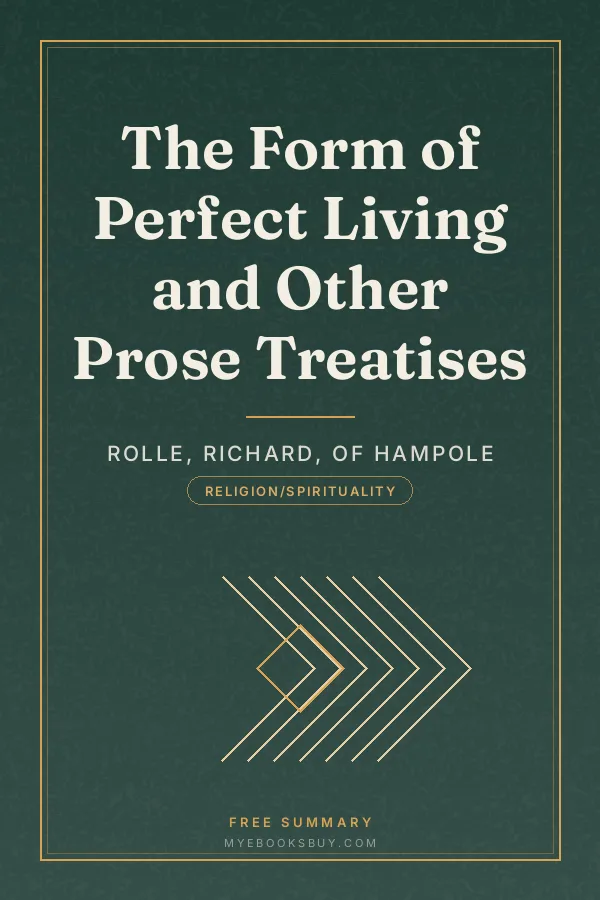
The Form of Perfect Living and Other Prose Treatises
Rolle, Richard, of Hampole (d. 1349)
A fourteenth-century hermit offers a timeless, radical invitation to strip away the distractions of the world and find the transformative, burning joy of divine love.
In Short
This collection of prose treatises is a manual for the interior life, written by a medieval mystic who abandoned university life to pursue a solitary, contemplative path. Through instruction on prayer, the nature of charity, and the rejection of worldly vanity, these texts urge the reader to move beyond ritual and toward an immediate, felt experience of God. The book has endured because its core argument—that true holiness is defined not by external deeds but by the intensity and purity of one’s love—remains a powerful, provocative challenge to modern complacency.
The Story
The journey begins with a stark diagnosis of the "wretchedness" that binds the human heart: a weakness of spirit, a preoccupation with fleshly desires, and the tragic error of trading eternal joy for fleeting worldly pleasure. The author addresses the reader directly, speaking with the urgency of a mentor who has seen the precipice of spiritual loss and is desperate to lead his charge to safer ground. He warns that religious appearance is often a mask; one may wear the habit of holiness while remaining internally vacant. To remedy this, he outlines a rigorous, step-by-step discipline of the mind and body.
As the argument progresses, the author moves from the necessity of penance to the high calling of contemplation. He insists that while keeping commandments is a baseline, "keeping His counsel"—the pursuit of an intimate, solitary connection with the divine—is the true path to perfection. He cautions against the vanity of excessive or performative abstinence, arguing that physical deprivation is useless if it is not fueled by a deeper yearning for the "spouse" of the soul. He describes the spiritual life as a dynamic movement: God comes to his lovers to offer a foretaste of sweetness, then withdraws, leaving the soul in a state of "holy longing" or "languishing" that deepens the seeker's devotion.
The trajectory of the work is one of total transformation. The reader is invited to move from an outward, distracted existence into an inner sanctuary of silence. The author provides practical guidance for daily life, including how to wake with a prayerful heart, how to eat with temperance, and how to carry the cross of Christ as an internal defense against the "fiend." By the end, the path leads to a state of "perfect living," where the soul is so aligned with the divine will that it is immune to the corruption of the world. He concludes with meditations on the "grimmest" realities—death, judgment, and the soul’s final account—not to induce mere fear, but to sharpen the reader’s focus on the urgency of love. The final vision is of a life entirely consumed by the "fire of the Holy Ghost," where the distinction between the lover and the Beloved is effectively erased.
How It Unfolds
The diagnosis of wretchedness The author identifies the three primary spiritual failures—weakness, fleshly appetite, and misplaced priorities—that prevent a person from reaching their potential. He argues that even those appearing to live godly lives may be tethered to worldly vanity.
The call to authentic holiness He challenges the reader to look beyond outward appearances and religious status. True holiness, he claims, is found only in the internal, burning desire for God, regardless of one’s station in life.
The discipline of the soul He establishes a framework for progress, warning against the trap of "unreasonable abstinence" that hinders true devotion. He emphasizes that the goal is not to punish the body, but to orient the will entirely toward divine love.
The nature of mystical experience He explores the "song of love," describing the unpredictable intervals of divine presence and absence. He teaches the reader how to sustain this love through constant prayer, solitude, and meditation, even during the "dry" periods of life.
The final surrender He concludes by detailing the seven gifts of the Holy Spirit and the necessity of constant vigilance. The book ends by reminding the reader that life is a swift, unpredictable transit toward death, making the cultivation of internal love the only truly urgent task.
The People
Richard Rolle serves as both author and archetype. A man who famously left his academic studies to live a life of poverty and solitude, he acts as a spiritual guide who speaks from personal experience rather than abstract theology. He is, by his own admission, a "feeble and fleshly" man, yet he possesses a burning intensity that sets him apart as an advocate for the solitary life.
His primary audience is the "sincere seeker"—those who, like him, find the standard social and religious life of the Middle Ages insufficient for their spiritual needs. This reader is often described as someone "given to the service of God" but struggling to reconcile that calling with the realities of daily existence. These individuals want to know how to maintain a heart "upward" while still inhabiting a world that demands their attention. Through his guidance, the seeker is encouraged to change from a person who merely follows external rules into someone who is "reaved" or snatched away from earthly comforts, ultimately becoming a person who finds their only true satisfaction in the presence of the divine.
In Its Own Voice
"Love is a life, joining together the loving and the loved."
(This observation serves as the central definition of the relationship Rolle seeks to cultivate between the soul and God.)
"Truth may be without love, but it cannot help without it."
(Rolle makes this distinction to argue that knowledge of doctrine is hollow if it is not animated by the warmth of charity.)
"And I have loved for to sit: for no penance, nor fantasy, nor that I wished men to talk of me, nor for no such thing: but only because I knew that I loved GOD more, and longer lasted within the comfort of love: than going, or standing, or kneeling."
(Rolle provides this personal detail to explain why he chose the solitary posture of sitting as his preferred method for deep contemplation.)
What It's Really About
At its core, this book is an argument for the primacy of emotional and spiritual intensity over legalistic religion. Rolle asks whether a person can truly be holy if they perform every religious duty but lack a felt, burning desire for God. He explores the tension between the "active" life of worldly business and the "contemplative" life of the heart. The underlying question is one of orientation: where does a person's "weight" fall? Is the heart anchored in the passing delights of the world, or is it pulled toward the "sweetness" of the eternal? His work is a rigorous, deeply internal inquiry into the capacity of the human heart to sustain a singular, all-consuming focus.
Why Read It Today
Readers who feel the modern world’s relentless noise and obsession with external productivity will find a surprising, quiet resonance here. Rolle does not offer a gentle, "feel-good" piety; he presents a demanding, sharp-edged spirituality that insists on honesty about one’s own inner failings. The prose is warm and personal, yet it remains a challenging relic of a different age.
You must be prepared to navigate the archaic sentence structures and a fourteenth-century worldview that holds death and hell as immediate, physical realities. While the language has been modernized for accessibility, the underlying tone is distinctly medieval, filled with references to "ghostly" (spiritual) strength and a rigorous, sometimes jarring, asceticism. This is not a book for someone seeking a quick motivational boost; it is for those who are interested in the history of the human heart’s hunger for the infinite. It stays with you not because it is easy, but because it asks the most uncomfortable question: does your current life allow room for the thing you claim to love most? For those willing to sit with his solitude, Rolle offers a profound, if demanding, mirror in which to examine the true state of their own devotions.
This summary was written by AI (gemini-3.1-flash-lite) on 2026-08-13 and is a guide to the book, not a replacement for it — it can be incomplete or wrong. The book itself is public domain. Copyright & AI disclosure · Report a problem