Free summary
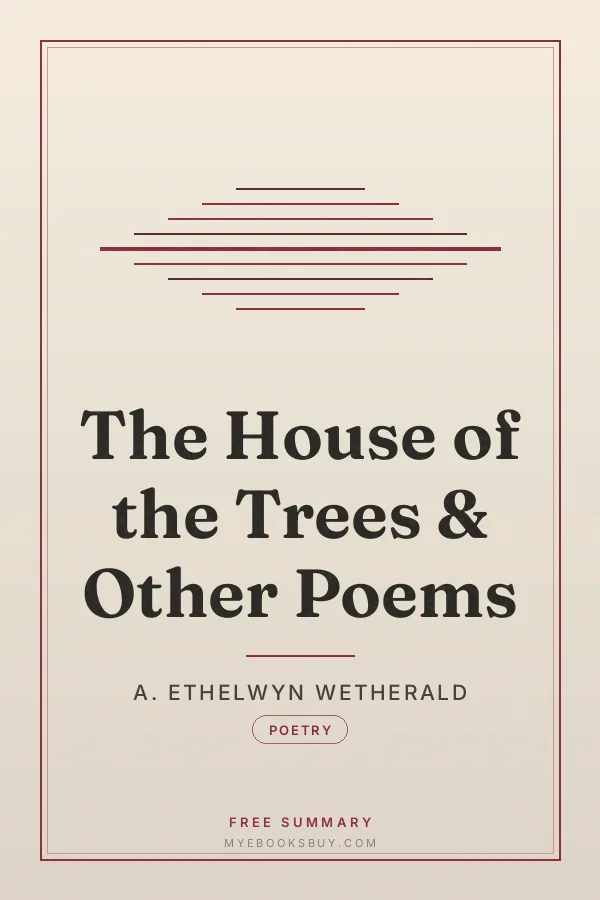
The House of the Trees & Other Poems
A. Ethelwyn Wetherald (1857–1940)
A collection of lyrical verse that seeks to bridge the gap between the chaotic, dusty modern world and the quiet, restorative sanctity of nature. This work finds its enduring power in the way it captures the ache of nostalgia and the gentle, persistent rhythm of the seasons.
In Short
This volume is a collection of nature-focused poetry that examines the human connection to the outdoors as a source of moral and spiritual renewal. Through images of trees, rain, and shifting light, the poems articulate a recurring desire to flee the "dust and din" of city life for the "sunless peace" of the woods. It remains a resonant work because it addresses the universal tension between our ambition for worldly success and our innate, often suppressed, need for quiet, simple communion with the earth.
The Story
The arc of the book is a movement from the noise of human industry toward the silence of the natural world, followed by a sober, reflective look at the inevitability of change and death. It begins with an invitation to the "Spirit of the wood" to wash the reader clean of urban life. The poet positions the forest as a sanctuary where the "leafy walls" serve as a cathedral for the soul. Throughout the middle sections, the poems shift their focus toward the cycle of the seasons. We see the spring’s "blossoming bright" and the summer’s "midday moon," but the tone gradually deepens as the leaves fall.
As the collection progresses, the imagery becomes more autumnal. The poet observes the trees preparing for their "way to death" and acknowledges the "cold touch" of November. This is not a story of tragedy, but of acceptance. The poems grapple with the transition from the vitality of youth—represented by the memory of a childhood spent in the grass—to the "gray, gray face" of age. The book does not shy away from the pain of loss or the "furious" nature of winter, yet it maintains a consistent argument: that nature provides a "patient earth" capable of holding all human experience.
The narrative reaches its conclusion in a meditation on mortality. The poet reflects on past loves, discarded ambitions, and the "wind of death" that eventually separates all things. However, the final note is not one of despair. Instead, it is a quiet surrender to the same forces that govern the changing of the leaves. By the end, the reader has been led through a full year of growth, harvest, and decay, arriving at an understanding that our brief lives are simply part of the same natural sequence as the fields and the trees. The book concludes by reconciling the soul with its own eventual silence, viewing death as a natural, almost gentle, transition back into the elements from which we came.
How It Unfolds
The call to retreat The poet begins by asking the woods to "ope your doors and take me in," establishing a desire to escape the "noisy light" of civilization. This section sets the stage, defining the forest as a place where the soul can find a necessary, sunless peace.
The season of growth As the poems move into spring and summer, the focus turns to the vibrant, delicate life of the earth. Images of hummingbirds, apple blossoms, and budding orchards fill the pages, highlighting the "sweetness" of a world that is constantly renewing itself.
The shift toward autumn The tone darkens as the "spirit of September" cuts adrift the languid dreams of August. The poetry begins to confront the reality of fading light, with the trees stripping themselves bare and the air growing thin with the approach of winter.
The confrontation with age The poet reflects on the "patient band" of trees that stand in winter, mirroring the human experience of growing old. We see a clear-eyed look at the limitations of the body and the creeping encroachment of the "chill burial urn."
The final surrender The closing poems accept the "wind of death" as a natural, even tender, force that cleanses the spirit of past hurts and ambitions. It is a graceful exit, concluding with a sense of unity between the human soul and the "mysterious sea" of the afterlife.
The People
The collection is populated less by traditional characters than by archetypal figures who embody the poet’s philosophy. The "Student" appears as a figure of intense, flickering energy, trapped in a small, white room, representing the intellectual cost of living disconnected from the natural world. In contrast, "Philippa" is a personified ideal of nature itself; she is a "stream-like girl" whose presence cools the fevered hands and aching feet of those around her, serving as a reminder of the healing power of gentleness.
There is also the "Old Man," who is twinned with his apple tree. His life is measured by the growth of the orchard, standing as an example of a life lived in harmony with the earth. He is not a person of great worldly status, but of "mirth and wisdom," suggesting that the most meaningful lives are those that mirror the steadiness of the natural cycle. Finally, the "Child" appears throughout—frequently the poet herself in memory—representing the lost, unburdened self. This figure is the one who remembers the "tall grass" and the "voice that silent spoke," standing in stark relief to the "grown" speaker who, while longing for that simplicity, recognizes that one cannot truly return to the state of being three years old.
In Its Own Voice
Ope your doors and take me in, Spirit of the wood; Wash me clean of dust and din, Clothe me in your mood.
(The opening lines set the book's fundamental desire to swap urban exhaustion for the restorative atmosphere of the forest.)
So sweet, so deep, seared by the sun, And smitten by the rain, They pierce the heart of every one With fragrance keen as pain.
(The poet describes the pine needles on the forest floor, capturing the way nature’s beauty often carries a sharp, melancholic undertone.)
The wind of death, that tenderly Is blowing ’twixt my love and me.
(In the final poem, the author captures the inevitable, quiet separation that death imposes on all human connections.)
What It's Really About
At its core, this book is an argument for "woodland worship." It questions the value of modern "success"—which the poet describes as being "rotted o'er with envious eyes"—and pits it against the quiet, unpretentious beauty of a weed or a blade of grass. The central question is whether a human life can achieve a sense of wholeness while remaining tethered to the "stifling sordid years" of the city. The book suggests that our greatest struggle is the loss of our "child-heart," and that the only way to find it again is to allow ourselves to be "washed clean" by the rain and the wind, recognizing that we are not masters of the earth, but its dependents.
Why Read It Today
This collection is for anyone who feels the creeping exhaustion of a life lived mostly indoors, behind screens, or within the "dingy walls" of a desk-bound profession. It is a slow, rhythmic read that functions almost like a tonic; the language is precise and traditional, avoiding the jagged, self-conscious irony that dominates much of today's poetry. You will find it feels like walking through a quiet, well-tended garden during a rainy afternoon.
It is not without its difficulties. The poet writes from the perspective of a late-Victorian sensibility, and some readers may find the reliance on moralizing tropes—the "dusty chambers of the brain" or the "fiends of sound"—to be a bit period-bound. The poems are consistently formal, which can feel restrictive if you prefer the loose, conversational style of contemporary verse. However, the emotional honesty regarding aging and the "pain of beauty" is timeless. You stay with these poems because they articulate a specific, quiet grief—the realization that we are growing away from the earth as we grow into our lives. It is a deeply grounding book, one that reminds you that even the most "sordid" life can be framed by the cooling, persistent memory of the woods.
This summary was written by AI (gemini-3.1-flash-lite) on 2026-09-14 and is a guide to the book, not a replacement for it — it can be incomplete or wrong. The book itself is public domain. Copyright & AI disclosure · Report a problem