Free summary
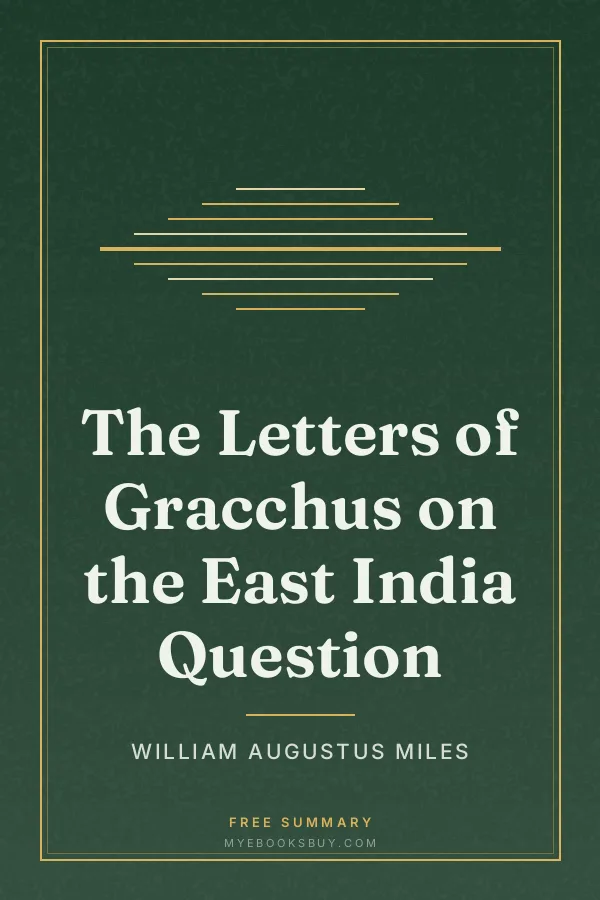
The Letters of Gracchus on the East India Question
William Augustus Miles (d. 1817)
The future of the British Empire hinges on the impending expiration of the East India Company’s charter in 1814. These letters argue that the Company’s monopoly must yield to the broader commercial interests of the nation.
In Short
This collection of political essays, originally published in the Morning Post in 1813, serves as an urgent polemic regarding the renewal of the East India Company’s governing and trading privileges. The author, writing under the pseudonym "Gracchus," meticulously dissects the Company's legal and economic claims, arguing that their monopoly is both obsolete and harmful to the British public. By examining parliamentary history, trade regulations, and the potential for expanded markets in India, the work functions as a primary record of the intense legislative struggle that reshaped British colonial administration.
The Story
The narrative begins at a critical juncture in 1813, as the clock ticks toward the expiration of the East India Company’s exclusive charter. The central conflict involves the British government’s desire to open trade with India and China to independent merchants, a move the Company vehemently opposes. The Company argues that ending their monopoly would jeopardize the stability of the Indian Empire and threaten the British Constitution itself. Gracchus rejects these fears as alarmist, countering that the Company is primarily acting out of a desperate need to protect its own dwindling financial dividends.
As the letters progress, the argument shifts from general principles to specific economic grievances. Gracchus highlights the Company’s mounting debts—exceeding forty-two million pounds—and their reliance on parliamentary aid. He systematically dismantles their excuses for resisting the "out-port" trade, showing that their warnings about increased smuggling are exaggerated and that existing customs regulations are sufficient to manage new traffic. The author paints a picture of a corporation so accustomed to sheltered privilege that it views any competition not merely as a business challenge, but as an existential threat to the state.
The arc of the argument expands to address the untapped potential of the Indian market. Drawing on the observations of scholars like Mr. Colebrooke and travel narratives like those of George Forster, Gracchus argues that the cultural and religious prejudices of the Indian people are not the barriers to trade that the Company claims. He asserts that the natives have a genuine, historical desire for European goods, and that the lack of demand is a failure of the Company’s own initiative rather than an inherent cultural wall.
In the final stages of the argument, Gracchus pivots to a constitutional analysis. He challenges the Company’s audacious claims of "permanent rights" over forts, cities, and territories. He argues that any authority the Company exercises in India is merely delegated sovereignty; the land and its governance inherently belong to the British state. He warns that by clinging to these "unmaintainable" pretensions, the Company is forcing a confrontation with Parliament that will inevitably result in a loss of their independence. The text concludes by calling upon Parliament to assert its authority, subordinate the Company’s private interests to the public good, and usher in a new era of open, regulated commerce that benefits the Empire at large rather than a single, faltering corporation.
How It Unfolds
The Impending Crisis The author identifies the year 1814 as the terminal point for the Company's current charter, characterizing the situation as a moment where the "public understanding" has been neglected. He establishes the distinction between the Company’s perpetual corporate status and its temporary, renewable trading privileges.
The Resistance of the Directors Gracchus scrutinizes the Court of Directors’ persistent refusal to open trade to out-ports, noting their reliance on the threat of smuggling as a primary defense. He contrasts this with the stance of Crown ministers, who express confidence that new regulations can mitigate risk.
The Financial Reality The focus turns to the Company's massive debt and the precarious nature of its dividend payments to shareholders. The author posits that the Company is effectively insolvent without parliamentary intervention, weakening their moral ground in negotiations.
The Myth of Indian Exclusion The argument addresses why European goods have not flourished in India, specifically rebutting the "religious prejudice" theory. By citing historical accounts of Indian merchants and their flexible trade practices, the author proves that the lack of market growth is a failure of vision.
The Constitutional Challenge The final letters confront the Company’s assertion that it holds permanent, private rights over Indian territories and ports. Gracchus invokes legal principles to argue that these are public assets, belonging to the state, which cannot be treated as private property.
The People
Gracchus acts as the voice of reason and the champion of public interest. He is a man of precise legal and historical knowledge who views the East India Company not with inherent malice, but with a firm demand for accountability. He wants to see the British economy opened and the sovereignty of the Crown restored over the Company’s overreaching claims.
The Court of Directors serve as the antagonists of the narrative. Described as insular and irritable, they prioritize their dividends and their monopoly over the broader prosperity of the British Empire. Their primary motivation is the retention of power, which they defend with "exaggerated" claims of national peril.
The Ministers of the Crown appear as the mediators and ultimate arbiters. They are represented as being in possession of the facts, having consulted with customs officials and engaged in "open and unreserved" conferences with the Company. They stand for the principle that the government must regulate trade for the "general benefit of the community."
Mr. Colebrooke and the travelers like Forster function as the expert witnesses who dismantle the Company’s claims about the Indian market. Their evidence is instrumental in proving that the natives are not hostile to trade, thereby stripping away the final layer of the Company’s justification for limiting exports.
In Its Own Voice
"The rights of the East India Company are two-fold; and have long been distinguished as, their permanent rights, and their temporary rights."
The author clarifies the legal framework that separates the Company's corporate existence from their expiring trading privileges.
"It has happened however, that, in our approaches towards this crisis, the Public understanding has been but little addressed upon the subject."
Gracchus laments the lack of public awareness regarding the vital importance of the 1814 charter renewal.
"In asserting for the Company a private right to forts and fortifications, the Company's advocates have therefore fallen into an extreme error."
The author critiques the Company's attempt to claim ownership of military infrastructure, which he argues must belong to the state.
What It's Really About
At its core, the text is an argument about the nature of sovereignty and the limits of corporate power. Gracchus posits that a commercial entity, even one as vast as the East India Company, is a creature of the state, not a power unto itself. The central question is whether the "public welfare" can be subordinated to the profit margins of a privileged monopoly. By stripping away the Company's "pretensions" of perpetual right, the author frames the debate as a choice between a stagnant, protected trade model and a dynamic, national economy. It is a defense of the idea that colonization and commerce are tools for the state to wield for the prosperity of the whole, rather than private fiefdoms.
Why Read It Today
This book is a fascinating study for those interested in the history of global capitalism and the slow death of mercantilist monopolies. It captures the exact moment when the ideology of "free trade" began to challenge the entrenched corporate powers of the eighteenth century. Reading these letters feels like listening to the opening arguments of a modern regulatory debate; the tone is intellectual, sharp, and persistently logical.
However, the reader should be prepared for the dense, nineteenth-century prose style, which favors long, complex sentences and high-minded rhetoric. Because the text addresses a very specific set of parliamentary debates from 1813, some context regarding the British Empire’s administrative history is helpful but not strictly required. Readers may also find the period-specific language and the intense, somewhat dry focus on customs law, shipping tonnage, and "dividend" mechanics to be a demanding experience. Despite these hurdles, the book provides a unique window into how the British public was convinced to strip a giant corporation of its power. It is an excellent example of how political pamphlets were once used to "address the public understanding" and shape the trajectory of national policy.
This summary was written by AI (gemini-3.1-flash-lite) on 2026-09-18 and is a guide to the book, not a replacement for it — it can be incomplete or wrong. The book itself is public domain. Copyright & AI disclosure · Report a problem