Long before history was recorded, a helpless babyhood quietly reshaped our ancestors into reasoning, moral beings.
In Short
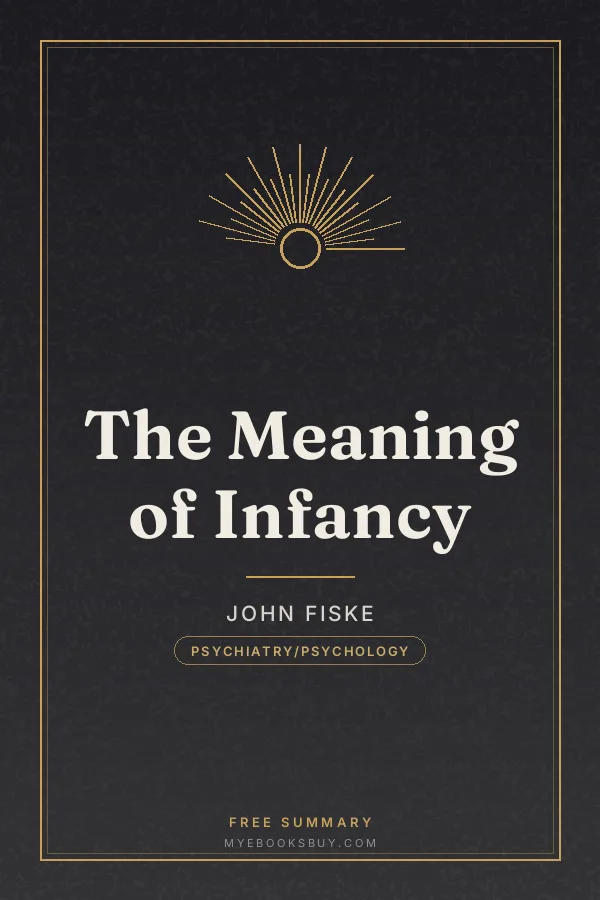
Exploring the profound biological bridge between human evolution and childhood, this work traces how mankind’s uniquely prolonged infancy fostered intelligence, family structures, and civilization itself. Moving from simple animal instincts governed entirely by heredity to the rich educability of human youth, the text reveals how babyhood became the primary engine of progress. By examining the shift from physical adaptation to psychical growth, it ultimately harmonizes modern evolutionary science with deep religious and spiritual truths, presenting humanity as the meaningful terminal point of a vast cosmic development.
The Story
The inquiry opens by examining the expanding social and scientific significance of education, driven by the dual forces of modern democracy and evolutionary theory. While lower creatures such as the codfish, turtle, or fly-catcher rely entirely on pre-established nervous connections and instinctual behaviors inherited completely through heredity, higher warm-blooded mammals display faint glimpses of educability and varied actions. Yet, true human progress begins when natural selection reaches a critical juncture, pivoting away from physical modifications toward the immense, unprecedented advantages of a flexible, developing intellect.
Building directly upon Alfred Russel Wallace’s vital insight, the argument explains how an increase in intelligence naturally necessitates a prolonged period of helplessness at birth. Because complex human experiences and varied actions cannot possibly be fully registered during brief embryonic development, human infants arrive into the world uniquely undeveloped, possessing a nervous system capable only of basic vital functions. This extended season of babyhood acts as the ultimate crucible for plasticity and learning. Unlike animals whose lives are bound by rigid conservatism and predetermined instincts, humans possess vast unformed potentialities awaiting the awakening touch of individual experience.
As helpless babyhood demands long-term parental care, fleeting sexual relations among ancestors gradually transform into permanent marital bonds and the foundational organization of the family. The family unit subsequently expands into the clan or tribe, requiring individuals to subordinate personal selfishness to the common interest. Through this social necessity, the crude germs of morality and altruism take root. The prolonged affectionate relationship between mother and child serves as the primary training ground for those higher spiritual attributes and community bonds that hold complex societies together across generations.
Reaching far beyond mere physical survival, this evolutionary trajectory reframes humanity's place in the cosmos. Far from reducing man to a mere biological accident, the conclusion positions human beings as the terminal factor in a magnificent, purposeful evolutionary process. The acquisition of manual dexterity through the human hand, the early mastery of fire, and the continuous shift from crude physical labor to trained intelligence underscore a unique, unending capability to act upon the environment. Ultimately, the text bridges scientific rigor with deep religious sentiment, arguing that the universal human yearning for a spiritual and eternal life represents a profound reality rather than an empty phantom, bringing evolution and religion into lasting harmony.
How It Unfolds
- The new significance of education: The text begins by exploring how democracy and evolutionary theory have elevated childhood, transforming schools from rigid, selective institutions into public necessities. It establishes that infancy represents humanity's greatest biological opportunity for conscious adjustment to the physical and social world.
- The codfish and the fly-catcher: Contrasting human development with lower creatures, the argument highlights how animals like turtles and birds rely entirely on inherited instincts. Their nervous connections form completely before birth, leaving no room for true infancy, variation, or individual learning.
- The lengthening of babyhood: As animal intelligence increases through natural selection, embryonic development runs out of time to pre-form all necessary nervous connections. This biological constraint results in a prolonged period of helpless babyhood characterized by immense plasticity and educability.
- The birth of the family and morality: The prolonged dependence of human infants fosters deep maternal affection and permanent parental relations, giving rise to the structural foundation of the family. This vital social unit expands into clans, breeding altruism and successfully subordinating individual selfishness to the common good.
- The terminal factor of evolution: Revisiting cosmic history, the author frames man as the supreme terminal factor of an intricate evolutionary process rather than an insignificant cosmic speck. The development of hands, tools, and the early mastery of fire enable an unprecedented manipulation of the physical environment.
- The harmony of science and religion: The journey concludes by uniting evolutionary science with religious aspirations, asserting that humanity's deep-seated yearning for eternity is a valid spiritual reality. By rejecting narrow materialism, the work envisions an ultimate, harmonious reconciliation between scientific discovery and spiritual faith.
The People
John Fiske serves as the central thinker and guide, seeking to reconcile evolutionary science with religious philosophy by tracing the profound biological origins of human childhood. Standing in his way are old theological dogmas, societal hostility toward evolution, and rigid materialistic assumptions that reduce humanity to an insignificant cosmic accident; through his extensive inquiry, he ends up redefining man as the purposeful, highly spiritualized terminal focus of creation. Alfred Russel Wallace contributes the foundational scientific insight that natural selection prioritized psychical intelligence over physical modifications, wanting to explain how humanity diverged so sharply from the apes. Overcoming the limits of purely physical Darwinian adaptation, Wallace emerges as the pioneer of a revolutionary psychological chapter in evolution. Nicholas Murray Butler builds directly upon this legacy, wanting to expand modern educational theory, and ultimately champions prolonged infancy as the supreme instrument of human cultural adjustment. Ancient figures like Anaximander and Anaxagoras provide crucial historical depth to the argument; Anaxagoras wants to understand human uniqueness, pointing to the development of the hand as the mechanical key that unlocked civilization, while Anaximander anticipates the ancient roots of the doctrine of infancy. Finally, Professor Haeckel represents the opposing dogmatic materialist who wants to settle all ultimate questions through rigid physical science alone, standing stubbornly in the way of spiritual harmony, and ends up entrenched in a narrow, unyielding view of nature.
In Its Own Voice
Exploring the foundational mechanics of human advancement, Fiske establishes the direct correlation between childhood and capability:
It can be shown that man's progressiveness and the length of his infancy are but two sides of one and the same fact; and in showing this, still more will appear.
Illustrating the stark boundary between instinctive biology and conscious learning, the text contrasts human potential with lower organisms:
With such creatures as the codfish, the turtle, or the fly-catcher, there is accordingly nothing that can properly be called infancy.
Reflecting on the unique psychological attributes that separate humanity from the rest of the animal kingdom, the author observes:
One of the philosophical things that have been said, in discriminating man from the lower animals, is that he is the one creature who is never satisfied.
What It's Really About
Underneath its biological observations, this work explores the profound philosophical question of how human beings emerged as progressive creatures rather than static automata. The central argument posits that natural selection shifted its focus from physical traits to intelligence, making a prolonged, helpless infancy the essential catalyst for human plasticity, family organization, and morality. The book investigates how the transition from hereditary instinct to individual educability enabled civilization, tool use, and abstract thought. Ultimately, it grapples with the deeper spiritual implications of evolution, asking whether humanity's emergence is a meaningless accident or the purposeful terminal point of a divine cosmic design. By aligning scientific evolution with the enduring human search for an eternal spiritual reality, the text reclaims human dignity against nineteenth-century materialism.
Why Read It Today
Readers fascinated by the intersection of evolutionary science, philosophy, and education will deeply appreciate this lucid, nineteenth-century intellectual journey. Reading the book feels like sitting down with a thoughtful Victorian scholar who patiently dismantles false conflicts between science and religion. You will be struck by the elegance with which everyday observations—like a bird catching a fly or an infant learning to walk—are woven into grand cosmic truths. However, modern readers must navigate the formal, leisurely cadence of nineteenth-century prose and occasional period assumptions regarding human history and social evolution. Despite these stylistic hurdles, what stays with you long after finishing is the striking realization that human vulnerability is our greatest superpower. Fiske reframes helplessness not as a weakness, but as the delicate cradle of civilization, morality, and spiritual yearning. This uplifting, deeply humanistic perspective remains profoundly relevant in our current age of accelerating technological change, reminding us that true progress rests upon the nurturing of our unformed potential.
This summary was written by AI (g4f/auto) on 2026-09-20 and is a guide to the book, not a replacement for it — it can be incomplete or wrong. The book itself is public domain. Copyright & AI disclosure · Report a problem