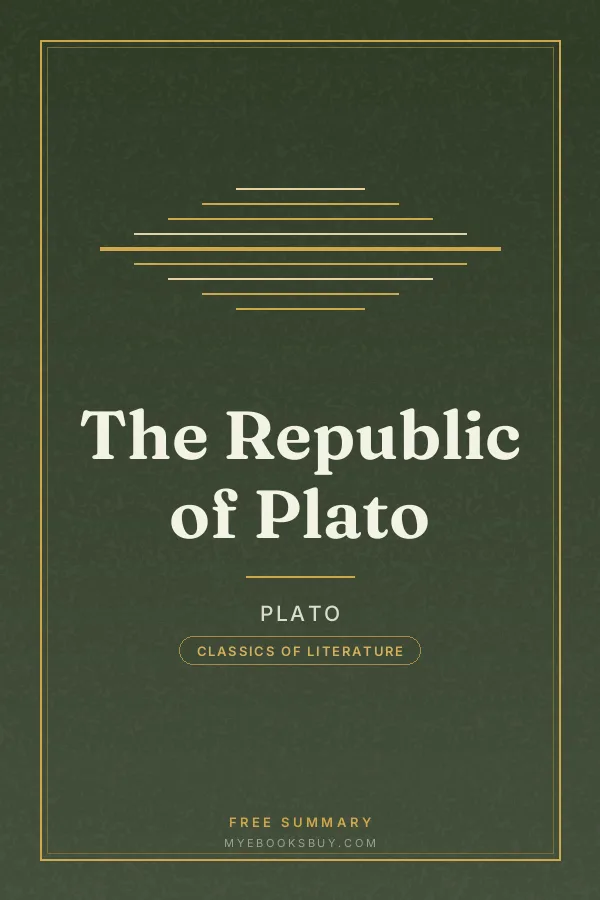
Imagine a dialogue so searching it dismantles the very foundations of how we live, demanding to know if justice is a mere social contract or the essential health of the soul itself.
The Story
The inquiry begins on a casual note in the Piraeus, where a group of friends gathers to discuss the nature of justice. What starts as a series of Socratic questions posed to elderly Cephalus and his son Polemarchus—can justice simply be paying one's debts or helping friends while harming enemies?—rapidly collapses under the weight of logical scrutiny. Thrasymachus, a fiery sophist, erupts into the conversation with a cynical provocation: justice is nothing more than the interest of the stronger, a tool used by those in power to exploit the weak. Socrates refuses to accept this cynical appraisal. To truly understand what justice is, he proposes they enlarge their view from the individual to the entire city-state.
By constructing an ideal city from the ground up, the group seeks to see justice writ large. They define the city’s structure based on a division of labor: every person must perform the task for which they are naturally best suited. In this hierarchy, the producers provide for physical needs, the auxiliaries protect the city with courage, and the philosopher-rulers govern through wisdom. Justice, they conclude, is this internal harmony—each part doing its own work without interfering in the business of others.
The conversation then turns to the education of these citizens. Socrates insists on a strict censorship of the poets, arguing that tales depicting gods behaving immorally or causing evil must be purged to protect the malleable minds of the youth. The discussion of the city’s internal mechanics expands into radical proposals: the guardians will live in shared poverty, hold property and children in common, and women will stand as equals to men in their duties. The ultimate goal is the unity of the state, modeled on the idea of a single, living body.
As the ideal state takes shape, the focus shifts to the intellectual qualifications of the rulers. Socrates introduces the vision of the philosopher-king, arguing that cities will never find rest from evil until those with the capacity to grasp eternal truths—the Forms—are the ones holding the reins of power. This leads to an exploration of the hierarchy of knowledge, climbing from the confused realm of shadows and physical appearances toward the luminous, intelligible world of absolute truth.
The final books of the work descend from this lofty height to examine the degradation of the state and the soul. Socrates traces the decline of the perfect city through four inferior forms: timocracy, where honor is the ruling passion; oligarchy, driven by the love of wealth; democracy, consumed by an excess of liberty; and finally, tyranny, the most wretched state of all. Each political decline mirrors a corresponding rot in the human spirit. The tyrant, in particular, represents the total collapse of reason under the weight of base, irrational appetites. The book concludes by reaffirming that the just life, lived in alignment with reason and virtue, is inherently more desirable and rewarding than the chaotic existence of the unjust man, who becomes a slave to his own darkest impulses.
The People
- Socrates: The relentless examiner and principal guide. He seeks to peel away the layers of conventional wisdom and social prejudice, guiding his companions toward the realization that justice is an internal state of order rather than an external gain.
- Thrasymachus: A challenging interlocutor who embodies the realist or cynical view of politics. He believes power is the ultimate reality and that those who act "justly" are simply naive victims of the powerful, an argument that forces Socrates to reach for a deeper, more metaphysical defense of morality.
- Glaucon: One of the most significant interlocutors, who pushes Socrates to defend justice for its own sake rather than for the rewards it brings. He wants to know if a person would remain just even if they could commit any wrong with total impunity.
- Adeimantus: The brother of Glaucon, who adds a layer of practical concern to the discussion. He worries about the influence of poets and the lack of incentives for being good in a world that often rewards successful injustice, prompting Socrates to fully articulate the education and structure of the ideal state.
- Polemarchus: Represents the traditional, conventional view of justice. He starts the conversation by suggesting that justice is giving every man his due, a definition Socrates dismantling by showing that moral actions cannot be reduced to simple formulas.
In Its Own Voice
The text often pauses to reflect on the gravity of the mission at hand, as when Socrates describes the arduous, uncertain journey of seeking truth:
Here is no path, I said, and the wood is dark and perplexing; still we must push on.
When considering how to influence the character of the rising generation through education, the argument becomes remarkably uncompromising:
Now early life is very impressible, and children ought not to learn what they will have to unlearn when they grow up; we must therefore have a censorship of nursery tales, banishing some and keeping others.
Finally, the work reaches its moral center in the description of the philosopher’s ultimate duty to the city:
And one feature they will erase, and another they will put in, until they have made the ways of men, as far as possible, agreeable to the ways of God.
What It's Really About
At its core, this work is an investigation into the isomorphism of the soul and the state. It posits that there is no meaningful distinction between a just individual and a just society, as both are governed by the same tripartite psychology: reason, spirit, and appetite. The central argument is that justice is not a social contract imposed by fear, but an objective state of psychic health. When the rational element of the soul—or the city—rules over the irrational, the result is harmony, and that harmony is the highest form of human happiness.
The text also grapples with the problem of appearance versus reality. It is deeply suspicious of the poets and those who deal in "imitation," arguing that art often appeals to the lowest, most irrational parts of the human experience. By favoring the clear, cold light of reason and mathematical calculation, the author constructs an epistemology that elevates intellectual contemplation above sensory perception.
Ultimately, the work is a profound meditation on the responsibility of the wise. It questions whether it is possible for a truly virtuous person to live in a corrupt society. The conclusion—that philosophers must rule—is not presented as a simple political ambition but as a tragic necessity. If the world is a cave of shadows, the person who has escaped to see the sun has an agonizing, yet unavoidable, duty to return and lead others out, even at the risk of being misunderstood, mocked, or destroyed. It is an exploration of the tension between the inner life of the mind and the external requirements of the community.
Why Read It Today
Reading this text is an encounter with the roots of Western thought. It requires patience; the style is conversational, winding through analogies and Socratic interrogations that can feel repetitive or archaic. Some of its prescriptions—such as the radical censorship of literature or the rigid control of human reproduction—will strike the modern reader as profoundly disturbing and even totalitarian. However, the rigor of the argumentation is unmatched. It forces the reader to confront their own definitions of fairness, duty, and authority.
You will likely be surprised by how current the frustrations feel. The critique of "democratic" excess—where freedom becomes a license for chaos and the loudest voice drowns out the most reasoned—resonates with a startling, almost uncomfortable familiarity. The book does not offer easy comfort or neat solutions; instead, it leaves you with a series of difficult questions about what we owe to our society and what the pursuit of truth demands of us.
It is best approached as a marathon, not a sprint. The experience is one of intellectual friction. You will find yourself arguing back, identifying flaws in the logic, and questioning the premises—which is exactly what the text invites you to do. It stays with you because it challenges the assumption that justice is an external law to be obeyed; it leaves you to wrestle with the idea that justice is something you must cultivate within yourself, requiring constant vigilance and a clear, focused mind. For those willing to set aside modern sensibilities to engage with an ancient, uncompromising, and deeply searching intellect, it remains a transformative read.
This summary was written by AI (gemini-3.1-flash-lite) on 2026-08-12 and is a guide to the book, not a replacement for it — it can be incomplete or wrong. The book itself is public domain. Copyright & AI disclosure · Report a problem