Free summary
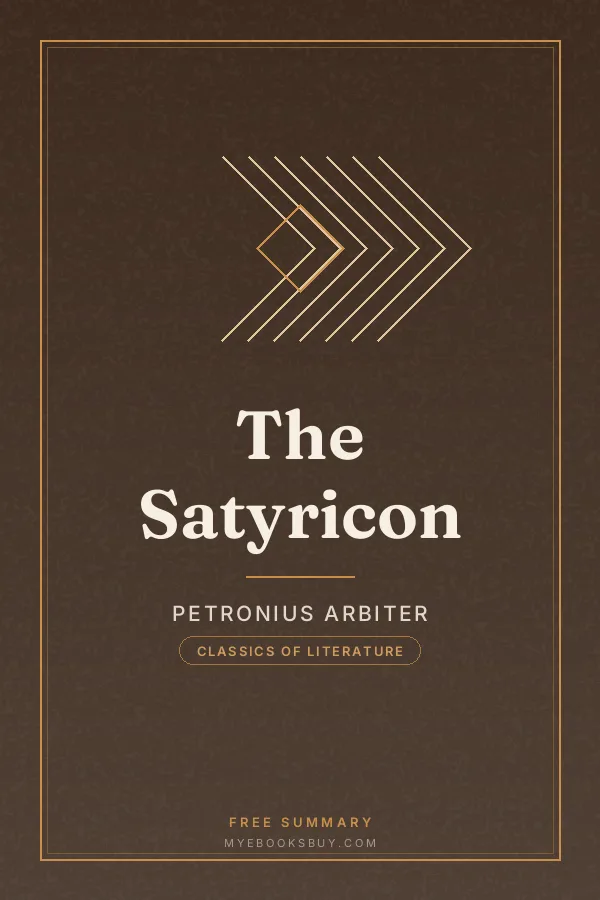
The Satyricon
Volume 06: Editor's Notes
Petronius Arbiter (20–66)
A sprawling, chaotic tapestry of Roman life, this narrative wanders through the underbelly of an empire obsessed with excess, legacy, and the pursuit of fleeting, sensory pleasure. It captures a world where social standing is a performance and survival is a game of wits.
In Short
This is a fragmented, picaresque work of Roman literature, celebrated for its raw, unflinching look at the decadence of the early Empire. It follows a band of roguish characters as they stumble through taverns, mansions, and temples, constantly seeking to exploit one another or escape the consequences of their own debauchery. By blending high-flown poetry with the coarse, colloquial speech of the lower classes, the work survives as a unique, cynical window into a society that viewed life itself as a frantic, often humorous, scramble for gain.
The Story
The narrative follows the misadventures of Encolpius, a young man of volatile temperament, and his companions—the fickle Ascyltos and the young, reluctant Giton. Their journey begins in a classroom of rhetoric, where Encolpius rails against the hollow, artificial nature of his education, signaling his own alienation from traditional Roman virtues. From this intellectual starting point, they are quickly plunged into the gritty reality of urban life, navigating a series of bizarre and often illicit encounters.
As they move through the city, the trio is beset by legal troubles, romantic rivalries, and the constant threat of poverty. Their path leads them to the most famous episode of the work: the banquet hosted by Trimalchio, a former slave who has amassed grotesque wealth. Here, the narrative dwells on the sheer absurdity of nouveau-riche excess—the mechanical ingenuity of the food, the sycophantic guests, and the host’s desperate, tragic obsession with his own eventual funeral. It is a spectacle of power and vanity, where the guests are as much pawns in Trimalchio’s game as they are consumers of his bounty.
Following the banquet, the group’s internal bonds fray. Ascyltos and Encolpius, already at odds over their shared affections for Giton, eventually part ways, leaving Encolpius to continue his aimless wandering. He drifts toward the coast, encountering new, equally eccentric figures, including the aging, opportunistic poet Eumolpus. This addition to their company brings further chaos; Eumolpus views the world through the lens of artistic detachment, often turning their misfortune into matter for his verse.
Their journey concludes in a state of moral and social disintegration. They find themselves aboard a ship and later in the city of Croton, a place so obsessed with legacy-hunting that citizens will do anything to inherit the wealth of the childless rich. Encolpius and his companions lean into this atmosphere of predation, adopting false identities to play the role of the wealthy, only to find themselves ensnared by the very greed they seek to exploit. The narrative ends without a grand resolution or a moral epiphany; rather, it simply dissolves into the ongoing, desperate schemes of its characters, leaving them as hollow and untethered as when they began.
How It Unfolds
The education of a rogue Encolpius begins by debating the merits of rhetorical instruction, establishing the cynical tone that will define his observations. This intellectual dissatisfaction quickly gives way to a desperate search for food and shelter in the city’s back alleys.
The theater of wealth The group secures an invitation to Trimalchio’s legendary banquet, an event that serves as the centerpiece of their wandering. Every course and interaction highlights the absurdity of a society that measures human value purely through the lens of material display.
The parting of ways Tensions between Encolpius and Ascyltos reach a breaking point, forcing a schism in their small, dysfunctional circle. Alone, Encolpius experiences the vulnerability of life on the road, where one wrong turn leads to immediate exploitation.
The poet’s influence Eumolpus joins the group, acting as a catalyst for new disasters while maintaining a detached, intellectualized view of their plight. His presence shifts the story from mere survival to a dark exploration of human vanity.
The final deception The characters arrive in Croton, a town entirely given over to the predatory practice of legacy-hunting. They attempt to turn the tables on their hosts, only to find their own survival compromised by the pervasive rot of the society they inhabit.
The People
Encolpius serves as our guide, a man defined more by his appetites and his capacity for self-deception than by any fixed moral compass. He desires stability but is perpetually drawn into scenarios that require him to sacrifice his dignity. Giton, the object of desire for both Encolpius and his rivals, remains a passive figure, often acting as the prize in a tug-of-war that reveals the possessive, rather than affectionate, nature of his companions.
Trimalchio is the book’s most memorable creation—a man who has bought his freedom and his status, yet remains a slave to his own need for validation. He stands as a grotesque mirror of the Roman ideal, attempting to replicate the gravity of a senator through the vulgarity of a showman. Finally, Eumolpus offers a different kind of corruption. As a poet, he believes himself above the squalor of his surroundings, yet his willingness to manipulate the dying for their fortunes shows that his intellectualism is merely another tool for predation. None of these characters grow in the traditional sense; they merely cycle through their flaws, finding new ways to exploit the world as it exploits them.
In Its Own Voice
"Since your husband's mode of life and his fidelity are known to you, and no woman usurps your rights, why are you so foolish as to be annoyed by his boys, (as if they were his mistresses), with whom love is a transient and fleeting affair?"
In this passage, a cynical observer attempts to justify an adulterous husband’s behavior by categorizing his infidelities as trivial and insignificant.
"They either take in or else they are taken in."
This concise observation summarizes the bleak worldview of the characters, who view all human interaction as a zero-sum game of deception.
What It's Really About
At its core, this work investigates the fragility of identity in a society where status is fluid and easily bought. It asks how one maintains a sense of self when the only available roles are those of the predator or the prey. There is a profound anxiety here regarding the decline of traditional Roman virtues, replaced by the performative, hollow rituals of wealth and sexual conquest. The narrative argues that a society obsessed with legacy-hunting—with the acquisition of wealth from the dead—is a society that has lost its ability to value the living. It is a dark, humorous, and ultimately unsettling critique of a culture that has mistaken consumption for civilization.
Why Read It Today
Reading this book is like stepping into a crowded, dimly lit room where the air is thick with ambition and decay. It will appeal to those who enjoy the dark, picaresque energy of early fiction and who are not easily shocked by the candid portrayal of human vice. There is a visceral, almost cinematic quality to the scenes—the frantic, desperate energy of the banquet, the sudden shifts in fortune, and the sharp, biting wit that surfaces even in the most degrading moments.
However, readers should be prepared for the book's fragmented state; it is not a neatly packaged novel, but a collection of surviving parts, meaning the narrative can feel disjointed or abrupt. Furthermore, the work’s unflinching engagement with the sexual and social attitudes of the first century is often jarring. It does not look away from the cruelties of slavery, the objectification of bodies, or the cynical manipulation of social bonds. It is a challenging, often uncomfortable read, but its power lies in that very refusal to sanitize the past. What stays with you is the haunting realization that the human scramble for power, comfort, and recognition—in all its messy, absurd, and occasionally pathetic forms—has changed remarkably little over two millennia.
This summary was written by AI (gemini-3.1-flash-lite) on 2026-08-21 and is a guide to the book, not a replacement for it — it can be incomplete or wrong. The book itself is public domain. Copyright & AI disclosure · Report a problem