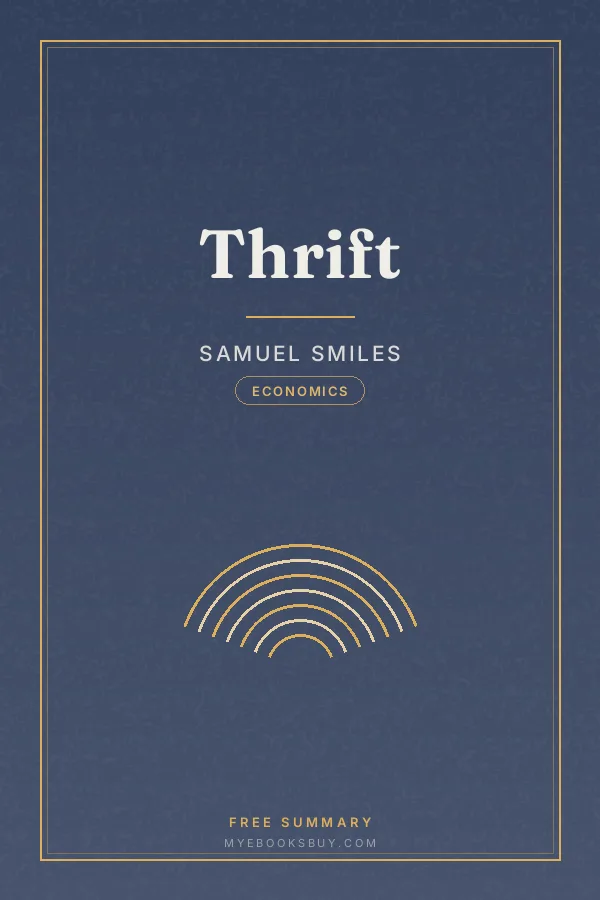
Frugality is not merely the hoarding of coins, but a foundational moral discipline that secures personal independence and strengthens the social fabric. This practical guide argues that the right use of money is inseparable from the virtues of character.
In Short
This book serves as a Victorian-era manual on the necessity of economy, foresight, and self-denial. It posits that industry and thrift are the essential building blocks of a stable society and a well-lived life. Through a mixture of moral philosophy, economic observation, and biographical examples, it outlines how individuals—from laborers to the professional classes—can escape the cycle of debt and dependency. It remains a classic of nineteenth-century self-improvement literature because it connects the mundane management of a household budget to the grander themes of human dignity, social duty, and the pursuit of true independence.
The Story
The narrative begins by defining thrift not as a stingy preoccupation with gold, but as a "spirit of order" applied to domestic life. It insists that the ability to earn is only half the battle; the true challenge lies in the wisdom of spending and the foresight of saving. The author builds his argument by contrasting the "thrifty" person—who manages resources for the benefit of their family and future stability—against the "thriftless" person, whose impulsivity leads to perpetual anxiety and the burden of debt.
The story progresses into the industrial reality of the mid-nineteenth century. The author surveys the working classes, noting that despite high wages in certain sectors like mining and engineering, many operatives squander their earnings on drink and fashion rather than securing a home or a future. He uses these observations to argue that the problem is not a lack of money, but a lack of character and discipline. The narrative then shifts to the practical mechanisms of progress: the creation of building societies, life insurance, and, most notably, the development of Penny Savings Banks. By bringing banking to the working class's doorstep, these institutions act as catalysts for transformation, turning reckless spenders into provident citizens.
The argument reaches its climax in the examination of debt as a social and moral cancer. The author paints a vivid portrait of the "gentleman" who lives beyond his means, ultimately becoming a slave to creditors and a drain on his community. He contrasts this with figures like James Nasmyth, the engineer, who meticulously saved his early wages to build the very tools that would secure his future success. The narrative moves through history and art, citing figures like Rembrandt and Vandyck to show that even geniuses succumb to ruin when they lack the "spirit of order."
Finally, the arc concludes with a broader view of human well-being. It argues that money is only a tool, and that real success involves the preservation of health and the cultivation of an active, intellectual mind in old age. The book ends by urging the reader to reject the "mania for buying" and to embrace a life of modest, systematic labor. It warns that a society failing to teach these principles risks its own foundation, as true national strength is built from the sum of individual households that practice, rather than preach, the virtues of industry and self-control.
How It Unfolds
The foundation of character The book opens by establishing that thrift is the necessary sequel to self-help and the bedrock of a moral life. It argues that the capacity to save is a direct expression of justice, generosity, and the duty one owes to those who are dependent.
The folly of extravagance The narrative moves to the dangers of consumer culture and the habit of "bargain-buying." It illustrates how individuals lose their independence by chasing ephemeral comforts or status symbols, eventually becoming trapped in a cycle of debt.
Industrial realities A detailed look at the factory districts reveals a discrepancy between earning potential and actual wealth. The author critiques the tendency of laborers to spend their substantial wages on immediate gratification, hindering their ability to rise socially.
The machinery of saving The focus shifts to concrete solutions, such as Building Societies and Penny Savings Banks. These institutions are presented as vital tools that encourage a "drill" of the desires, helping the working class move from poverty to property ownership.
The moral weight of debt The text explores the corrosive effect of debt on personal dignity and societal health. It uses historical anecdotes of famous figures to show that even the most talented individuals are not exempt from the consequences of financial disorder.
Old age and the end of toil The final beats emphasize the necessity of preparing for one's later years through both savings and intellectual cultivation. It concludes with the idea that while external laws can improve society, true progress only occurs when the discipline of thrift penetrates the home.
The People
The book is populated by archetypes and historical figures who illustrate the consequences of financial choices. Mr. Sikes stands out as a reformer who recognized that charities often failed the poor, whereas teaching habits of saving—through the establishment of Penny Banks—could genuinely empower them. He serves as the bridge between the author's theory and the practical application of his ideals.
James Nasmyth represents the ideal of the "laborious man." He is depicted as a person of steady industry who, rather than consuming his early earnings, invested them back into his own professional tools. His progression from a humble worker to a successful industrialist is the book’s blueprint for how the exercise of thrift leads to both material success and personal satisfaction.
Conversely, the book presents cautionary figures like the unnamed "rich man" who, on his deathbed, finds his only comfort in clutching a pile of gold coins. He represents the ultimate failure of character: the person who has allowed money to become an end in itself. Similarly, the "unthrifty son of Linne" serves as a traditional metaphor for the generational decline caused by the lack of discipline—the grandfather who builds, the father who maintains, and the son who squanders. Through these lives, the reader sees a clear divide: those who master their resources achieve a life of dignity, while those who are mastered by them end in tragedy or moral poverty.
In Its Own Voice
"Every man is bound to do what he can to elevate his social state, and to secure his independence."
The author establishes that personal responsibility for one's financial future is not a choice, but a fundamental moral duty.
"The habit of saving arises, for the most part, in the desire to ameliorate our social condition, as well as to ameliorate the condition of those who are dependent upon us."
This explains that the ultimate purpose of thrift is not personal greed, but the protection and advancement of one's family.
"To be a 'gentleman' nowadays, is to be a gambler, a horse-racer, a card-player, a dancer, a hunter, a roué,--or all combined."
The author offers a sharp, period-specific critique of how the term "gentleman" has been degraded by idle, extravagant, and debt-ridden behavior.
What It's Really About
The central argument is that financial management is an extension of ethical conduct. The book posits that "money power" is a necessary ingredient for personal freedom, but it must be tempered by a rigid moral code. The underlying questions explore how much of our suffering is self-inflicted through lack of discipline and how society can foster a culture of independence rather than one of dependency. It frames the "rule of order" as the antidote to the chaos of modern industrial life, arguing that a nation is only as strong as the self-restraint exercised by its poorest citizens.
Why Read It Today
Readers who appreciate classic Stoic philosophy and Victorian-era social commentary will find much to admire here. The writing is precise, earnest, and deeply moralistic, offering a window into a time when the "dignity of labor" was considered a supreme virtue. It is best read in small doses; the book's relentless pace of moralizing can be heavy, and its Victorian attitude toward the working class—which sometimes attributes systemic poverty entirely to personal choices—can feel blunt or insensitive to modern sensibilities.
However, for those navigating today’s culture of consumerism and instant gratification, the book offers a bracing, timeless reminder of the power of delayed gratification and the psychological peace that comes with financial order. You will likely walk away with a newfound appreciation for the quiet, unglamorous work of building a foundation for one's life. While some of the specific examples—such as the discussion of Victorian-era factories or the specific banking practices of the 1870s—are historical curiosities, the core message remains a persistent challenge to the reader: are you the master of your resources, or are you their slave? It is a demanding read, but one that rewards the patient with a clear-eyed perspective on the relationship between character and capital.
This summary was written by AI (gemini-3.1-flash-lite) on 2026-08-16 and is a guide to the book, not a replacement for it — it can be incomplete or wrong. The book itself is public domain. Copyright & AI disclosure · Report a problem