Free summary
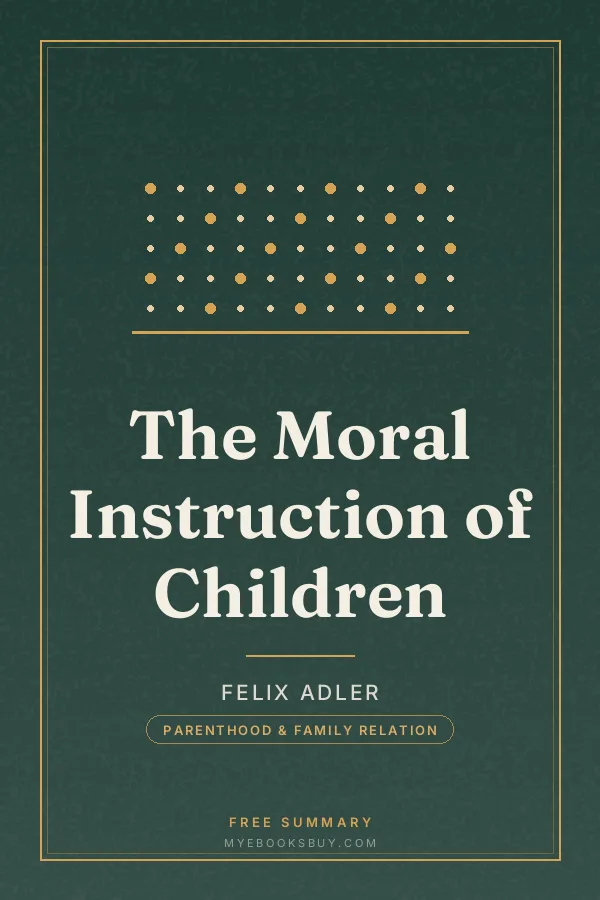
The Moral Instruction of Children
Felix Adler (1851–1933)
The school must be more than an intellectual drill-ground; it should serve as a second home where a child’s character is intentionally cultivated through a thoughtful, progressive system of moral education.
In Short
This foundational text argues that moral instruction is a distinct, vital discipline that should be integrated into the state school curriculum without relying on sectarian religious dogma. Moving beyond mere rote memorization, the author outlines a structured, age-appropriate syllabus—from fairy tales for the young to abstract ethical principles for the older student. It has endured as a primary resource for educators because it balances high moral idealism with practical, developmental pedagogy, seeking to build character by aligning a child’s expanding social circles—from family and school to the state—with their deepening sense of duty.
The Story
The argument unfolds as a systematic blueprint for moral development, beginning with the premise that secular schools must find a way to teach ethics that is both non-sectarian and deeply compelling. The author rejects the "paltry concession" of allowing clergy into classrooms, arguing instead that moral instruction should be an inherent, purposeful part of the school day. He maps a developmental journey for the student, starting with the young child, for whom the paramount duty is reverence and obedience toward parents. He contends that this filial bond acts as the center around which all other virtues—such as personal cleanliness and truthfulness—can be organized and understood.
As the child matures into the "grammar school" age, the focus shifts. The student is no longer just a recipient of parental care but an aspiring individual tasked with the duty of acquiring knowledge. Here, the author introduces narrative as a pedagogical tool. By utilizing carefully selected fairy tales, the teacher can cultivate the imagination, allowing the child to step into the lives of others, thereby building empathy. This is crucial: the author argues that much of the world's cruelty stems not from malice, but from a profound deficiency of imagination—an inability to feel the needs of those outside one’s immediate sphere.
The curriculum then advances from these "percepts" to "concepts." Through the study of classic texts like the Odyssey and biblical narratives, students begin to reason about moral distinctions. The author demonstrates how to analyze these stories, stripping away unnecessary dogma to reach the underlying ethical truths. He shows, for instance, how the story of Cain and Abel can be taught as a lesson about prosperity and character rather than a complex theological puzzle. Finally, the scope widens to the "civic duty," where the school serves as the bridge to society. The student learns that they belong to a larger body politic, with duties that extend to justice, law, and the state itself. The narrative of the book concludes with a call for the teacher to look beyond the "machinery of government" and instead instill the animating spirit of political life: the idea of the supremacy of law and the necessity of justice. The author leaves the reader with a clear vision of education as a lifelong expansion of moral horizons, where each period of life prepares the student for the higher, more complex duties of the next.
How It Unfolds
The rejection of sectarianism The author asserts that the state’s duty is to provide an unsectarian education, arguing that any compromise involving religious instruction in public schools inevitably creates a disjointed, subpar experience for both the student and the state.
The developmental sequence The curriculum is organized by age, beginning with the child’s primary duties to parents and personal habits, then moving toward social responsibilities and finally the abstract moral principles required for civic life.
The cultivation of imagination Through the strategic use of fairy tales and fables, the teacher fosters the child’s ability to empathize with others, which the author identifies as the essential prerequisite for true moral action.
The transition to reasoning For older students, the method shifts from observation to generalization, using literature and biography to help pupils derive maxims and concepts of duty that they can apply to their own lives.
The emergence of civic identity The final stage of the proposed course prepares the student for life in the state, teaching them to see themselves as citizens with a responsibility to uphold the justice and mercy that sustain a civilized society.
The People
The central figure is the Teacher, who holds the most significant responsibility in the classroom. This person is not merely an instructor of facts but a guide who must possess the wisdom to select appropriate stories and the patience to lead students through stages of moral growth. The teacher must be able to recognize the "paramount duty" of each age—reverence for parents, the acquisition of knowledge, and eventually, service to the state.
The Child is the subject of this transformation. Starting as a creature of physical needs and filial dependence, the child is gradually challenged by the teacher to expand their worldview. By the end of the course, this pupil has evolved from a passive recipient of rules into a morally independent agent who understands the "why" behind their actions.
The Parent serves as the initial, natural authority in the child’s moral life. While the school takes on a greater role as the child ages, the author consistently emphasizes that the teacher must respect and build upon the foundation of love and duty established at home. The Citizen is the final incarnation of the student, a person who has internalized the laws of the community and acts not out of fear of punishment, but out of a genuine, informed commitment to the public good.
In Its Own Voice
The moral motive is the highest, it is really the only sufficient motive.
The author emphasizes that while aesthetic or intellectual arguments can support moral choices, the duty itself must remain the primary driver of behavior.
The school should be to the pupil not an intellectual drill-ground, but a second home; a place dear at the time, and to be gratefully remembered ever after; a place in which his whole nature, and especially what is best in him, may expand and grow.
This statement captures the author's holistic philosophy, moving away from the "intellectual loom" model of education toward the development of the whole character.
What It's Really About
The book is an inquiry into the "gradualism" of moral growth. It grapples with the question of how to ground a child in virtue when the traditional religious framework of the era is no longer universally applicable in public institutions. The author argues that morality is not static; it is an evolving capacity that must be nurtured through the right sequence of intellectual and emotional experiences. At its core, the work asserts that a student’s character is constructed by moving through concentric circles of obligation—starting with the self, moving to the family, and concluding with the state. It asks whether humanity can be taught to be "divine" through the conscious, purposeful application of reason and empathy.
Why Read It Today
This work will appeal to educators, parents, and anyone curious about the historical roots of character education. It feels remarkably modern in its critique of "standardized" education that ignores the moral and imaginative life of the student. Readers will find the author's warmth and deep respect for the child’s potential to be both refreshing and challenging.
The prose is precise and dignified, typical of late nineteenth-century educational discourse. While the book is firmly rooted in its time—particularly in its frequent references to the "ideal" of the patriarchal family and its somewhat formal, academic tone—the core pedagogical insights are evergreen. You may find some of the specific historical anecdotes or references to "Oriental despotism" to be artifacts of a bygone era, and the lack of modern psychological vocabulary might initially feel like a barrier. However, if you are willing to overlook the period-specific framing, you will discover a profound, humanistic guide to teaching that values the development of a person over the mere production of a student. It stays with you as a reminder that the most significant work we do is not in the accumulation of data, but in the slow, painstaking cultivation of a conscience.
This summary was written by AI (gemini-3.1-flash-lite) on 2026-08-20 and is a guide to the book, not a replacement for it — it can be incomplete or wrong. The book itself is public domain. Copyright & AI disclosure · Report a problem